

Home Projector Lumen Ratings Are Almost Meaningless — Here's Why
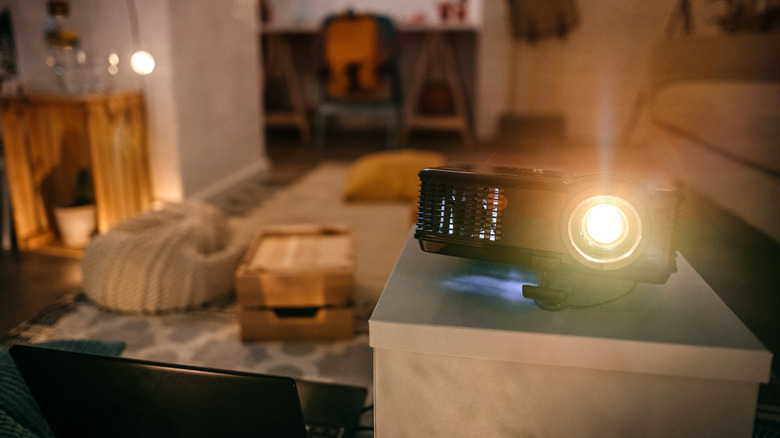
Are you comparing or shopping for projectors? Thinking about getting one for your entertainment space? There are quite a few features and specs you'll have to consider before choosing one that meets your needs, but before you dive in, there's something important you should know. Advertised brightness levels, one of the most important measurements, are kind of a mess. Many projector brands share misleading or non-standard measurements that make their models seem more capable than they really are. It's so bad that Epson sued a bunch of companies for this very thing — alleging various brands were advertising false brightness ratings and publishing inaccurate information.
Certain brands may use terms like "lux," as is the case with many companies Epson sued. Others may advertise "lamp brightness," "LED lumens," or simply "lumens" when marketing a projector's peak brightness. The problem is that none of these terms are part of an industry standard when it comes to projectors. They're defined individually — not a good comparison point for the greater market — and often refer to a specific function of the projector, such as the perceived brightness of the bulb inside the housing, not its peak projection brightness on a surface. Many "lumen" or nondescript ratings you find on product listings are nearly meaningless for these reasons.
Instead, what you should be looking at are ANSI lumens. ANSI stands for the American National Standards Institute, an organization that develops and manages verifiable standards in the United States. Lumens and ANSI lumens, although they both are used to measure light, are not the same thing. ANSI lumens are considered to be more accurate and more reliable because they follow a specific set of parameters, like base operating conditions, which makes assessing various products such as projector models more consistent.
The non-standard measurements create ambiguity and confusion for consumers

If you understand the difference between lumens and ANSI lumens and know how to spot the various fake parameters, you might be able to navigate the projector market a little easier. But it's still tough to compare models with dissimilar measurements. The average person is essentially stepping into a field of landmines here. Believing fake brightness specifications, falling for viral marketing, and ignoring ambient light in the install space are all common mistakes people make when buying a projector. They all have to do with the brightness of the projector itself, too. A suitably bright projector works better, even in spaces with lots of light — but a dim one will only really work in dark spaces, and even then the projected image might be tough to see clearly.
Buying the wrong model isn't going to work out well for anyone, but the numerous fake claims make it tough to find the "right" options. That's precisely why Epson sued dishonest brands. As Epson explains, when "recognized standards" are followed and upheld, there's no ambiguity or confusion as to how projectors are properly measured and compared. The deception actually hurts legitimate manufacturers and providers who are disclosing the true capabilities of their products. They have to compete with companies outright lying or deceiving buyers, who are also damaging the credibility of the industry on the whole.
The correct standard for manufacturers to follow here is ISO-IEC 21118, which sets the baseline for white brightness and color brightness in front-projection data projectors — in other words, the common type of projector you'd be using for home theater setups. Many of the cheap projector brands you should avoid do not follow the standard when determining the brightness figures they market their projectors around.
You can convert lumens to ANSI lumens to help spot misinformation

If you see "lumens" or "LED lumens" on a product listing, you can convert that unit of measurement to ANSI lumens for a rough estimate. What's important to note here is that it's not a one-to-one comparison, because lumens typically measure the brightness of a source, while ANSI lumens factor in other measurements to accurately represent the brightness of the light a projector casts onto another surface — i.e., the brightness of the screen. You shouldn't really use this method to compare two dissimilar projectors, but instead, to simply see when one might be sharing deceptive information.
Per BenQ, 1,000 LED lumens is the equivalent of 417 ANSI lumens, and 1,000 lumens is about 60 ANSI lumens. You can convert LED lumens to ANSI lumens by dividing the LED lumen value by 2.4. Similarly, you can convert lumens to ANSI lumens by dividing the lumen value by 16.7. Therefore, a projector advertising 20,000 lumens of brightness would really be about 1,200 ANSI lumens (20,000 ÷ 16.7 = 1,197) — this is below the recommended brightness range for living room home theater projectors, which falls between 2,000 and 3,000 ANSI lumens. To provide another example, a projector advertising 2,400 LED lumens of brightness would be more like 1,000 ANSI lumens (2,400 ÷ 2.4 = 1,000).
In both cases, you would end up with a projector that's not very bright at all, and may even ruin the experience unless you're in a super dark room. This is also a great example of how most cheap projectors will probably leave you disappointed when brands stretch the truth.