

What Does The 'Qi' Symbol On Your Phone Charger Mean?
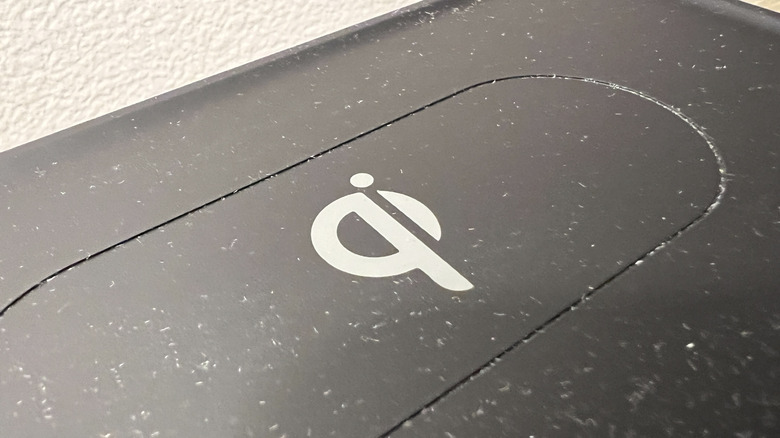
Whether on your wireless charger at home or in your car, you may have noticed the "Qi" symbol featuring lowercase "qi" letters in a rounded font. It means that the charger supports the Qi charging standard and can top up any compatible device, regardless of the manufacturer. This standard uses electromagnetic induction technology to send power from the transmitter (charger) to the receiver (your phone or other Qi-enabled device) for charging without cables. Although it is now the de facto wireless charging technology for mobile devices and accessories, there have been other options along the way.
Before Qi came to market, mobile devices used proprietary technology or alternative standards like Powermat and Palm's Touchstone. However, Qi won the wireless charging war, as the other solutions didn't see wide market adoption. It's maintained by the Wireless Power Consortium (WPC), which develops it and certifies compatible devices. The standard was introduced in 2010 as smartphones were becoming popular, and was initially capable of transmitting just 5 watts of power. However, over the years, the Qi standard has evolved to handle 25 W of power delivery and support magnetic wireless charging, a feature popularized by Apple's Qi-based MagSafe technology.
The Qi standard has several versions
You'll find Qi charging support in smartphones, tablets, wireless earbuds, e-readers, and a variety of other gadgets. However, as devices can support different Qi versions, capabilities will differ, so it's important to understand how they function. Early versions of Qi were focused on improving charging stability, compatibility, and foreign object detection for safer charging. 2017 brought support for Extended Power Profile (EPP), which enables up to 15 W "fast wireless charging" on compatible devices, while the original 5 W standard became the Baseline Power Profile (BPP).
The next major evolution of this wireless charging standard came with the launch of Qi2 in 2023, which was inspired by MagSafe and introduced a Magnetic Power Profile (MPP) for better alignment between the device and charger. WPC further improved the Qi standard with Qi 2.2, also known as Qi2 25W, in 2025, which, as the name suggests, supports 25 W charging. Phones that support this latest Qi standard include the Pixel 11 series, the Pixel 10 Pro XL with its big screen, certain iPhone 17 models, and theincreasingly refined Samsung Galaxy S26 Ultra.
How to check if your phone supports Qi charging
As there is no easy way to tell whether a phone supports Qi wireless charging visually, you will have to consult the device manual or specifications supplied by the manufacturer. This will also inform you whether the phone supports an older version of the standard that's limited to 15 W or newer Qi2 versions. That said, wireless charging is a common feature in most high-end phones and some mid-range models.
Although all modern mobile devices using wireless charging rely on the Qi standard, some use proprietary technology as well to offer faster charging speeds. For example, OnePlus uses AirVOOC to deliver 50 W wireless charging with the OnePlus 15 and its huge battery. In such cases, while you can use a typical Qi wireless charger to juice up the phone, you'll need the company's specific wireless charger supporting this proprietary technology to get the top charging speeds, as standard Qi chargers won't deliver beyond than what they're rated for.