

Oura Ring 5 Review: The Best Smart Ring Is Still Too Expensive
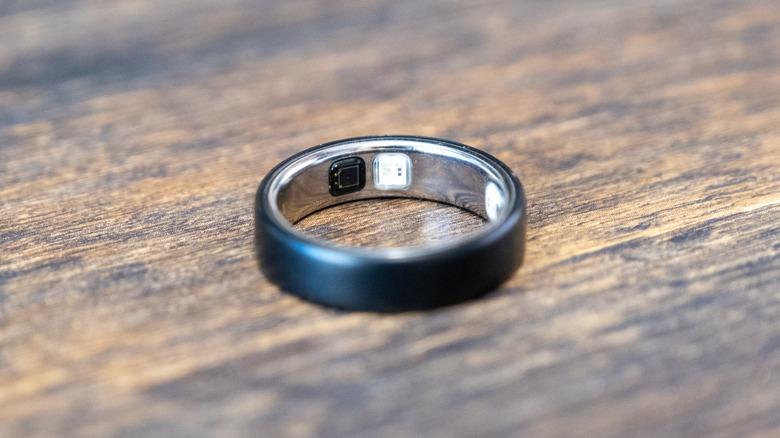
Oura has been making smart rings longer than almost anyone, and now the company is back with its latest and greatest model, the Oura Ring 5. The basic premise of the device is the same — it's a relatively subtle smart ring that happens to be packed with fitness and health-tracking features, including the ability to track sleep, recovery, and more. This time around, however, Oura has made some changes to the design — including making it dramatically smaller than before.
It's a premium product, and it's still priced like a premium product. The Oura Ring 5 starts at $399 for the Silver and Black finishes, with fancier colorways reaching $499 — and that's before the membership fee that unlocks most of what the ring can actually do. More on that later.
Given the fact that smart rings have gotten a whole lot more popular in recent years, is the Oura Ring still the go-to for those that like the idea of a ring that can handle health-tracking without the need for something bigger, like a watch? I've been using the Oura Ring 5 for a while now to find out just how well it works.
Design
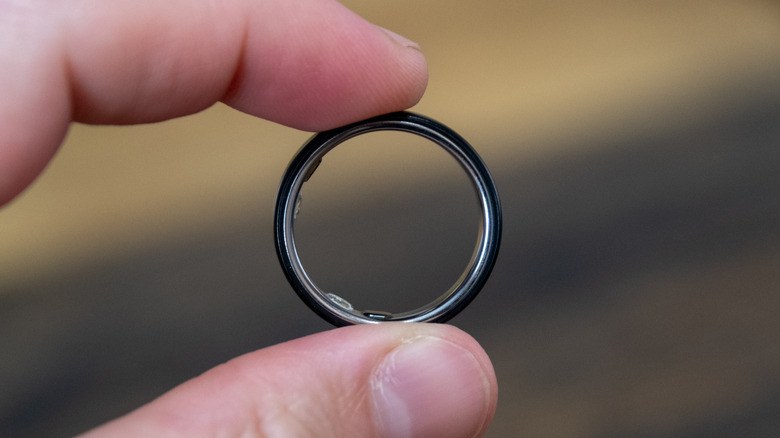
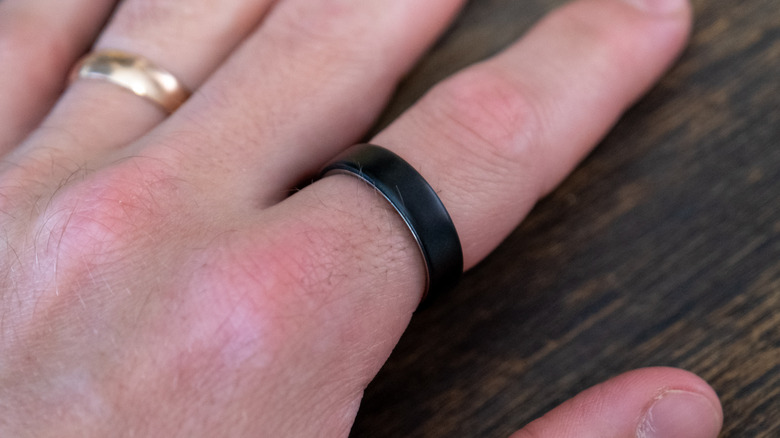
The design of the Oura Ring 5 is perhaps one of the biggest changes compared to previous-generation models. Oura says the new ring has around 40% less volume than the Oura Ring 4, and I indeed found it to be a lot more subtle and a lot less intrusive. The Oura Ring 4 wasn't uncomfortable, but it was still noticeably chunky on a finger. The Oura Ring 5 still isn't quite at the level of, say, a traditional wedding band — but after using it for a few days, it's easy to forget about. It measures roughly 6mm wide and around 2.3mm thick, and it weighs about 2 grams depending on the size.
The build quality is quite good, which is what you'd expect at this price. The body is titanium with a hardened, scratch-resistant coating that Oura says holds up better than previous generations. After weeks of daily wear, mine doesn't have a single scratch, which is nice to see. That wasn't always true of earlier Oura rings, which picked up scuffs pretty quickly, so the coating seems to be doing its job.
Sizing matters more with a smart ring than with most wearables, because the optical sensors need snug, consistent contact with the skin to produce clean data. Oura sells sizes 6 through 13 and ships a free plastic sizing kit first, and you should actually use it for a few days rather than guessing. Fingers swell and shrink through the day, and a ring that's slightly loose at night will quietly degrade your readings.
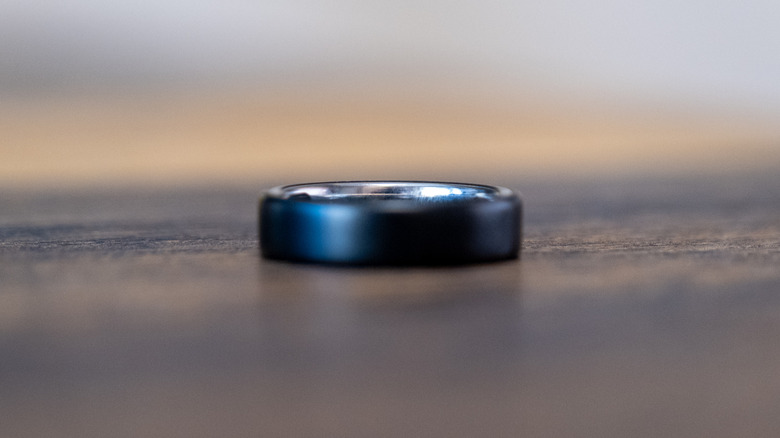
There are six finishes — Black and Silver at the $399 base price, with Stealth, Brushed Silver, Gold, and Deep Rose commanding the $499 premium. The upcharge is purely cosmetic. Every finish has the same titanium body and the same sensors, so the only question is whether the look is worth an extra $100 to you. The design as a whole passes as ordinary jewelry, which is arguably the entire point of a smart ring. I do particularly like the Stealth model that I'm testing, though. Like previous generations, there's a small notch on the Oura Ring 5 that's tells you which way to face it so that the sensors can get the best reading. It's pretty subtle, which is nice.
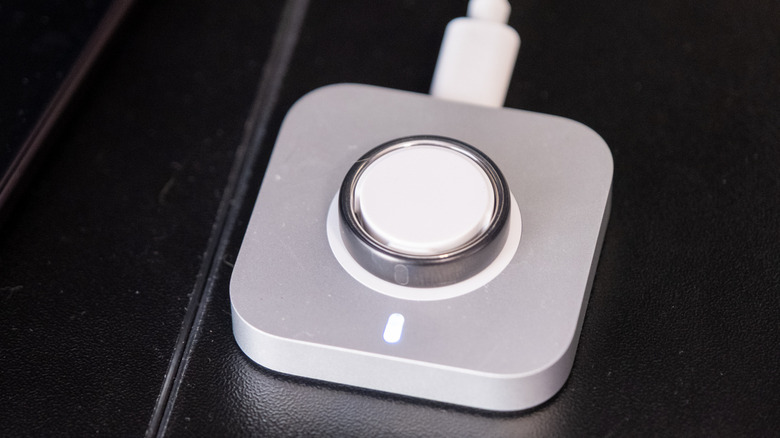
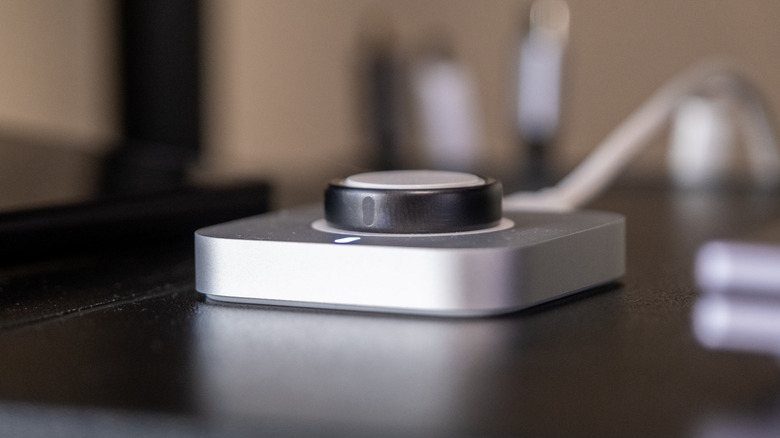
Water resistance is rated to 100 meters, so showers, swimming, and washing dishes are all fine. That comfortably covers everyday life and edges out plenty of smartwatches. The device also comes with a charging dock, which is similar to older models in terms of design. It has a USB-C port on the back and makes it pretty easy to put the Ring on to charge every now and then.
As a whole, I really like the design of the Oura Ring 5. It's relatively sleek and stylish, and because of the thinner build, most users will forget they're even wearing it.
Battery and charging
Oura rates the Ring 5 at six to nine days per charge, with larger sizes trending toward the high end because they physically fit bigger batteries. In my experience, that's about right, though I was never able to stretch to the full nine days before needing to top up. Most of the time, I got a notification that I needed to charge the ring after around a week.
That's about on par with other smart rings. The Samsung Galaxy Ring lasts around 7 days between charges, for example. Either way, it's a significant improvement over a smartwatch that needs to charge every night or two.
Charging happens on the aforementioned dock, and a full charge from low battery takes about 80 minutes. Because I only had to charge once per week or so, I kept the charging dock on my desk — but if you do get into the routine of charging, say, every morning during a shower or something, you'll never really have to worry about battery life.
Features
The sensor package covers a lot for something this small. There's a photoplethysmography (PPG) module — the optical sensor that shines light into your finger to read heart rate and estimate blood oxygen — plus skin temperature sensors and a 3D accelerometer for movement. From those raw signals, Oura derives more than 50 metrics spanning sleep quality, readiness, activity balance, stress, resilience, and more.
For many, sleep tracking will be the biggest advantage, and it's still arguably the best reason to buy the Oura Ring 5. The nightly breakdown of sleep stages, heart rate, HRV, temperature, and respiration feeds a morning readiness score that could impact how you go about your day, if you let it. When your readiness score is low, it's supposed to be a sign that you should prioritize rest, whether it be because you slept poorly or because you had a serious workout the day before. When your readiness score is high, it's a sign that you can be a little more active. The Oura Ring 5 also adds a host of cycle-tracking and ovulation features, though I didn't test those.
New for this generation are two cardiovascular features. The Blood Pressure Signals feature monitors overnight cardiovascular trend patterns. To be clear, these aren't blood pressure readings in the cuff sense — they're derived patterns meant to flag when your overnight cardiovascular trends drift from your baseline. Nighttime Breathing does something similar for respiration, watching for irregularities during sleep. Both are trend tools, not diagnostics, and Oura is careful to say so. Neither has much independent validation yet, so treat them as interesting extra context rather than anything to act on. Samsung's Galaxy Ring offers a comparable optical and temperature sensor set with its own Energy Score, but it has no answer to Oura's blood pressure trend tracking.
It's worth being clear about what this ring is not. Oura says outright that it's not a medical device, and it isn't built for serious training either. The Ring 5 is optimized for long-term trend-tracking, just like many other fitness and health trackers. It does a pretty good job at helping track your health, but if you want granular workout analytics or something similar, you may want a Garmin.
Performance
Under the hood, Oura redesigned the sensor array to maintain its high quality despite the smaller build. The number of optical light paths has dropped from 18 to 12, but the lights themselves are, according to Oura, four times stronger — the idea being to preserve or improve signal quality in a smaller package. Based on the data I saw, it works perfectly fine. Readings were consistent night to night, and I had very few gaps or obviously junk numbers.
Oura claims the new array delivers a 12% improvement in overnight HRV accuracy, a 24% improvement in workout heart-rate signal quality, and a 19% improvement in automatic activity detection for many top-tracked activities, compared to the Ring 4. In practice, workout heart rate tracked pretty close to my Apple Watch Ultra 2, and the device did a good job at activating automatic activity tracking.
It is worth noting that the Oura Ring 5's core algorithms are unchanged compared to the Oura Ring 4 — so if you have an Oura Ring 4 and are perfectly happy with it, then it's probably not worth upgrading. Connectivity is Bluetooth Low Energy to the iOS or Android app, and syncing was quick and drama-free throughout my testing. Opening the app in the morning pulled the previous night's data within a few seconds, and I never had to fight a dropped pairing.
Software
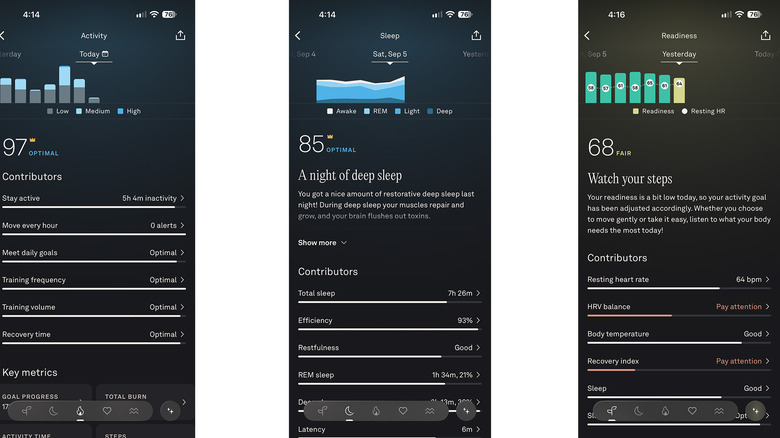
The Oura app is quite well-designed and easy to use — which is important given the fact that without a display on the device itself, the app is how you manage everything. Overall, it's clean, well-organized, and good at explaining what a metric means and what to do about it.
Unfortunately, most of it sits behind the Oura Membership, which runs $5.99 per month or about $70 per year. Without it, you get basic daily scores and not much else. Technically, the subscription is optional, but in practice, there's not much point in buying the Oura Ring 5 if you don't plan on subscribing. Budget for it as part of the price, because the $399 ring is really a $470 commitment for the first year alone.
There are some new software features, too. For example, Health Radar acts as a proactive monitoring layer, surfacing alerts when trends like Blood Pressure Signals or Nighttime Breathing deviate meaningfully from your baseline, rather than expecting you to dig through charts yourself. Live Activity Tracking finally lets you start a workout from the app and watch real-time data during the session — a gap in previous generations, where the ring was almost entirely passive. There's also a device locator now, which matters a great deal for a 2-gram object you regularly remove to charge.
GLP-1 Insights is the most specialized addition. Available in the U.S., India, and the UAE, it lets people on GLP-1 medications log dosing, side effects, and weight changes alongside the biometric data the ring already collects, all in one longitudinal view. It's early and unvalidated, and Oura stresses it's educational rather than medical advice, but for the growing number of people on these medications, consolidating that tracking into one app is helpful.
The app isn't flawless — there are a lot of features in there, so it can take some time to get used to how it all works and how to navigate. But, for the most part, you'll find it relatively easy to get your bearings after messing around with it for a few days.
Should you buy the Oura Ring 5?
The Oura Ring 5 is the best smart ring you can buy if you're not locked into a Samsung phone. The smaller titanium build makes it easy to wear 24/7, the battery life of 6 to 8 real-world days embarrasses most smartwatches, and the sleep and recovery analysis remains among the best of any consumer health tracker. For cross-platform buyers who want discreet, continuous health-tracking, this is the ring to get.
That is if you're willing to pay for not just the high retail price, but also the ongoing subscription. At $399 to $499 up front, plus another $70 or so per year, you have to really want the extra features on offer by the Oura Ring 5. If you don't need extra features that other products don't offer, it's worth paying a flat fee for one of them instead and saving hundreds in the long run.
The other serious option is the $399.99 Samsung Galaxy Ring, and the decision there mostly comes down to your phone. If you carry a Galaxy device and want tight Samsung Health integration, gesture controls, and no monthly fee, Samsung's ring is the more sensible pick. If, however, you use an iPhone or another device, then the Oura Ring 5 is still worth considering — it's the best smart ring out there, even if it is pricey.