

Mount Vs. Stand: How To Choose The Best Setup For Your Home Projector
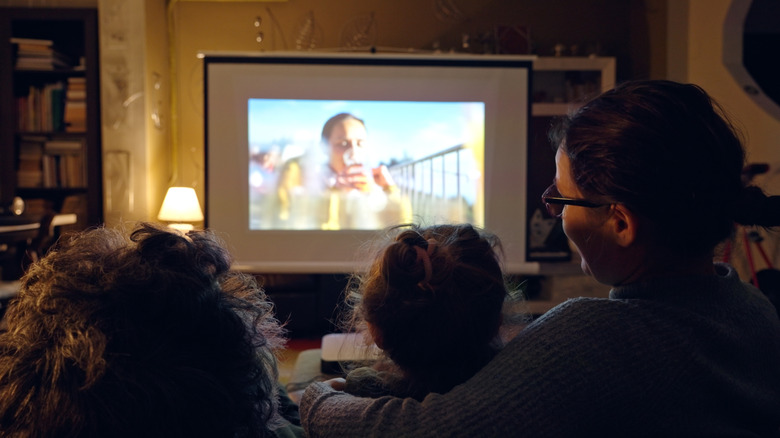
So, you're thinking of treating yourself to a home projector. While it's important to avoid these common mistakes, you might also be wondering whether to mount it on the ceiling or use it on a stand. Both options have their pros and cons, so let's take a look at what each has to offer so you can decide what's right for you. Broadly speaking, the best setup for your home projector depends to some extent on whether you're keen to have a permanent, home theater-like installation, in which case a mount makes sense, or a more flexible, low-effort arrangement, for which a stand will work better. But there may be factors out of your control that push you toward one option over the other. For example, a very high or sloping ceiling can make mounting a projector much more complicated, as you may need additional hardware or adjustments to get it positioned correctly.
Your living situation could also have an impact on whether you go for a mount or a stand. Renters, for example, usually face more limitations when it comes to drilling into walls or ceilings. You should also take a moment to think about how the room is used day to day. If it's a multi-purpose space, a ceiling-mounted projector would eliminate the need to pack the device up and clear the cables after every use. Conversely, if portability is important because you want to use it in different rooms, then a stand is obviously the way to go. Let's examine some of the main considerations when choosing between a mount or a stand.
The practical side of projector placement
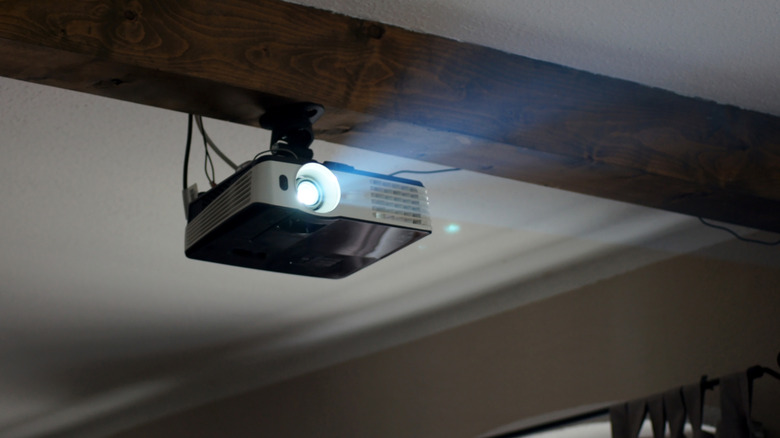
The choice between a mount and a stand often comes down to practicalities, like how much time you're willing to put into setting it up, and how stable and safe it needs to be. An important factor to think about is the stability of your projector. A fixed mount keeps the projector securely in place and out of the way, while a stand can wobble or be knocked over in a busy room, especially if there are kids and pets. More planning and effort is needed for a mount, too, with some DIY skills required if you're thinking of taking on the task yourself. A stand, on the other hand, is quick to set up, and can be moved from room to room, or even outdoors, giving you more flexibility about where you watch content.
Cable management is another important consideration. Use a stand and you might have cables snaking across the floor, creating a possible trip hazard. A projector mounted on the ceiling, on the other hand, is out of the way, though hiding the cables requires some extra work. Finally, image positioning can be an issue. With a mount, you can get the image perfectly aligned during setup and leave it in place, but with a stand-based projector you're probably going to have to adjust the image each time you use it. You can also follow these tips for a better projector image.
In the end, there's no single right answer on whether it's best to use a mount or a stand. The former offers things like stability and tidiness, while the latter means lower cost and greater portability. As long as your ceiling and living situation allow for it, the choice ultimately comes down to which of those factors matters to you most.
A third way could be the sweet spot
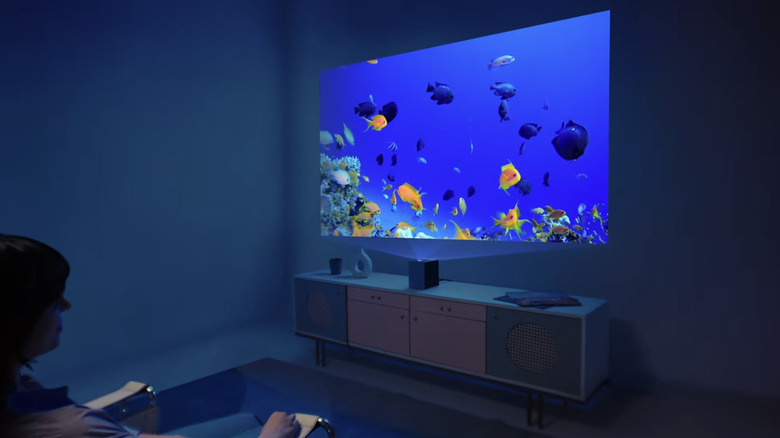
If you want the best of both worlds, then you might want to consider a UST (ultra short throw) projector, which can offer a comfortable middle ground between the other two options. A UST projector sits just a few inches from the screen or wall and uses a specially designed lens to project a properly proportioned image.
The benefit is that the projector can be kept out of the way while still allowing you to move it between rooms if desired. A UST projector can also offer much of the permanence of a mounted projector — without the hassle of installation — as you can simply leave it in place when you're not using it. A conventional stand-based projector is more likely to be positioned further into a room, away from the walls, making it more likely that you'll need to pack it away after each use. With this in mind, a UST projector gives you a tidy, discreet setup. It's also ideal for small rooms where there isn't enough space between the wall and a non-UST projector to produce a large image.
But there are a few downsides to consider. For example, UST projectors project the image at a very steep angle, and so getting the image perfectly aligned can sometimes be a bit trickier than with a regular projector. They also tend to be a bit heavier and larger than home projectors marketed as portable, so moving them from room to room may be a little more cumbersome. Also, keep in mind that UST projectors usually cost more than non-UST models with similar specifications.