

The First Liquid Cooled Phone Is Already Here, But Does It Make Any Difference?
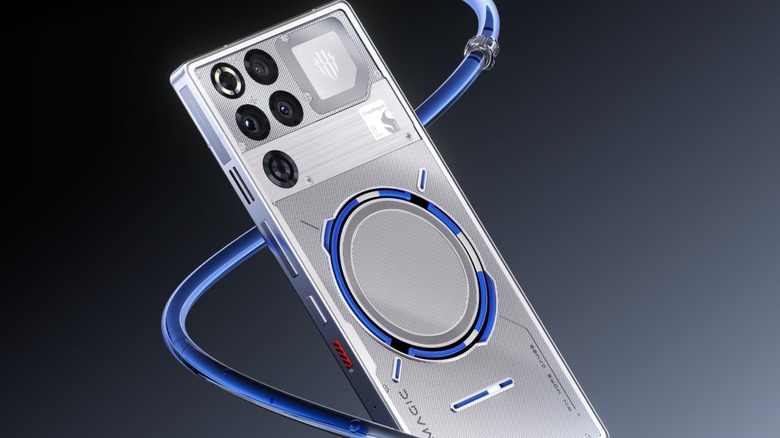
Most smartphones rely on passive cooling to prevent overheating, but that isn't always enough. Sometimes you need to do more to cool down your phone. Last year, RedMagic released the RedMagic 11 Pro (later refreshed as the RedMagic 11S Pro), the first phone that uses liquid cooling to avoid overheating while under heavy loads. By heavy loads, we mostly mean gaming. When outlets such as Linus Tech Tips ran benchmark tests, they found that while the phone outperformed rival devices, it didn't provide that much of an improvement.
Linus Tech Tips pitted the RedMagic 11 Pro against four other devices: the RedMagic 10S Pro, the OnePlus 15, the Galaxy S25 Ultra, and the iPhone 17 Pro Max. Linus Tech Tips ran the phones through multiple tests in 3DMark Wild Life Extreme and Geekbench 6. After 20 tests, the RedMagic 11 Pro came out on top of the 3DMark test with an average score of just over 6,000, followed closely by the RedMagic 10S Pro with a score of around 5,500. Meanwhile, the Galaxy S25 Ultra trailed behind with a score of under 4,000.
The Geekbench 6 tests had similar results. RedMagic 11 Pro had a three-run average score of 3,768 for single-core tests and a multi-core score of 11,864, followed by the OnePlus 15 with scores of 3,639 and 10,979. Again, the Galaxy S25 Ultra came in last place with a single-core score of 3,201 and a multi-core score of 10,129. When channels such as Versus tested the RedMagic 11 Pro with actual games, the phone generally ran better than the iPhone and Galaxy, but it also ran hotter as a tradeoff.
How does cooling compare

Going by benchmark numbers, the RedMagic 11 Pro, while superior to other phones, isn't a huge step up. RedMagic 11 Pro's Qualcomm Snapdragon 8 Elite Gen 5 chip, which has 20% more CPU power and 30% better GPU performance over the RedMagic 10 Pro line, likely accounts for most of the results. If we're being honest, the liquid cooling system doesn't seem to provide much, well, cooling. The system amounts to little more than a sticker with liquid inside squeezed into the phone's internals. As a result, the liquid just moves heat around, which improves heat transfer to the main cooling components inside the phone: a tiny fan and a vapor chamber. A vapor chamber is a sealed chamber that uses water to absorb heat and disperse it via a repeating process of vaporization and condensation. These components do most of the heavy lifting.
While vapor chambers aren't novel in the world of smartphones, RedMagic claims the RedMagic 11 Pro features the largest vapor chamber in a phone, covering 13,116 mm². Although, it's difficult to accurately gauge this claim since phone manufacturers generally don't publish their vapor chamber dimensions. For example, Apple's customer-side documentation boils down to "three times the surface area as the previous generation." While the RedMagic 11 Pro provides superior sustained game performance, how much is the result of the more powerful processor and how much comes from the cooling systems (and which ones) remains a mystery. The only thing we know for certain is that the RedMagic 11 Pro doesn't quite measure up to the likes of the Steam Deck, mostly because RedMagic admitted as much.