

Which AMD GPU Is Equivalent To The Xbox Series S?
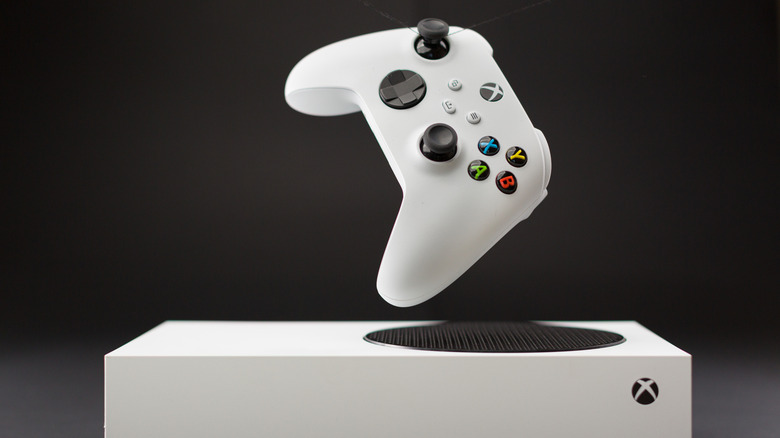
Many people view gaming consoles as weak from a pure performance standpoint, but that's not always quite true. Sure, consoles pale in comparison to even more robust mini gaming PCs, but models like the Xbox Series S can still run all the latest games. In fact, Microsoft's weaker variant (compared to Xbox X and PlayStation 5) of the Xbox will be able to run GTA VI in November, while PC gamers will have to wait until who knows when to finally roam the streets of Vice City. So, because the Series S remains a capable machine, let's just say theoretically, if you could build a gaming PC that's spec-wise similar, what components would you use? Specifically, which AMD graphics card is equivalent to the Xbox Series S?
To start with, the more powerful Xbox Series X's Nvidia equivalent is an RTX 3060, which is a midrange GPU from 2021. No surprise, then, that the Series S sports something a bit more subdued: its GPU is in the ballpark of an AMD Radeon RX 5500 XT or an RX 6500 XT. Of course, there's bound to be some differences. The GPU is a custom AMD solution built around a Lockhart GPU with eight gigabytes (GB) of GDDR6 RAM and a clock speed of 1565 megahertz (MHz). In terms of specs, the RX 5500 XT is a close match, as it also has 8 GB of GDDR6 RAM with a GPU clock speed of 1750 MHz. However, this one is based on the first-gen RDNA, while the Series S uses newer and faster RDNA 2 architecture that supports hardware ray tracing. Thus, the AMD RX 6500 is a fine contender architecture-wise, despite its seemingly skimpy four megabytes of RAM.
Do these AMD GPUs match the performance of Xbox Series S?
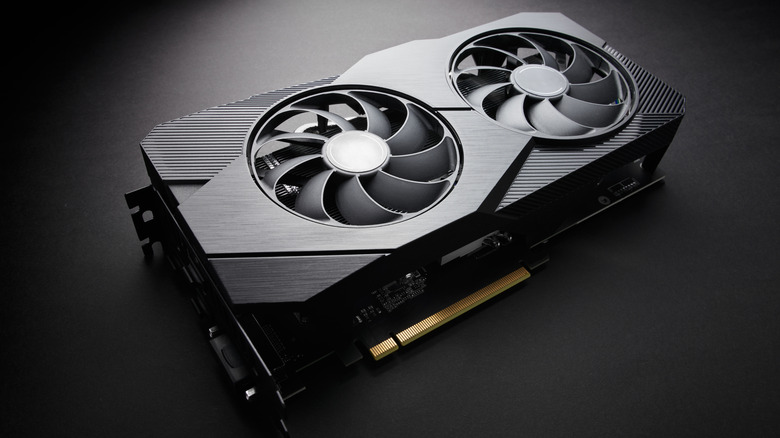
Let's take a demanding game like Indiana Jones and the Great Circle to see how well these graphics perform in the real world. Surprisingly, various real-world tests have shown the Series S to run Indy's adventures at a clean 60 frames per second (FPS) with FidelityFX Super Resolution (FSR) upscaling to 1080p. Understandably, the game doesn't look all that glorious, but it maintains a steady framerate, which is a valid goal for many gamers. The entire thing is even less glorious on the RX 5500, which maintains 60 FPS (with occasional dips) on low settings. Unfortunately for the RX 6500 XT, its lower VRAM definitely shows, and the game barely hits 30 FPS on the lowest graphics preset.
As another example, Alan Wake 2 is limited to the Quality mode on the Series S, with FPS capped at 30 and the resolution upscaled from 850p to 1440p. However, the console runs the game like a champ and looks marvelous. RX 5500 XT, in contrast, occasionally dips below 30 FPS on the lowest settings and FSR 2. The RX 6500 XT fares a lot better, hitting an easy 60 FPS with low settings and the FSR Quality preset. Bumping up the graphical settings to high while maintaining the same FSR setup, you get extra eye candy while maintaining 30 FPS.
These AMD cards may not have the stability of the Xbox Series S, as most of these games are developed with consoles in mind, dinging optimization on PCs. Yet, both are priced at around $200, and for that money, getting something that can run these demanding games (and in some scenarios, even blow the Series S out of the water) can be a great deal for a budget-conscious gamer.