

Chinese Scientists Find Unexpected Solution To The Problem With Underwater Drones
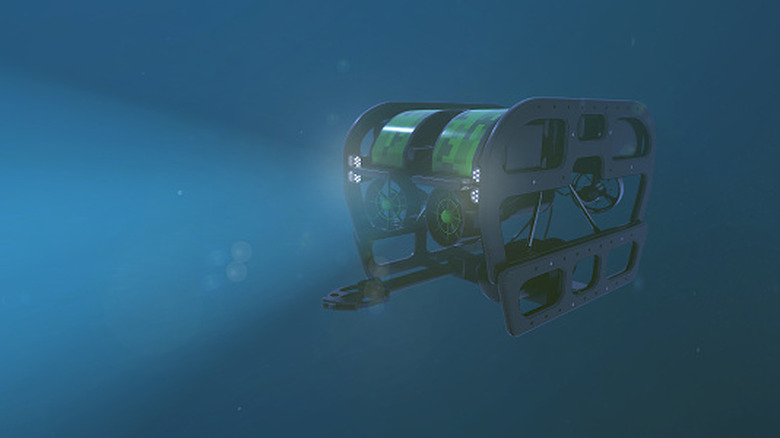
The ocean is Earth's final frontier. Satellites have mapped 100% of the seafloor at roughly one-mile resolution, but less than a third has been mapped with modern high-resolution sonar. Multibeam sonar used by ships is good for broad sweeps, but even the best shipboard systems produce maps with just 49- to 164-foot resolution once you're a mile or two deep. Underwater drones can carry sonar closer to the seafloor and sharpen that picture considerably. Unfortunately, the drone's shape could blur what the sonar is there to discover. Scientists in China think they have a surprisingly simple fix. They developed a custom acoustic lens that bends the sound waves back into focus.
Sonar works by sending acoustic energy outward, where it reaches objects, creating echoes that can be analyzed. When attached to underwater drones, sonar transducers are put behind a smooth, curved dome that protects the sonar and reduces vehicle drag. There's a problem, though. Because the dome is curved, it distorts the sonar's wavefront, creating a wider, weaker beam. It's like having 20/20 vision and looking through someone else's prescription glasses. Current solutions use complex electronics and computers to steer and shape sound. It's expensive, heavy, and requires too much power to operate. The new lens corrects the distortion physically before the sonar beam passes through the dome. It's similar to how NASA scientists corrected distortion to make Hubble Telescope images much better looking.
How Chinese researchers improved underwater drone sonar
Researchers from Xiamen University developed an acoustic lens that manipulates sonar's sound waves. They calculated exactly how the dome distorts the wave, then created a lens of concentric silicone rings to bend it the opposite way. Each ring holds a different ratio of tungsten, which changes how fast sound travels through the silicone, and reshapes the wavefront. The holographic lenses can be custom made to match the aberrations created by the domes of various underwater drones.
This is more than a theory. The team tested the lens in a lab, finding the lens helped the sonar beam sharpen from over 65 degrees to between 16 and 30 degrees. After that success, the team took it out into the real world — the lively Jiulong River. They towed a hollow plastic sphere about six feet down, then deployed an underwater drone to spot it with sonar. Without the lens, environmental and boundary reverberations were too strong. After adding the lens, researchers reduced the reverberation by 11.98 dB, making the sphere visible to sonar.
Sharper sonar like this could open new frontiers in deep-sea exploration. More than 100,000 seamounts rise above 3,280 feet, yet fewer than one-tenth of 1% have been explored. Scientists believe these could be biological oases, supporting the kind of life that can survive without the sun. There could even be an unexpected necropolis like the one discovered in the depths of the Indian Ocean. The Xiamen University researchers next want to test their lens in real seawater, after trials in artificial saltwater, and see how it performs with the creatures who live there.