

Nintendo Holds A Guinness World Record That's Out Of This World
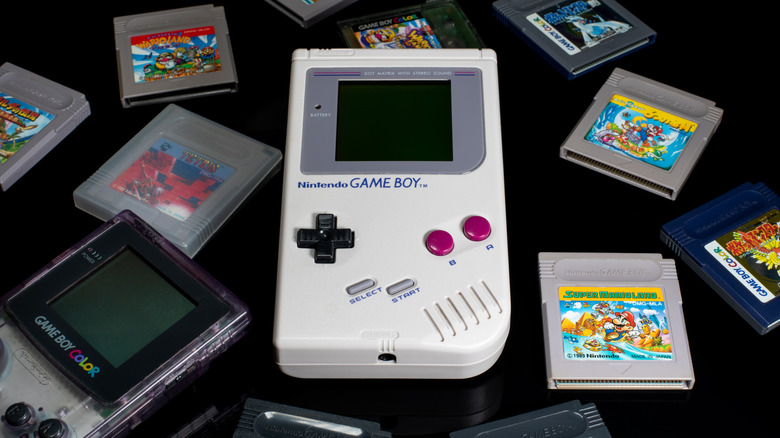
Nintendo designed the Game Boy to be tossed in your bag or pocket and taken anywhere. On July 1st, 1993, the Game Boy's portability reached an all-new extreme, setting a remarkable Guinness World Record along the way. An original Nintendo Game Boy and a copy of "Tetris" made their way into space, making it the first video game played among the stars.
The console made it into outer space via the Russian Federation's Soyuz TM-17, en route to the modular Mir space station, during Aleksandr Aleksandrovich Serebrov's 196-day mission. The cosmonaut packed the Game Boy and a "Tetris" cartridge — a game which was created by Moscow-born Alexey Pajitnov — for his trip, later revealing in an autographed note, "During flight, in rare minutes of leisure, I enjoyed playing Game Boy." Over the course of the mission, the console and cosmonaut orbited Earth more than 3,000 times before returning to Earth.
Serebrov's original Game Boy, "Tetris" cartridge, instruction manual, and the aforementioned autographed note sold at the Space History Auction in 2011 for $1,220, including premium fees. That's rather more than you could probably expect to sell your original Nintendo Game Boy for today. That figures, though — any dust on your old console is unlikely to be from space, after all. The auction Bonhams listing describes the console as a "space Nintendo" and notes that the Game Boy and instruction manual include partially visible Mir postmarks.
Other video games have made it to space since then

Although Serebrov was the first person to enjoy a little gaming in space, he wasn't the last. In 1998, another trip to Mir saw astronauts gaming onboard. Andy Thomas brought a CD-ROM of "Monty Python's Complete Waste Of Time" to play on PC during STS-89, alongside a selection of books, music, and other programs.
One year later, STS-96 saw a crew inhabiting the International Space Station (ISS) for the first time. Among the crew was Daniel T. Berry, a NASA astronaut who brought Blizzard's "StarCraft" along with him for the ride. Unfortunately, he couldn't play it for a number of reasons; according to a now-archived interview with Berry on the StarCraft website, the game was stashed away in space, making it inaccessible and playing it on a flight computer would've required NASA approval. Perhaps most predictably, astronauts have little time in space. But the CD did make it up there and back down to Earth, making it another title to follow in Tetris' zero-gravity footsteps.
All manner of weird and wonderful items have made it into space over the years, ranging from audio recordings, golf balls, and Legos, to raptor bones and gorilla costumes. With that in mind, there's a good chance that other games have also made it to the cosmos, even if we don't know about it. ISS crew have even confirmed they took PCs for gaming up there, as disclosed during an unexpected interview with Barack Obama and a group of middle schoolers back in 2009.
Nintendo is a Guinness World Records' frequent flyer
When you take a look at Guinness World Records that are related to video games, Nintendo comes up unsurprisingly frequently. Some of these records are fairly straightforward and couldn't be held by any other competitors, like the record for the fastest-selling Nintendo game, the first Nintendo console to use discs, or the largest Nintendo-made world. Meanwhile, some others are much quirkier, varying from gigantic Miis to unexpected methods for forensic investigations and beyond.
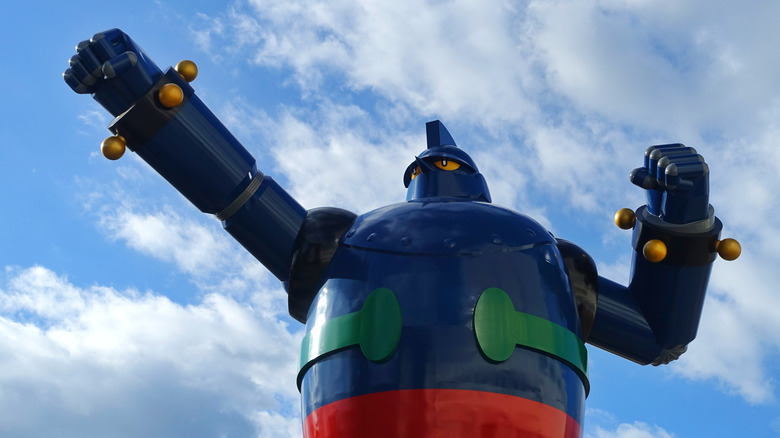
In 2011, a dedicated Nintendo 3DS fan group created the largest Nintendo Mii on record by designing a massive augmented reality marker using 256 sheets of A3 paper. Using the enormous marker and a 3DS, the group generated a replica of a 60-foot-tall statue of Tetsujin 28-go, a beloved Mitsuteru Yokoyama robot character you might know as Gigantor. The record is simply credited to Tetsujin 28-go itself.
Beyond recreations of giant robots, Nintendo's Mii Maker is also involved in other Guinness World Records. In 2008, a Japanese police force used a Nintendo Wii to create a wanted poster while searching for the perpetrator in a hit-and-run case, marking the first time on record that a Nintendo product was used for a criminal investigation. Notably, the poster's success (or lack of) isn't mentioned on the record itself. So, while Nintendo has produced a lot of weird products over the years, we probably don't need to worry about them branching into forensics any time soon.