

Bluetooth Range: How Far Does It Really Reach?

Bluetooth is a short-range wireless standard that's not really designed to stretch long distances, at least not on the consumer side. The main goal is to allow peripherals like headphones, portable speakers, keyboards, and game controllers to quickly and easily connect to other devices. But if you've ever strayed with a pair of headphones or moved your phone away from a speaker, only to have the signal worsen or drop out, you understand Bluetooth has its limits. So, how far does it really reach and is there a way to extend that distance or boost the signal in some way?
The first thing to understand is what causes Bluetooth's limit or range restrictions. The Bluetooth version or Bluetooth protocol determines range up front. Most older versions of Bluetooth, below 4.0, can extend to 30 or 33 feet. Bluetooth 4.0 to 4.2 devices can reach further, up to around 200 feet. The 5.0 standard significantly upgraded capabilities, offering a theoretical reach of up to 800 feet. But the problem with these numbers is they're most accurate under ideal conditions with little interference, no obstacles in the way, and a strong source of power. There are actually quite a few factors that inhibit signal quality.
Physical obstructions like walls and obstacles, the weather or moisture in the air, battery life, the sensitivity of the receiver in the connected device, and poor transmitting power can all affect signal strength and distance. But another important factor is the 2.4-gigahertz (GHz) wireless band, which is where Bluetooth operates, which means it's fighting with a swarm of other devices, including Wi-Fi routers and even appliances like microwaves, for bandwidth. Needless to say, the 2.4 GHz frequency can get pretty crowded, which can cause signal interference for Bluetooth devices.
The Bluetooth class also matters
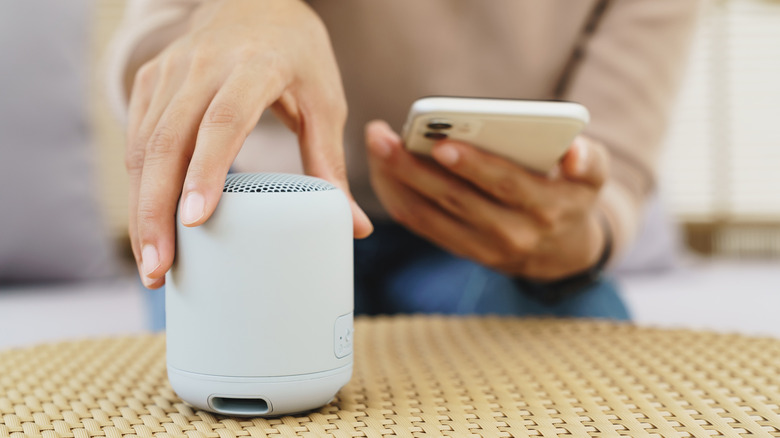
There are three power classes of Bluetooth technology in use, starting with Class 1, which is reserved for industrial equipment and long-range adapters. Class 1 Bluetooth devices can maintain a connection for up to around 330 feet, but they also require more juice — 2.5 to 100 milliwatts of transmit power. They're not likely to be portable or battery-operated for that reason. Class 2 Bluetooth devices, which you likely are most familiar with, constitute consumer-grade devices like smartphones, earbuds, speakers, and so on. They have a maximum range of 33 feet, but that's because they have a lower power draw, which also means they're energy-efficient. It's also what allows them to work for longer periods on a rechargeable battery and in portable formats.
The final class, Class 3, is reserved for devices like medical-grade equipment or dongles, key fobs for vehicles, and other short-range tech. They have a max range of close to three feet and use very little power: We're talking a fraction of a milliwatt.
So, already, we have a variety of environmental and external factors to consider, the Bluetooth version (like standard Bluetooth versus Bluetooth LE), and the class of device in question, all of which contribute to signal strength and quality. A lot of different elements can get in the way, but can you boost signal strength somehow to combat any deficiencies?
Mind the limitations, find the sweet spot, use the latest tech
Ultimately, there's no way for the average person to boost or strengthen the Bluetooth signal at the source. Outside of upgrading to the latest protocols and making sure the devices you own and use are at least Bluetooth 4.0, what you get is what you get.
However, you can ensure the signal has less competition. That means making sure your devices have a fully charged battery, so there's plenty of power, removing any potential wireless interference in the way, such as routers or mesh nodes nearby, and trying to reduce obstructions between the devices as much as possible. If you have to separate them, keep line of sight as best as possible, and follow the other guidelines laid out here. No, a direct line of sight is not absolutely necessary, but it can help. Bluetooth can go through walls and physical barriers, but some materials can cause issues. The signal can pass through plastic, glass, and wood, but thicker materials like concrete or metal are a no-go. The human body can also cause interference.
While one of the common Bluetooth myths people fall for is that the technology is only for short-range applications, that's changing as the technology advances and becomes more capable. We might not have access to long-range technologies at home quite yet, but there are some big changes coming to Bluetooth in the near future. It may not be long before that range stretches further than we could have imagined. But most importantly, future Bluetooth technologies are coming with higher data throughput capabilities, support for higher frequency bands that aren't as crowded, and a host of other enhancements.