

A Popular Plan To Fix Climate Change Could Have An Unexpectedly Disastrous Effect

The world has been getting hotter and hotter for decades due to the effects of anthropogenic climate change. 2025 was one of the warmest years on record, following a steady upward trend, but what if we could do the opposite, and actually cool the globe? There's a proposed practice called marine cloud brightening that would entail artificially brightening clouds over the ocean so that they reflect more sunlight away from Earth, essentially turning clouds into giant mirrors to bounce solar rays back where they came from. Less solar radiation means less global warming, but the proposal might be too good to be true. A 2025 study published in the journal Earth's Future warns that marine cloud brightening could cause an unexpected crisis by disrupting the critical El Niño cycle.
The El Niño Southern Oscillation, or ENSO, is a cycle that recurs every two to seven years. It moves warm water back and forth across the Pacific Ocean. When the warm water moves east, towards the Americas, it is known as an El Niño event, and when warm water moves west towards Asia, it is known as a La Niña event. When researchers at the University of California, Santa Barbara ran simulations of marine cloud brightening conditions, they found a shocking 61% reduction in the amplitude of this cycle. This would reduce the amount of rainfall both sides of the Pacific see, potentially devastating global agriculture. So why are scientists so interested in marine cloud brightening in the first place?
How marine cloud brightening works

Marine cloud brightening has some sound reasoning behind it, perhaps best demonstrated back in 1991, when Mount Pinatubo in the Philippines erupted and seeded clouds around the world. These clouds ended up reflecting some solar energy, and as a result, global average temperatures dropped 0.6 degrees Celsius (1 degree Fahrenheit) that year. If we could create cloud cover without a volcanic eruption, we could simulate the same effect ... right?
In order to manufacture bright clouds, scientists have looked to the natural world. Clouds form from aerosols, tiny particles suspended in the air, such as smoke, dust, or ice crystals. Over the oceans, clouds form from salt particles sprayed up from the ocean, and that's what proponents of marine cloud brightening propose using to make artificial clouds. Ships on the ocean would have to spray salt particles up into low-lying clouds, making the clouds swell and reflect more solar rays. Theoretically, the particles should naturally disperse after a few days. It's a pretty simple idea on paper, but in practice, things look a lot more complicated.
Why marine cloud brightening could disrupt El Niño
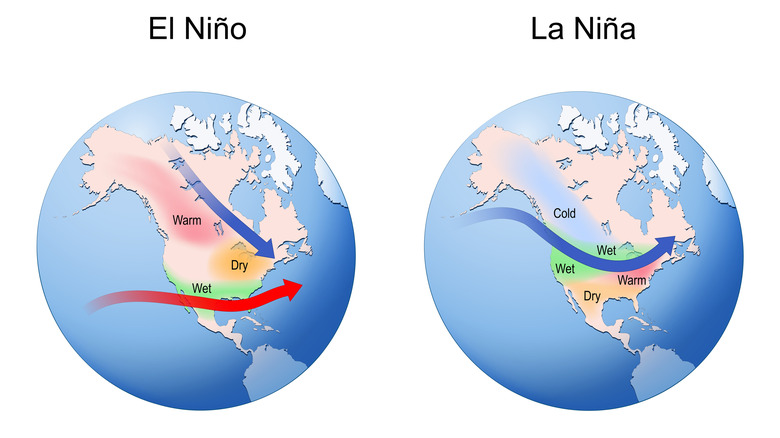
Although it's true that marine cloud brightening has the potential to lower global temperatures, it's going to have its most profound effect on the marine climate itself, perhaps to a dangerous degree. By reflecting solar radiation away from the water, the surface will cool and less natural evaporation will occur. Additionally, the proposed means of marine cloud brightening would introduce especially small aerosol particles into the cloud cover, which are less likely to form raindrops than large aerosols are.
These effects could combine to reduce rainfall on both ends of the Pacific. This could have a catastrophic effect on weather systems such as the southeast Asian monsoons, which play an integral role in agriculture in the world's most populous region. Based on this, the study's authors advocate against using marine cloud brightening over the Pacific. The Atlantic Ocean is also cooling rapidly, so it hardly seems like a good candidate for marine cloud brightening either. Fortunately, there may be another way to accomplish what marine cloud brightening aims for.
An alternative to marine cloud brightening
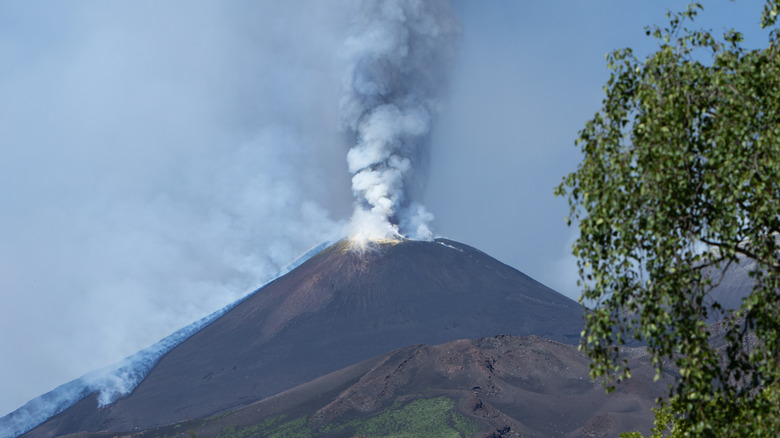
The research team at UCSB also ran simulations for a proposed process called stratospheric aerosol injection. This technique more closely parallels the impact of the 1991 Pinatubo eruption in the Philippines as well as other major volcanic eruptions (which may be getting easier to predict). Those events send massive amounts of sulfate aerosols high into the atmosphere. These particles, at very high altitudes, spread out much further than the low-lying clouds targeted by marine cloud brightening.
Stratospheric aerosol injection would work very similarly to proposals for marine cloud brightening, except, instead of having ships spraying salt particles in the air, you would have planes spreading sulfur dioxide high in the sky. When the researchers ran this model, they didn't see any significant impact on the El Niño Southern Oscillation. They attribute this to the fact that stratospheric aerosol injection results in more widely dispersed aerosols, causing even cooling, while marine cloud brightening creates an uneven cooling effect.