

5 Of The Most Gloriously Odd Gadgets Sold By RadioShack

In 1921, the Boston-based Deutschmann brothers founded RadioShack, a small mail-order business focused on amateur radio. By 1999, the business had grown into a consumer electronics empire under the Tandy Corporation, with 8,000 RadioShack locations worldwide and 94% of Americans reportedly living within five minutes of a store.
During its peak, RadioShack was a haven for tech enthusiasts and DIY hobbyists, offering components, computers, gaming consoles, stereos, gadgets, cables, and much more. But let's be honest, one of the biggest draws of a RadioShack store was the odd gadgets you could buy. From snack-deterrent fridge pigs and robotic arms to space-age speakers and TV/boombox combinations, RadioShack has stocked some truly bizarre gadgets over the years.
While the company now primarily functions as an online retailer following financial difficulties and sells fewer weird products, we've rounded up five of the most gloriously odd gadgets and electronics RadioShack has ever sold.
Realistic Futura High Fidelity Speaker
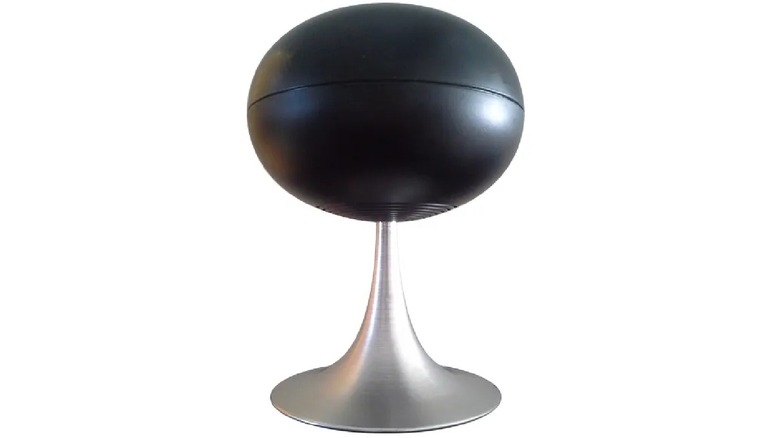
Back in the '70s, RadioShack sold this charming yet bizarre Futura High Fidelity Speaker. This space-age gadget featured an orb-shaped speaker atop a narrow aluminum stem that flared into a circular base, almost like a trumpet. Through this acoustic suspension design, the Realistic Futura would provided what it called "futuristic" sound, with the round speaker emitting audio omnidirectionally and the sound then reflecting off the base in a 360-degree pattern, enabling it to fill an entire room.
What's particularly cool about this odd-looking speaker is that you can place it almost anywhere in a room. You could place it on a desk or table, or hang it on a wall or ceiling. Given it's more than 40 years old now, the Futura High Fidelity Speaker's audio quality likely wasn't as high as the spatial audio tech and Bluetooth speakers we have today, but it looks infinitely weirder and, therefore, more interesting.
Refrigerator Pig

If you wanted to feel guilty about grabbing a late night snack in the '80s and '90s, you could pick up a Refrigerator Pig from RadioShack. This novelty, pig-shaped gadget would sit on a shelf in your refrigerator and oink at you when you opened the fridge door, deterring you from snacking. The Refrigerator Pig was light-activated, with an internal light-sensor switch triggered by turning its tail. So, if placed correctly, the rubber pig would be directly exposed to light when you opened the fridge and therefore oink.
This is very much a gadget of its time. In the '80s and '90s, diet culture was at its peak, with body shaming mainstream, at-home workout videos a cultural phenomenon, and new fad diets popping up constantly. Fortunately, nowadays we're more focused on body positivity and wellness. So, you can ignore that judgemental pig and have that PB&J sandwich or slice of cake.
Armatron
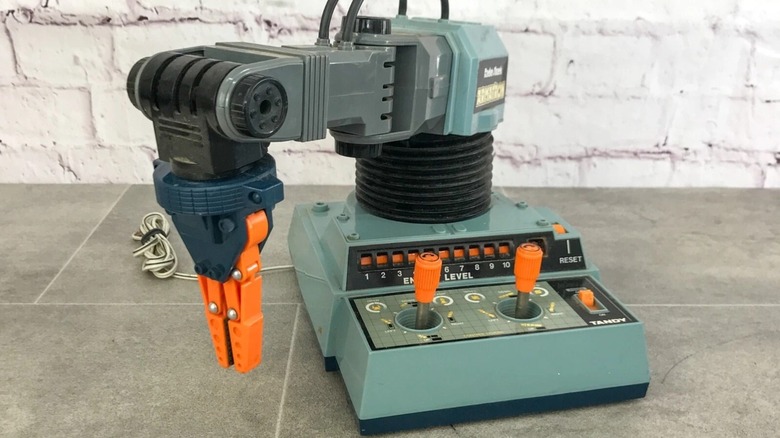
Made by TOMY and distributed by RadioShack, Armatron is one of the most iconic RadioShack gadgets of all time, as well as one of the weirdest gadgets made in the '80s. This toy robot first hit shelves in 1984 and featured a crane-like arm you could control with a set of joysticks, with six degrees of freedom that let you manipulate its 'wrist,' 'elbow,' 'shoulder,' and pincer-like 'fingers'. As such, you could use the Armatron to pick up small objects and move them from place to place with impressive dexterity and accuracy. While this may sound somewhat dull in a modern context, you could easily lose hours to this robot toy, while simultaneously improving.
While Armatron may have looked like a weird electrical gadget, its design was much more complex. The toy was primarily mechanical, with no automation inside. Although it featured a compartment for a pair of D batteries, a three-bolt DC motor, and a switch, gear trains and mechanical transmissions controlled its functions. Today, the Amatron is credited with inspiring modern robotics and a generation of engineers.
Realistic Portavision TV Boombox
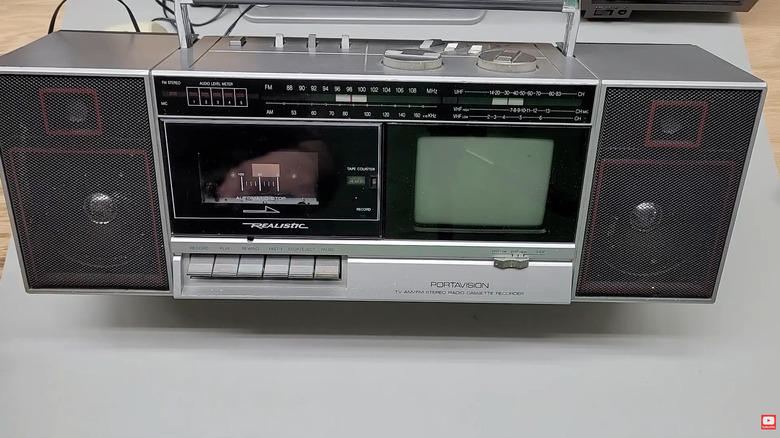
Back in 1987, phones and TVs didn't function like all-in-one entertainment systems as they do today. Instead, you had to rely on the Realistic Portavision TV Boombox, which combined a 4.5-inch black-and-white CRT TV, an AM/FM stereo, and an audio cassette recorder into one weird portable package.
This entertainment system ran on batteries and featured two mics, a cassette recorder that could record from the built-in TV or radio, dual two-way speakers, an antenna, headphone jack, a five-segment LED audio output level meter, separate tuning controls for the radio and TV, and more. But this gadget didn't come cheap, costing $219 (around $645 in 2026).
RadioShack has offered variations of this Portavision all-in-one system over the years, including a suitably colorful '90s edition. While these combination systems died off for a few decades, they may be making a comeback, as Panasonic showcased its equally bizarre concept for a boombox/CD player/portable TV in early 2026.
CueCat
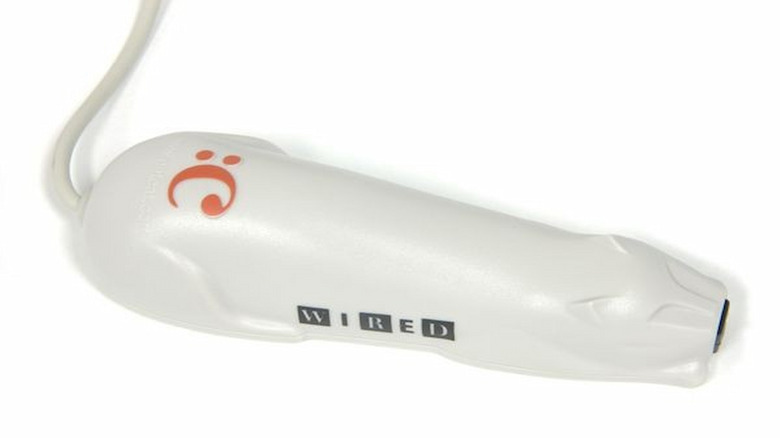
In the late '90s, the Texas-based Digital Convergence Corporation came up with the idea of creating a gadget that would bridge the gap between print media and the digital world. The company designed and developed the CueCat, a cat-shaped device that connected to computers via a keyboard port and let users access an internet URL by scanning a special barcode.
After receiving a total of $205 million in investment from several companies, including RadioShack, Coca-Cola, and Belo Corporation, mass distribution of the CueCat began in 2000. RadioShack, alongside Wired and Forbes, gave away the gadget for free in stores and featured scannable CueCat barcodes in its product catalogs. Over 10 million CueCats were manufactured, including USB versions, but the gadget faced heavy criticism, with users and experts pointing out that the cumbersome gadget aimed to solve a problem that didn't actually exist at the time. Ultimately, CueCat failed.
While the cat-shaped gadget is considered one of the worst inventions of the '00s, it's also credited with laying the conceptual groundwork for modern QR codes.