

Does It Matter How Long An Ethernet Cable Is?
We may receive a commission on purchases made from links.
We spend most of our days online, so any hitch in connection quality can send us into total overdrive. So after a while, everyone starts experimenting with ways to boost download speeds. More often than not, the result of each of these side-quests is realizing that for the best quality and reliability, you should switch to a wired, old-school Ethernet. You may even begin to wonder if anything in the chain, like the wire length, is in any way impeding your connection. Signal degradation with longer cables is a known fact, whether it's audio cables or HDMI cables over 50 feet. Does the same apply to your Ethernet cable too?
The short answer, and one without nuance at that, is yes, cable length does play a role in the strength of your connection. It's pure physics: as the signal travels through wires, it slowly degrades as its amplitude drops with distance. However, in most cases, this is only a concern for those running cables to the extreme. What constitutes extreme is in the eye of the beholder, but with your regular Cat5e and Cat6, you're good if your cable length is anywhere under 320 feet.
To be safe, keep the cable around 100 feet. YouTube creator Landpet tested a variety of Cat5e Ethernet cable lengths, and while it wasn't a controlled experiment, the creator noticed first signs of signal loss after connecting cables longer than 100 feet. It's better to be safe than sorry, and it's not like you need a Boeing 737's wingspan-worth of cable, right?
What you should check about the Ethernet
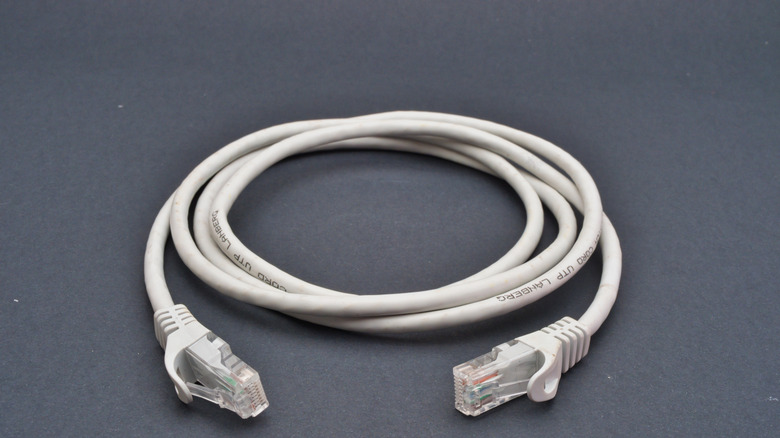
Now that you've confirmed you're safe because your Ethernet cable is no longer than a football pitch, what else could be hypothetically ruining your connection quality? First, if your Ethernet cable is something you found in a cupboard where you stash things you swore you'd use later, that may be it. Believe it or not, cable technology has progressed in the last few years, with the latest consumer standard being the Cat6. You could technically get by with a Cat5e, but the newer one has higher bandwidth and much thicker conductors, so it's more dependable.
You should also check for signs of damage. Even a tiny bit of fraying, from, say, a table, could cost you megabytes. The same goes for the connectors: if it's bent, it's time to replace it. Go to the hardware store and ask for an RJ45 connector, or simply replace the entire cable to avoid the hassle of swapping out connectors. You can get a high-quality, 50-foot, Cat6 Ethernet cable on Amazon for as little as $15.
Other than that, enjoy your internet. Ethernet connections aren't rocket science, and as long as you don't push things too far or rely on cables that are old enough for school, you're good. What's more important to you: saving $15 by insisting the cable is still good, or having the best internet possible?