

Why Are Chromebooks So Much Cheaper Than Googlebooks?
Remember those Chromebooks you or your kid were handed back at school? Old news. Maybe you were able to upcycle them, maybe you weren't. Either way, Chromebooks are gone, and remaining supplies are being sold off, some for below even $50.
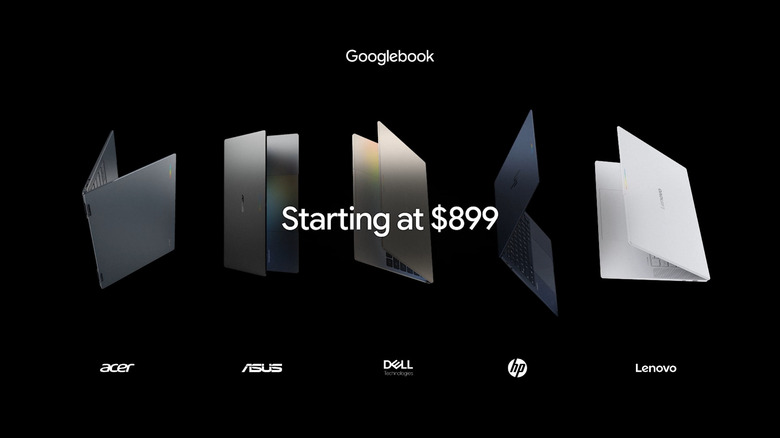
In their place, we have entered the era of the Googlebook, a new series of Google-powered laptops that still run the Chromebook's ChromeOS, but have extra features for AI. Those changes included more powerful processors and 16GB of RAM, which was at least twice as much as most well-reviewed Chromebooks before. There is also now an added suite of continuity features that allow Android users to more easily connect with their lapto... sorry, Googlebook. The tech giant also added integrated AI-powered Gemini Intelligence tools with smart speech-to-text, the ability to interact with apps through an AI prompt, and improved photo editing.
These Googlebooks start at $899 and are a far cry from the more basic $200 to $300 Chromebooks, which often came with just with 4GB of RAM and 128GB or less of storage. In terms of processing power, Googlebooks include a last-gen Snapdragon X Elite from Qualcomm and the latest third-gen Intel Core Ultra 5, both if which are beefy chips for relatively low-budget computers. Google also gives Googlebook buyers a complimentary year-long subscription to its Google AI Pro plan with 5TB of storage and access to other Gemini features, which Google values at $240. The company also offers free trials to services like Nvidia GeForce Now, YouTube Premium, and several Adobe Creative Cloud apps with a reported redemption value of $350.
Googlebooks have (almost) always existed
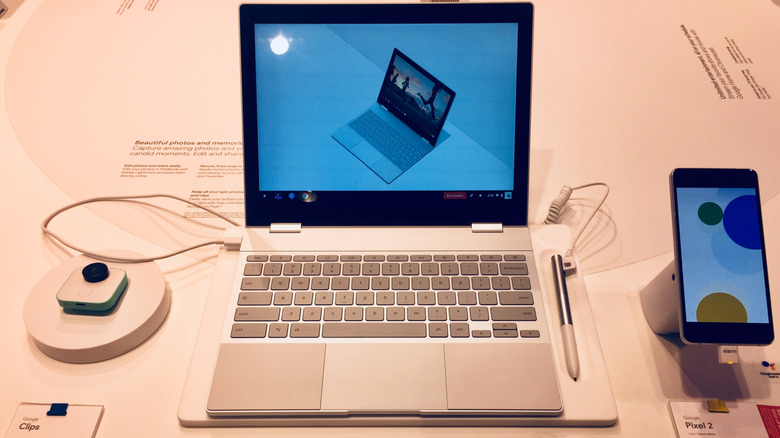
Chromebooks started as internet-focused machines without the hassle or price of their competitors. That typically meant the devices were made with lower-quality screens, flimsy keyboards, and plastic cases. Still, there's always been a flagship hanging around. In 2013, Google released the Chromebook Pixel, a $1,300 laptop described by then-Android SVP, now-CEO of Google Sundar Pichai as a "labor of love" from its engineers. It got an updated design in 2015 and was then replaced in 2017 by the $1,000 Pixelbook, the $1,000 Pixel Slate of 2018, and then the $649 Pixelbook Go in 2019. All of them carried spiffy displays and optionally powerful silicon, catering to the tech-savvy needs of Android and ChromeOS devotees.
Google's self-sustained premium scene for Chromebooks then went quiet for a few years before the company decided to coordinate an attempt to elevate the product category with its 2023 Chromebook Plus initiative. For $400 to $800, buyers could pick up a notebook from Asus, Acer, Lenovo, and other partners with 12th-gen Intel Core i3 or AMD Ryzen 7000-series chips, 8GB of RAM, and at least 128GB of storage. When the bulk of Chromebooks sold during the pandemic still had screens with 1366×768 resolution and webcams that were nominally 720p, Chromebook Plus bumped standards up to 1080p on both fronts. The company even offered its free subscription gravy train for Plus buyers, too.
As manufacturers follow on from Chromebook Plus and buy into the Googlebook program, we could be seeing the best-furnished foundation to morph the image of the humble ChromeOS laptop away from its cheap fleet past. But it's doing that at a tough time, when worldwide energy disruptions and manufacturing demand have created economic uncertainty. Google will also be going up against Apple's $700 MacBook Neo, one of its cheapest-ever computers, bucking the trend of higher prices. So the question facing Google won't be so much about technology, but instead whether people will be willing to pay more than they were used to.