

What The 'EAC' On Your Electronics Actually Means
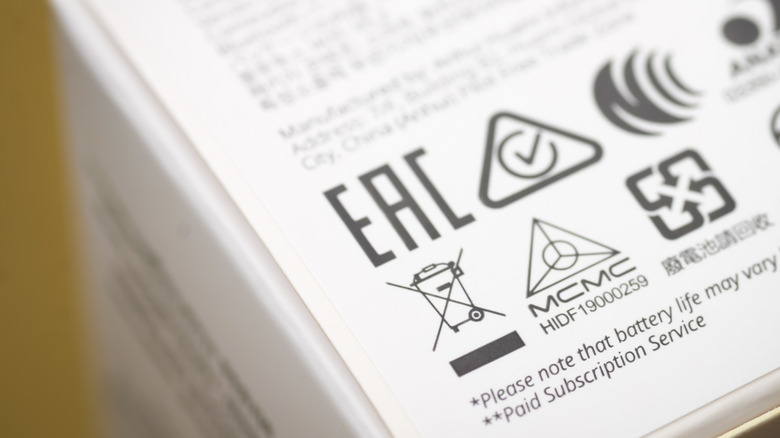
If you take a close look at your electronics, you'll spot various symbols, usually hidden somewhere on the back. One of these may be "EAC" spelled out in blocky, elongated letters. This is an example of a product certification mark, and on technology devices, they are meant to assure consumers that a given product has been tested and found to be safe and reliable. These marks are issued by third-party organizations like governments, which require manufacturers to have products certified before they can be legally imported, marketed, or sold in a given market.
In the case of EAC, the mark is an abbreviation of Eurasian Conformity (EAC). It's issued by the Eurasian Customs Union (EAEU), a trade organization made up of five post-Soviet states: Armenia, Belarus, Kazakhstan, Kyrgyzstan, and Russia.
As with other product certification marks, the EAEU has specific rules on how the EAC mark may be used and displayed. The logo has to be at least five millimeters in size and adhere to the set font and proportions. It also has to be included on the product itself (or a label on the product) and somewhere on the packaging.
Which products need a certification mark?
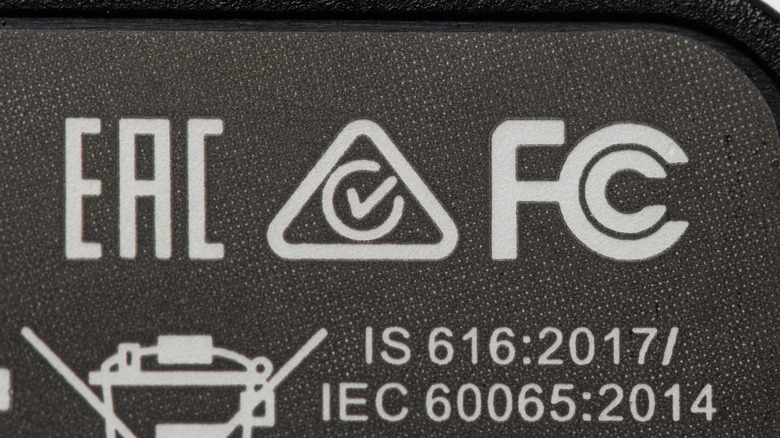
You can spot product certification marks on tech of all kinds, from video game controllers to robot vacuums, though some foreign vacuum models are now subject to a Federal Communications Commission (FCC) ban. Depending on what country you're in, you might see certifications on non-tech products like toys, furniture, and measuring equipment. Specifically regarding the EAC mark, the EAEU requires it to be included on clothing, cosmetics, wine, and more. Similarly, the European Union's CE and Great Britain's UKCA marks are required on anything associated with health, safety, or environmental regulations.
Of course, product certification marks that come from government agencies are regional, so if you're in the United States, you'll most likely see the Federal Communications Commission (FCC) logo along with the European and British ones. Furthermore, you might not see the EAC mark on newer electronics. Over 1,000 companies pulled out of the Russian market starting in early 2022, around the start of the war in Ukraine, and many continue to uphold their bans or suspensions. These include Apple and Nintendo, though devices like iPhones still sell through a sort of gray market that allows some products to be imported without the permission of the trademark owner.
Additionally, though product certification marks aren't required or enforceable abroad, in a way, they can impact internationally-made products. A perfect example is Apple finally eliminating its Lightning port to comply with an EU mandate that requires various devices like smartphones to use USB-C. Without that change, new iPhones would not be able to obtain the EC mark, effectively banning Apple phones from the entire European market.