

Do Electric Vehicles Use Liquid Cooling For Their Batteries?
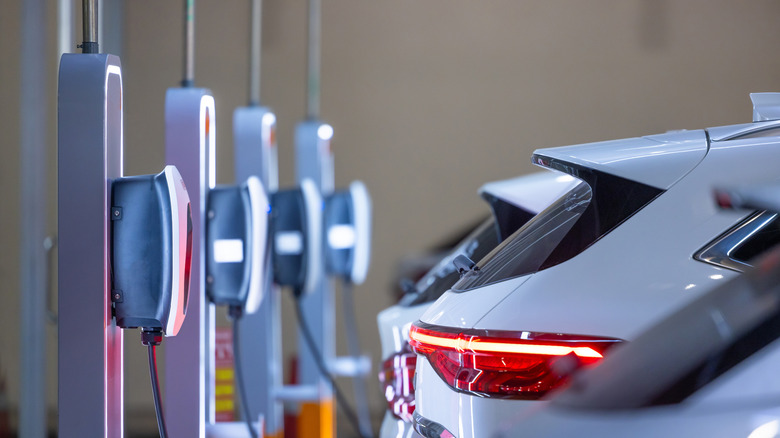
If you've been keeping up with the EV industry, there's an arms race of sorts to see who can produce better batteries, since they're the heart of how EVs operate. Sure, developments of a more efficient sodium-ion battery or the first solid state EV battery are both exciting, but until these become widespread, we have to make do with what we have available — and that's the good old Li-ion. But there's a catch: have you noticed how your phone battery heats up when it's connected to a charger? Well, the same principle applies to electric vehicles and EV batteries, only on a much larger scale. More size equals more heat released during both charging and discharging, and as such, the batteries in an EV require dedicated cooling. So, do electric vehicles use liquid cooling?
Some do. Just like computers can be cooled with liquid or air, so can EV batteries. For instance, the simplest cooling method is using air from outside the car to vent the battery. However, just letting in natural air passively isn't enough. Active air cooling is a superior choice and works much better because it sucks in the air from the existing HVAC system.
That said, in the 2010s, more and more electric vehicles started using liquid to cool the battery, a prime example being the Ford Focus Electric from 2011 with a 23 kWh liquid-cooled battery. Why? Efficiency, and more importantly, avoiding the battery going into the redline. If the battery temperature increases to unhealthy levels, so does the thermal runaway risk, which can cause the battery to go boom.
How does liquid cooling in EVs work

Broadly speaking, liquid cooling relies on either water or a liquid coolant such as ethylene glycol. The system employs tubes and plates surrounding the cells of the battery. As the coolant flows through these channels, it absorbs heat and expels it elsewhere, most commonly to a radiator. Naturally, since an active liquid cooling loop requires a bunch of parts like a radiator, fans, and pumps, it's much more expensive than having a single vent that carries in outside air.
This type is the most popular, and is employed by the likes of Tesla. Still, there are other liquid cooling systems that dial up the complexity by a notch or two. A good example is swapping out the glycol coolant for a refrigerant and putting in an evaporator on the battery cells, which technically turns the battery cooling system into a small HVAC. Alternatively, some manufacturers directly cool the cells through immersion cooling: think submerging the cells in liquid.
While a definite improvement over air cooling, liquid does have its own set of challenges. Leaks can happen, and as the system ages, the pipes can corrode, and so can the cold plates. If one of the channels gets clogged, the battery could develop hot spots. Proper maintenance can eliminate the risk of this happening, but there are those who believe a full immersion cooling rig is more effective and robust, and can even work well if the pump fails. Nonetheless, that one's a bit more niche compared to the system that Tesla is using.
What EVs use liquid cooling?
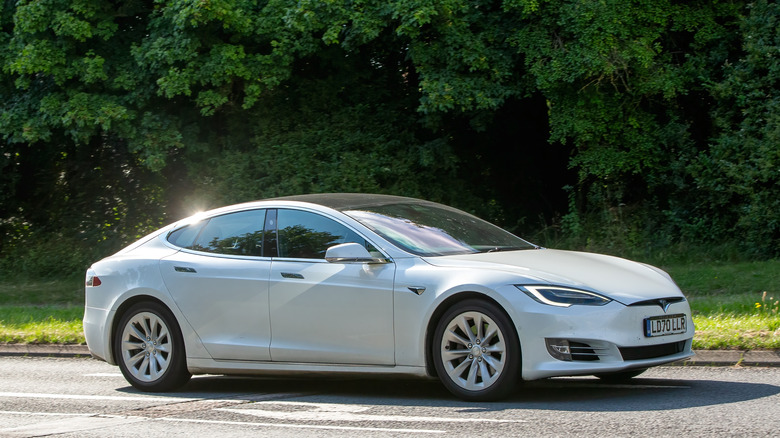
Fortunately, you won't need to look far to find a car that relies on liquid cooling, since it's the most widely-used method. Chalk it up to battery prices dropping, but manufacturers are no longer forced to cut costs by going with a simple air-cooled system. This doesn't mean it's completely disappeared, as the Nissan Leaf (which the manufacturer has heavily iterated on) and the Volkswagen eGolf are popular cars that use active air cooling.
As mentioned, the Tesla Model S, which contributed to the brand becoming the most satisfying to drive, relies on a water/glycol mixture for keeping its battery cool, and so does the Chevrolet Volt. If you want a system with a refrigerant, then the BMW i3 is the prime choice. The most premium option is one that goes for immersion cooling.
McLaren Speedtail, a hybrid sports machine that can hit 205 mph, cools its battery pack with hydrocarbon-based oil, and you can get it for the low price of around $2 million. If you're rich and seeking adrenaline, go for it, but for most drivers, the Tesla Model S will likely suffice. If longevity is a concern, more mechanics are probably familiar with servicing Tesla's cooling system than they are fixing problems with a $2 million McLaren.