

The Oil Crisis Could Be Exactly What Tesla EV Semi-Trucks Need To Succeed
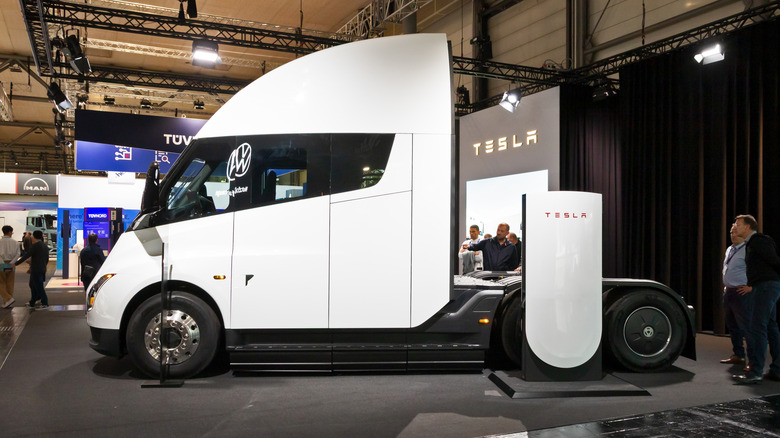
You've probably heard the news about gas reaching astronomical prices. According to AAA, the average cost to pump gas is around $4.41 per gallon, but that's just when you fill the tank with regular. If you drive a heavy-duty truck, you need diesel, which currently costs an average of $6.39 per gallon. Some semi-truck manufacturers are switching to hybrid options, but Tesla execs believe this crisis could produce a windfall for one of the company's newer ventures.
The Tesla Semi, the oh-so-creatively-named semi-truck of the Tesla line, was revealed in 2017. Elon Musk promised production would start in 2019, but reality didn't unfold that way. However, as of September 24, 2026, Musk announced (via 13 posts on X) that his company is finally rolling out the trucks. One of his talking points was the Semi's economic viability: Musk stated that the "cost of electricity per mile" is way cheaper than the cost of diesel. Even though power bills are increasing due to AI data centers, the cost of electricity hasn't jumped anywhere near as much as diesel. But don't just take Musk's word for it.
According to the outlet Axios, the CEO of Forum Mobility (a logistics company that leases electric trucks and operates their charging depots), Matt LeDucq, stated that the Tesla Semi "has changed everything." He claimed the operating costs of the truck are significantly cheaper than alternatives. Plus, 25 carriers have allegedly reserved over 330 Semis from a single depot in California. For the sake of comparison, only around 200 Semis are currently in service. These numbers potentially bode well for the truck's future, or at least the potential for electric trucks to replace diesel-powered haulers.
Energy and cost efficiency aren't the only hooks
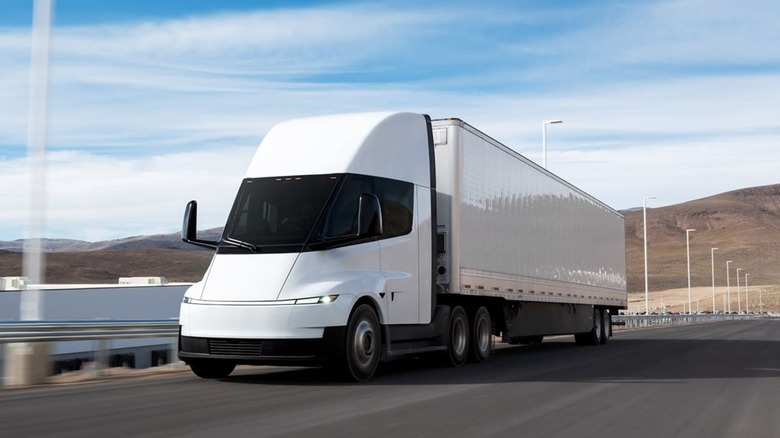
Electric vehicles are notoriously expensive in the short run when compared to their gas-powered analogs. However, EVs are often cheaper than gas cars in the long run because the cost of electricity is generally more stable than gas. The Semi might help demonstrate this fact, but it isn't the truck's only selling point.
While the Semi's production has begun several years after Elon Musk's initial promise, Tesla hasn't been sitting idly by; according to Musk, the company has been hard at work redesigning the Semi — and its manufacturing process — to be more reliable and "more manufacturable," whatever that means. Some of these alleged improvements include a steel-caged rotor that is cheaper and more efficient than carbon fiber alternatives, a fully electric steering system that lacks any hydraulic components, and a new heat pump that handles cabin HVAC and powertrain management by recycling engine heat. Here's hoping some upgrades finally provide the big range that Tesla promised for the Semi.
Additionally, according to Musk's various posts, Tesla built an entire factory dedicated to the Semi. This downright behemoth of a building spans 1.8 million square feet and is expected to churn out 50,000 units each year. All Semis will be built there, including ones designed for the European market (which require their own unique specs). Moreover, according to Musk, this factory will decrease manufacturing costs (and presumably time) by implementing "vertical integration." Not only will this factory assemble the Semis, it will also manufacture all of the components — from drive axles to seats — in a veritable farm-to-table fashion. Even if the Semi doesn't prove as successful as Musk wants, perhaps the vertical integration plan could prove fruitful for future manufacturers and industries.