

Why SpaceX Wants To Catch Starship Instead Of Giving It Landing Legs
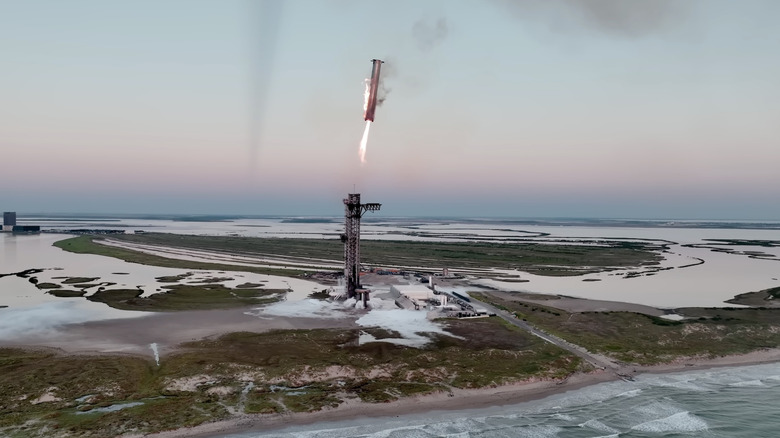
Anyone with even a passing interest in rocketry has probably marveled many times at SpaceX's upright landing of its first stage Falcon 9 rocket minutes after delivering a payload into orbit. The American spaceflight company first performed the feat in 2015 and has done it more than 600 times since, enabling it to reuse the same boosters over and over again. SpaceX engineers have applied what it's learned from the autonomous booster landings to its next-generation and much larger Starship rocket, but the process involves some important differences.
Instead of following the Falcon 9 plan and using landing legs for a touchdown on the ground or a droneship stationed in the ocean, SpaceX has adopted a new design that uses giant mechanical arms on the Starship's launch tower to catch the returning first-stage booster, called the Super Heavy, before it touches the ground. Although you may wonder why it didn't simply emulate the tried-and-tested Falcon 9 leg-based landing, SpaceX has good reasons for taking a different approach.
For starters, building the Starship without landing legs reduces the vehicle's overall weight, allowing for bigger crews, heavier cargo, or more fuel. For a rocket like the Starship that's designed to lift more than 100 tons of cargo, even small savings in mass can pave the way for more payload and improve launch efficiency. It also wants to make the Starship a quickly reusable rocket that can be caught at the launch tower before being inspected and prepared for another flight without having to be transported to a separate facility, as is the case with the Falcon 9. SpaceX said the ultimate goal is to enable airline-like operations with multiple launches of the same first-stage booster per day. And there are some very good reasons for this highly ambitious plan.
SpaceX's bold plans for the Starship
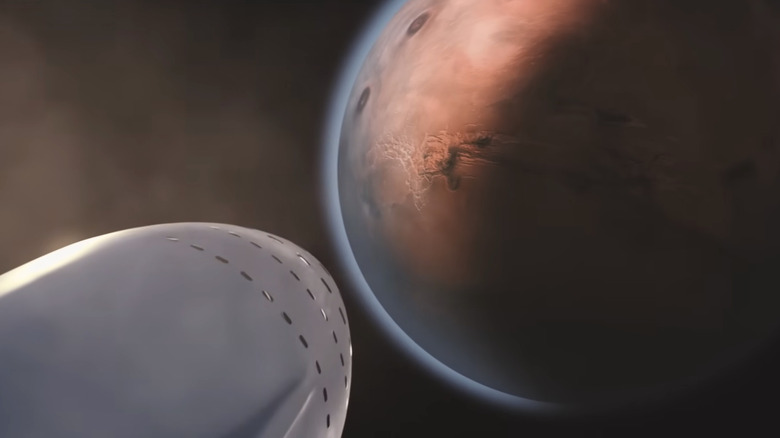
For more than two decades, SpaceX CEO Elon Musk has spoken often of his desire to build a sustainable city on Mars as a way to protect life should something catastrophic happen on Earth. When the first Starship rocket launched in April 2023, Musk's dream of sending humans to the red planet edged closer, despite the flight lasting only a matter of minutes. That's because it's the Starship that Musk wants to use to send people, building materials, and other cargo all the way to Mars.
Launch windows to the red planet open every 26 months or so, with each one lasting several weeks. During those opportunities, SpaceX wants to launch multiple Starship rockets — comprising the first-stage Super Heavy and upper-stage Ship — laden with cargo and crew for Mars. The process would involve launching a Super Heavy and a Ship, followed by additional tanker Ships that would refuel the Mars-bound vehicle in orbit. Once fueled, the Ship could begin its voyage to the red planet, with the Super Heavy returning to the launch tower for refueling ahead of another launch. The process could be repeated multiple times in a matter of days by multiple Super Heavy boosters and launch towers, sending huge amounts of material and, eventually, people, to Mars.
Musk has also spoken of using the Starship for super-fast suborbital passenger and cargo flights between major cities, cutting most long-haul trips to under an hour. It means that international routes like New York to Paris could be completed in around 30 minutes instead of the current seven or eight hours. Again, the Starship would launch as it does now, before coasting on a high suborbital arc before arriving at a destination upright and being caught at a specially built tower.
It may be a long wait
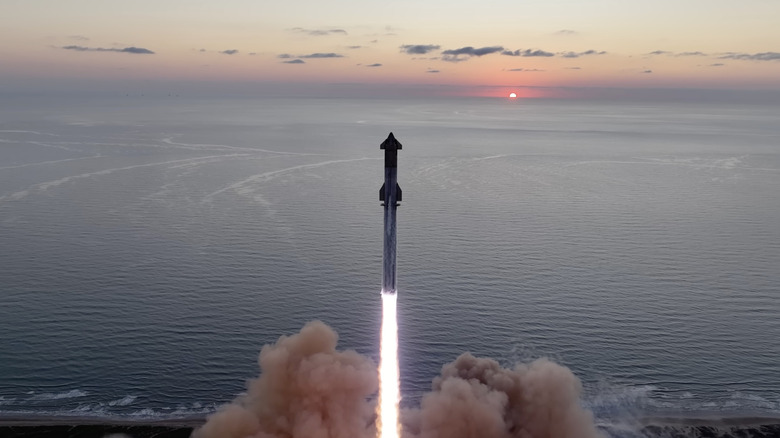
The challenges to make either of Musk's plans a reality are huge. Numerous target dates set by the SpaceX chief for the first human flight to Mars have come and gone. The Starship remains in testing, too, with many milestones still to be achieved, including having the upper-stage Ship land on another celestial body, as well as back on Earth following an orbital flight. Beyond developing a vehicle capable of making the voyage to and from Mars reliable, long-duration life-support systems also need to be built, tested, and certified. NASA, meanwhile, is developing technologies that it says could enable human missions to Mars sometime in the 2030s. But even if it achieves that goal, a sustainable colony there still feels like it's many decades away. With that in mind, Musk has now proposed setting up a colony on the moon first.
As for suborbital passenger and cargo flights around Earth, the idea is technically possible but still needs plenty of development. Again, the Starship is still being tested and has many hurdles to overcome before it becomes operational. The safety of Starship flights over populated areas has to be assured, and the impact of sonic booms and numerous rocket flights must also be considered. The system would have to be economically viable, too, with expensive infrastructure for launch, landing, and maintenance needed at each Starship destination.
SpaceX has shown that it can fly and land the Starship, but these achievements seem like baby steps compared to the remaining work needed to reach its loftier goals. Still, the spaceflight company has come a long way since it arrived on the scene in 2002, so with continued effort, who knows what it will accomplish in the coming years.