

What Does EPG Mean On TVs?
Initialisms, acronyms, and other jargon pose an obstacle for people who are not in the know. For example, you know that TV stands for 'television,' but what about an LCN or PSIP. Do I need a new TV antenna for ATSC 3.0, and why do half of these terms only matter to people with antennas? With all the shorthand surrounding TV, it can be hard to decide where to begin. Let's start with our headline: an EPG is an Electronic Program Guide.
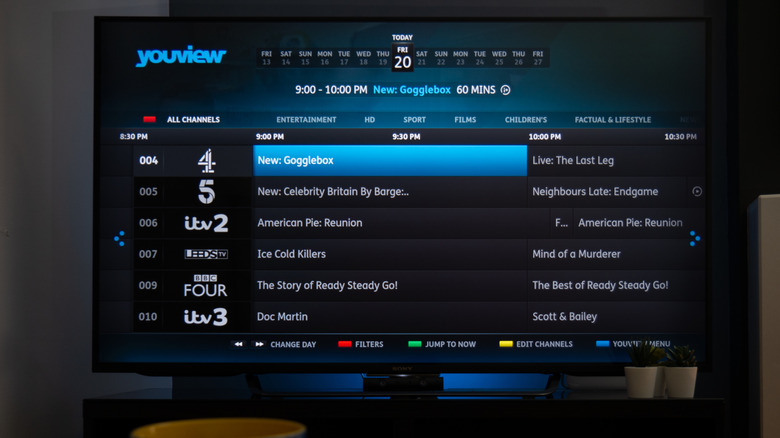
You may not remember picking up a "TV Guide" from the end of the checkout lane in the supermarket. But you might have seen a schedule generated by your smart TV, cable box, or webpage featuring all the stations viewable in your area along with channel numbers, program times, show descriptions, and content ratings. That's an EPG.
Sometimes you'll see the term IPG refer to guides with interactive elements, such as self-navigation or the ability to make Pay-Per-View purchases, but it's an obsolete distinction today. EPG listing providers like Nielsen-owned Gracenote are responsible for ingesting information from stations, networks, and MVPDs (oh, we'll get to those, too), and making sure they're aggregated and displayed correctly to viewers in different regions. This is just the tip of the TV acronym iceberg.
PSIP and LCN
TV channel numbers used to refer to specific bands of frequencies assigned by the Federal Communications Commission (FCC) that carried a signal's audio and visual streams from a transmitter over the air to a receiving antenna. Channel assignments were spread out across the country to ensure that the signal ranges of, say, channel 5 stations in different markets did not interfere with each other. At the turn of the century, stations signed on digital over-the-air (OTA) signals as part of the protracted slow roll to high-definition broadcasting.
However, those signals were on channels that did not correspond to the analog channel number that stations used to brand themselves. After all, channels are tied to frequencies and there's no way for analog and digital TV signals to share one set of frequencies concurrently. To cope with this, the television industry rallied around technical standards for digital broadcasting. Embedded within those standards is PSIP, or the Program and System Information Protocol, which dictates the structure of digital broadcast streams, including viewable channels as well as EPG-type metadata.
PSIP introduced the concept of virtual channel numbers, also called logical channel numbers or LCNs. Basically, a station on analog channel 5 that got assigned to digital channel 20 could remap their digital placement so that viewers with digital TV antennas could enter channel 5 on their remotes and watch the station known as channel 5. The protocol also set forth standards on channel multiplexing so that viewers could access multiple program streams from the same station.
ATSC 3.0
The development of television across the world was relatively slow. Experimental transmissions through the mid-1920s slowed in pace during The Great Depression. It was during World War II that radio and appliance companies coalesced to form the National Television Standards Committee (NTSC). The NTSC developed and published technical specifications for analog broadcasts in 1941, that informed the FCC on how to proceed with regulating TV airwaves.
North American broadcasters followed the standard along with a handful of adoptee regions across the globe that didn't take to the competing PAL and SECAM standards. The NTSC standard was amended for color output in 1953, at which point the industry began the move toward high-definition television and going digital. This led to the formation of the Advanced Television Systems Committee (ATSC) in 1982, while the 1995 ATSC spec laid a pathway for digital broadcasting that included guidelines for HD picture parameters.
Further iteration would come in 2018 with ATSC 3.0, dubbed NextGen TV by marketers. Its benefits, such as 4K HDR viewing at up to 120 frames per second, interactive program elements without the need for external equipment, and live reception on mobile phones have yet to reach most viewers thanks to slow turnover of equipment and content pipelines at the local and network levels. Speaking of high definition, we've got a deep dive on the meaning of HDMI as well.
MVPDs and FAST channels
In the days prior to cord cutting, cable TV operators provided a greater choice of viewing. Not so much today. The science of delivering TV over coaxial cable is fast becoming obsolete, while the term "cable company" already has. In the case of regional provider WOW!, it stopped offering TV packages in 2023, telling customers to plug their accounts into YouTube TV.
Whether we're talking about satellite, cable, or over the internet, many in the business now refer to pay TV operators as Multichannel Video Programming Distributors, or MVPDs. Players like YouTube TV and Sling TV who maintain less infrastructure and don't require special viewer-end equipment tend to be called virtual MVPD (vMVPD). At the same time, free ad-supported streaming television, or FAST, channels have started populating social media, smart TV interfaces, YouTube, and other free TV services like Tubi.
A FAST channel may be self-explanatory, but the business decisions that result in cable channels like Music Television (MTV) airing endless repeats of comedy clip show "Ridiculousness" don't apply here. Content owners can create channels based off of a niche genre or even a single series if they have a library deep enough. "The Price is Right: The Barker Era" and "The Price is Right" with Drew Carey are prime examples.
MTS, SAP, DVS, and AC-4
We've had plenty to watch, but let's talk now about sound. Parallel to the NTSC was another working group from the Electronic Industries Association, the Broadcast Television Systems Committee (BTSC) that brought stereophonic sound to the monophonic world of analog TV in 1984. The BTSC Multichannel Television Sound (MTS) system, which wound up incorporated into the NTSC standard, was able to utilize spare broadcast spectrum in each channel to run the mono and stereo service, a backchannel for professional use, and the Second Audio Program, or SAP.
TV remotes used different labels to access this channel. While some said SAP or MTS, others would use "Language" because an SAP often carried a second-language dub of a program. SAPs would sometimes carry an audio description stream — also known by its trade name of Descriptive Video Service (DVS) — which was pioneered by the Media Access Group at public media powerhouse GBH. Low-vision viewers could tap into a DVS and hear annotations to the existing soundtrack describing what was happening on screen.
In the digital era, ATSC uses Dolby compression technology to distribute simultaneous audio streams for a single program. ATSC 1.0 used Dolby Digital, more often referred to as Dolby Audio Codec 3, or AC-3, while ATSC 3.0 uses Dolby AC-4. The former brought 5.1 surround sound capability as its main improvement while the latter can pump through a 7.1.4 Dolby Atmos setup. For more on this front, we've taken a look at the differences between Dolby Digital and Dolby Digital Plus.