

4 Reasons To Buy The MacBook Neo Over The HP OmniBook 5
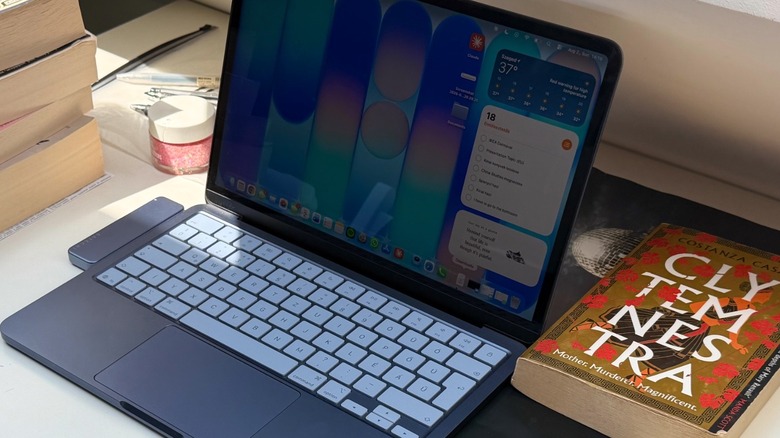
Since Apple introduced the MacBook Neo, Windows competitors have been working at full speed to bring competitive laptops to the same price range. While the memory crisis has caused Apple to raise prices for the MacBook Neo from $599 to $699, this laptop is still very enticing for everyday users, and this is why it made us wonder whether the HP OmniBook 5 could be the Windows equivalent of the MacBook Neo. Released this October, the OmniBook 5 shares somewhat similar specs with the Neo, which could make choosing between these laptops a difficult choice. However, if you're into the Apple ecosystem, then macOS integration, the Apple Silicon efficiency, and even a superior display might entice you to choose the MacBook Neo over the HP OmniBook 5.
While it's important to note that the MacBook Neo isn't for everybody, it can be the most budget-friendly option for those who want to experiment with macOS. Even though Apple keeps pushing for more powerful machines, such as the recently released Mac Studio with the M5 Ultra processor, or even the high-end MacBook Pro models, there's also a wide range of users who don't require that amount of power. They're satisfied with a computer that is comfortable enough for them to type for long periods, has a great battery life, and can easily integrate with other devices they have, such as a smartphone or tablet. With that background, here are some of the reasons you might want to buy the MacBook Neo over the HP OmniBook 5.
Apple Silicon efficiency

Apple chips are known for being efficient. Even though the OmniBook 5 processor can theoretically be faster than the one available on the MacBook Neo, the real-life story shows other important details. For example, this Windows laptop uses the Intel Core 5 320 chip, while the MacBook Neo uses Apple's A18 Pro. In multithreaded testing, the OmniBook surpasses the MacBook Neo, meaning it's slightly better at doing multiple tasks at once, though at least some tests have shown the Neo surpasses the HP laptop in single-threaded benchmarks. However, there's something important to take into account: Apple's A18 Pro is a lot more efficient, which means that it draws less battery power to perform its actions compared to its Intel counterpart.
With that, HP puts a fan inside the OmniBook 5 to ensure the laptop runs cool. Still, depending on the workload you might be trying to run, you might be able to hear the fan's noise, which was something common with Apple's Intel MacBook models. With the MacBook Neo, a fanless design means you'll never hear any noise from the computer. Evidently, Apple feels so confident about its laptop that, even though it offers similar benchmarks to HP's counterpart, it doesn't even need a fan to ensure the device is going to run cool. Still, it's important to note that if you try to take the MacBook Neo to its limits and it does start to heat up, the laptop will just start throttling until it cools down by itself, while the HP counterpart might sustain peak performance for longer.
Apple ecosystem integration
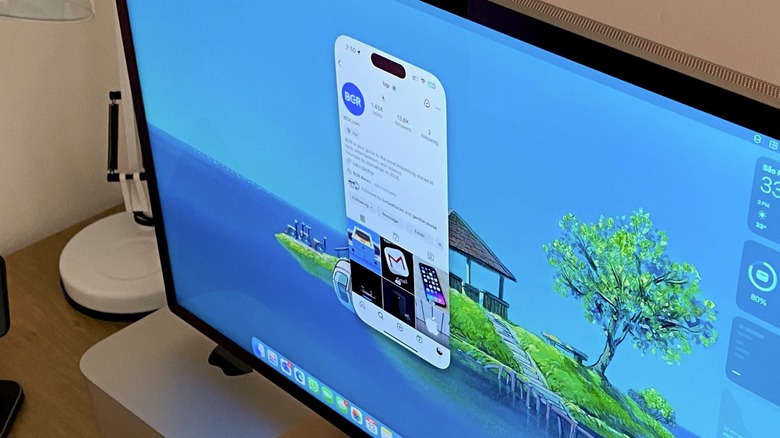
If you're an Apple user, meaning that you might have an iPhone, iPad, Apple Watch, and/or AirPods, then there's no better option than the MacBook Neo. After all, this laptop was made to be deeply integrated with Apple's platform, and ever since iOS 26 and macOS Tahoe, the company has been able to unify the design language between those products and offer even more combined features. That means, for example, that Mac users can control their iPhones using iPhone Mirroring, unlock the Mac whenever they have their Apple Watch on their wrist, use Sidecar to enable the iPad as a second screen for the Mac, and a lot more.
All told, the ecosystem integration between Apple devices is unbeatable. Users can copy text on the iPhone and, as long as they have their Mac on the same Wi-Fi, with Bluetooth on, and using the same Apple Account, they can paste the information on their computer. iCloud also helps sync everything in real time, including photos, messages, music, and more, while users can also instantly switch the audio output from the iPhone to the Mac using AirPods by simply starting to play a song on the Mac or starting to watch a YouTube video.
While Windows and Android competitors have been trying to narrow the gap between their devices to ensure a similar experience to what Apple offers, they still haven't really come near to achieving that. If you're looking for the type of integration you get with Apple products, a Windows laptop just won't deliver the same sort of seamless experience.
Brighter display
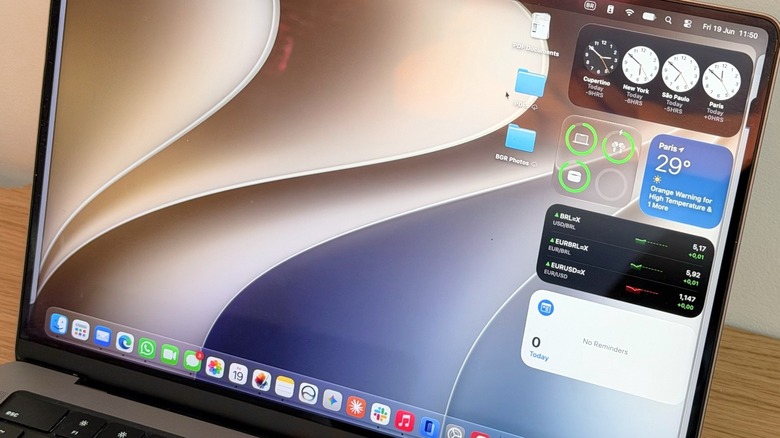
When a laptop manufacturer adds an OLED display to its product, it usually means we're talking about a high-end device, as an OLED panel can deliver colors that pop, deep black, and rich contrast. In other words, if we were to compare only the processing technology behind the OmniBook 5 and the MacBook Neo displays, it might be easier to just go with the OmniBook 5. However, the accompanying 14-inch, 2K panel has a few downsides. For example, a better, brighter display (up to 2.5K resolution and 620 nits) is coming, but you'll have to wait until March 2027 — and it most likely will come at a higher price.
Meanwhile, the LED-backlit display available with the MacBook Neo not only offers a higher resolution (2408 by 1506 pixels compared to 1920 by 1200 pixels for the OmniBook 5), but the maximum brightness of the Neo is 500 nits. Even though 500 nits isn't a lot, it's a lot more than the brightness available with the HP counterpart (300 nits), meaning that if you constantly use your laptop in outdoor environments. If you have a source of light (like a window) reflecting on your laptop display all the time, the HP might be challenging to see clearly.
Thanks to the better brightness and resolution, icons, text, and other information on the MacBook Neo display look sharper, because Apple's Retina Display requires a certain standard to run macOS. A Windows user might not call the OmniBook 5 display bad, exactly, but it's going to be relatively blurry compared to the Neo.
Higher resale value
Apple devices, in general, have a higher resale value than their Windows and Android counterparts. Various studies, as well as consumer experiences, show that MacBooks tend to retain a large portion of their value even a few years after launch. Even if you sell your MacBook after years and years of use, you're likely to get a higher resale value than if you were selling a Windows laptop with similar specs.
Of course, since the MacBook Neo was first released just a few months ago, it's unclear how its resale market will hold. Much of that will depend on how much Apple might offer for the first-generation in a trade for a second-generation model. The current official refurbished market for the MacBook Neo only shows that a model that retails for $799 sells for $679 in refurbished condition.
That puts a refurbished model at about 85% of the new sticker price, which means depreciation should not be much of an issue for the Neo. It's yet to be seen how the value of the OmniBook 5 will hold up over time, but that's a steep standard to measure to.