

SpaceXAI's Plan To Deal With Starlink Collisions Is Facing An International Obstacle
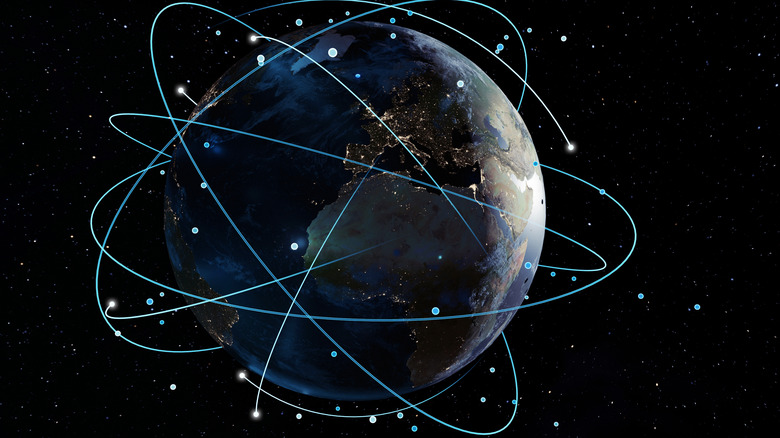
There are more than 18,000 satellite payloads floating in orbit as of 2026, and over 11,000 of those are active Starlink satellites operated by the U.S. company SpaceX — which is part of SpaceXSI. Satellites aren't the only thing that's up there, though. Back in 2025, NASA reported that there were more than 45,000 trackable man-made objects orbiting Earth. That's a lot of clutter, and it calls into question how rockets avoid hitting satellites during launch. Without international cooperation, it would be near impossible to prevent collisions between the increasing number of satellites up in orbit. Starlink satellites had to make over 355,000 collision avoidance maneuvers during the one-year period between May 2025 and May 2026. The problem is only going to get worse, but SpaceX has a plan.
Michael Nicolls, SpaceX's vice president for Starlink and president of AI at SpaceXSI, hosted a presentation at the 2026 International Astronautical Congress in Turkey, during which he called for international satellite operators to share their ephemeris data with the world. Ephemeris data describes a satellite's position, velocity, and trajectory. SpaceX already publishes ephemeris data for its Starlink satellites, but without other agencies doing the same, collision avoidance will continue to be a feat hindered by international obstacles.
Why won't other nations share satellite position data?
As part of his presentation, Nicolls shared a chart illustrating which countries are refusing to share ephemeris data. Chinese and Russian organizations seem to be particularly secretive, though there are some in the United States, Europe, and Japan that also refuse to share. While there's no official reason why certain satellite operators are so secretive about ephemeris data, it likely stems from political relations and the tense state of data protection policies between trade rivals.
However, there have been positive instances of countries working together to prevent disastrous satellite collisions. In October 2025, China and NASA cooperated to avoid a satellite collision for the first time ever. It's worth noting, however, that neither side shared more information with one another than was absolutely necessary during this incident. But with Chinese entities like SpaceSail planning to launch more than 10,000 of their own Starlink-style satellites, this type of cooperation will become absolutely crucial in the future.
SpaceX has proven to be a leader in the effort to improve satellite detection capabilities. The Stargaze situational awareness system by Starlink is making it possible to enhance the safety of low Earth orbit operations for every organization that manages technology there. The tracking capabilities of Stargaze may also help with eliminating space debris, which will be important as more satellites enter orbit — and more go out of commission with age.