

LG's Next-Gen OLED Displays Could Be As Big (Or Small) As You Want
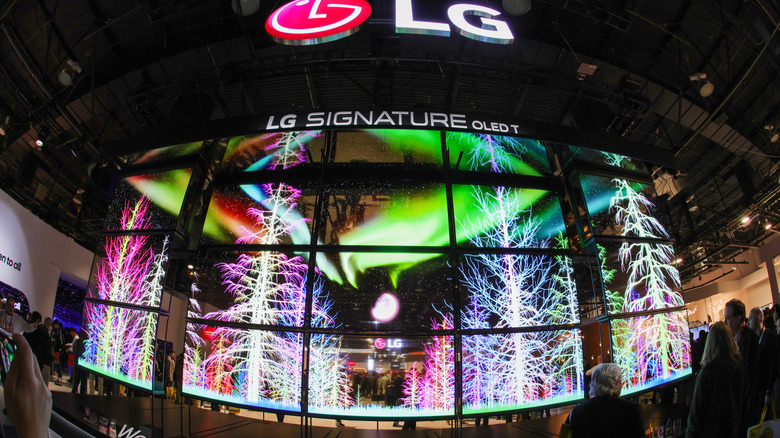
OLED (organic light-emitting diode) display technology is considered to be the highest-quality option for TVs and other screens. OLEDs are popular because of their excellent contrast, brightness levels, and color range. Several different kinds of OLED displays are in use nowadays, and they could all be seeing improvements before long. LG, one of the biggest manufacturers of OLED displays and panels, has announced a manufacturing technology for OLEDs called FLiPP, or FMM-Less innovative Pixel Patterning. One of FLiPP's key advantages is its ability to create panels that range from 1 to 100 inches in size. By comparison, the FMM (fine metal mask) manufacturing technique commonly in use today adds weight, limits pixel size, and can cause sagging, which complicates using certain panel sizes.
LG claims that the FLiPP technology offers several other advantages over FMM, including creating panels that are 1.6 times brighter. The panels should last 2.4 times as long, too, according to the manufacturer, as long as the two types of displays are measured "under identical conditions." Additionally, the OLEDs manufactured using FLiPP should use 13% less power than those made using FMM. The OLED TV screen you already own was probably made by LG, as the company captured nearly half of the global OLED TV market in 2025. By incorporating FLiPP technology into new OLED screens, it may give the company an even larger share of that market.
How LG's FLiPP OLED manufacturing compares to FMM techniques
FMM has served as LG's primary manufacturing process for OLEDs for more than 10 years. However, the manufacturer's recent announcement indicates it will replace FMM with FLiPP. LG's first products manufactured using FLiPP are expected to appear in late 2027.
To create the pixels on an OLED using the FMM technique, the manufacturer would make millions of micron-sized holes in a thin metal mask. The mask ensures accuracy in the application of the red, green, and blue (RGB) light-emitting vapors that form the pixels of the OLED panel when placed on a glass substrate. Each time the manufacturer wants to change the size or resolution of the panel being made, though, it must create a new mask, leading to more time and money being spent. Additionally, even though the metal in the mask is thin, it still carries enough mass that the middle of larger panels can become slightly misshapen. This issue may affect the accuracy of the RGB pixel application.
By using FLiPP instead, OLED manufacturers can move beyond the need for a metal mask. Instead, the manufacturer adds the light-emitting vapors in a precise sequence and uses photolithography to ensure they fill in as much space as possible. This creates an accurate pattern of tightly packed RGB pixels. It potentially allows for non-standard aspect ratios or resolutions that some people would like to use with their screens.
How FLiPP delivers its advantages in OLED display panels
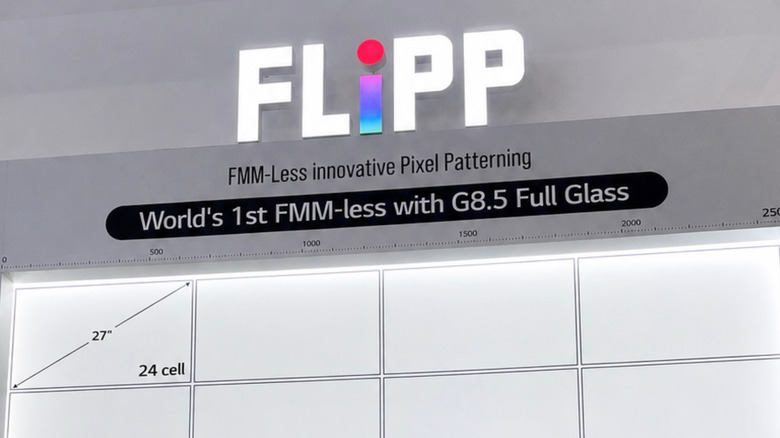
Being able to manufacture panels of multiple sizes in a cost-effective manner is a major advantage of using the FLiPP technique. Since manufacturers don't need to deal with the weight of the metal, extremely large panels should be possible. Without the mask, the FLiPP process also allows tightly packed pixels for a tiny screen.
FLiPP should eventually become the new standard for LG's OLEDs in a wide range of display sizes and types, including screens for tablets, computer monitors, smartwatches, televisions, and virtual reality (VR) and augmented reality (AR) headsets. Curved screens made using FLiPP that are brighter should remove some of the problems with glare and uncomfortable viewing with some of today's curved screens. Although LG mentions manufacturing TV sizes of up to 100 inches, the technology itself should not have restrictions on OLED screen sizes or resolutions.
If you're only interested in the brightest OLED displays you can buy, purchasing a screen manufactured using FLiPP technology should give you a noticeable jump in performance. By eliminating the metal mask, LG can apply the light-emitting vapors onto the glass substrate far closer together. The FLiPP technique should increase the amount of glass covered with the RGB pixels by 55% over the FMM technique, improving the quality of the display and accounting for the aforementioned 1.6x increase in brightness. In other words, the FLiPP technique allows the manufacturer to start using the area taken up by the FMM technique's mask by adding more light-emitting vapor material.