

What's The Difference Between LG And Samsung OLED TVs?
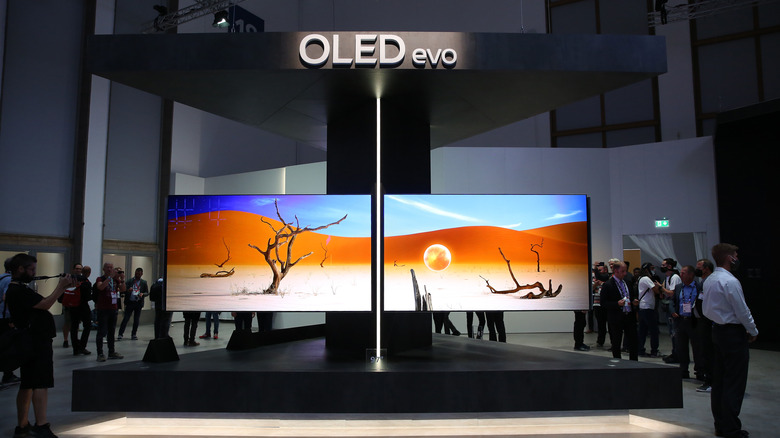
Although LG has been selling OLED TVs for years and its offerings are frequently among the best TVs, Samsung re-entered the segment after almost a decade-long hiatus in 2022. The company's OLED TVs have received a warm reception and also often find a place alongside LG OLEDs among Amazon best-sellers. However, despite both being referred to as OLED TVs, there are several big differences between LG and Samsung OLED TVs that set them apart. The most notable of these differences is in the OLED panel technology.
LG primarily relies on W-OLED panels; however, in some of its latest and most expensive models, it also uses RGB Tandem OLED panels, which are based on the traditional WOLED technology. Samsung uses QD-OLED, WOLED, and RGB Tandem OLED panels in its OLED TVs. The panel difference typically depends on the TV model as well as TV size. For example, in the company's 2026 lineup of OLED TVs, all sizes of S85H use a W-OLED panel, whereas the S95H has a QD-OLED panel in each size, except for the 85-inch model. The S90H leverages both WOLED and RGB Tandem OLED for different sizes. However, when Samsung restarted making OLED televisions, all models and sizes used QD-OLED panels. That said, each panel tech has its advantages and disadvantages.
Besides different panel techs, LG and Samsung OLED TVs have some feature disparities, particularly on the HDR front and how well each TV handles glare and reflections. Both manufacturers also use different smart TV platforms and have different software support periods.
WOLED vs. RGB Tandem OLED vs. QD-OLED
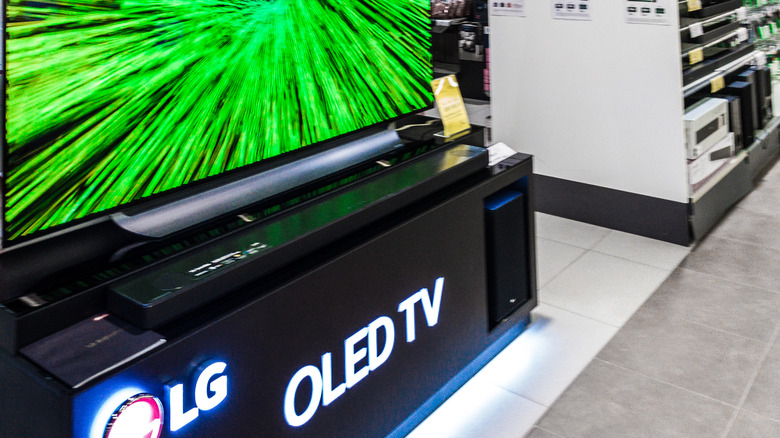
LG's WOLED panels typically have a white light source, created by layering blue and yellow OLED materials, with color filters. When the light is passed through the filters to convert it into red, green, and blue, the light intensity decreases. To account for this intensity loss and ensure you get a bright picture, LG adds an extra white sub-pixel. The extra white sub-pixel makes LG OLED TVs brighter, but it also impacts color accuracy, particularly in brighter scenes.
On the other hand, Samsung's QD-OLED panels use quantum dots to convert the colors. Quantum dots are more efficient in terms of color conversion. So, when the light produced by the blue OLED material goes through a layer of quantum dots, there is less loss of light intensity and more accurate colors. The result is a better color volume and wider color gamut than regular WOLED panels. Unfortunately, QD-OLEDs aren't as good as WOLEDs at maintaining black levels in a room with high ambient lighting. As QD-OLED panels lack a polarizer, blacks can look slightly purple in bright rooms.
The RGB Tandem OLED is newer than both WOLED and QD-OLED technologies. Tandem OLED panels have a four-stack design using layers of red, green, and blue OLED materials to produce white color, which is then passed through color filters, and a white sub-pixel is added, similar to regular WOLED panels. This results in higher brightness and a wider color gamut. However, a Tandem OLED panel's color accuracy and volume still fall behind QD-OLED panels. That said, regardless of the OLED panel used, both LG and Samsung OLED TVs have a near-infinite contrast ratio, wide viewing angles, and inky blacks, resulting in excellent picture quality.
HDR support and smart TV platforms
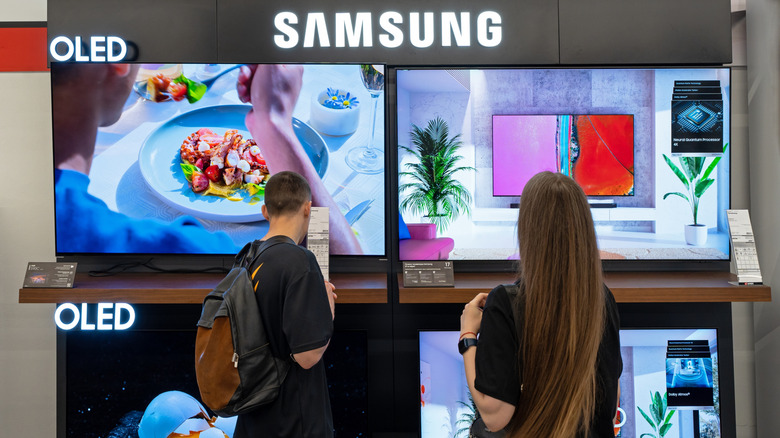
Apart from the OLED panel technology, another major distinction that you'll find between LG and Samsung OLED TVs is on the HDR front. While TVs from both manufacturers support HDR10, LG OLEDs come with support for Dolby Vision as well. Unfortunately, you won't find Dolby Vision on any Samsung TV, including OLED TVs; however, they do include HDR10+ support. Although both Dolby Vision and HDR10+ are dynamic HDR formats that leverage scene-by-scene or frame-by-frame optimizations, Dolby's offering is more popular, and you are likely to find it available on various streaming platforms and even games.
LG and Samsung OLED TVs also use different smart TV platforms. For example, you'll find webOS on LG TVs, whereas Samsung TVs come with Tizen and One UI. Both smart TV platforms give access to popular streaming services, cloud gaming services, and more. The difference is mostly in terms of the interface and how many software updates you'll get. While Samsung has promised to offer up to seven years of software updates for its AI-powered TV models released since 2024, as well as select 2023 models, LG is only providing up to five years of webOS updates for its OLED TVs starting from 2022.