

How Many Starlink Satellites Are In Orbit Today?

Look into the night sky at the right time, and you'll spot a glowing constellation of Starlink satellites steadily moving through low Earth orbit. If you didn't know any better, you might imagine them as otherworldly, appearing as a long, stretched-out line of synchronized yet individual blips. However, once you realize each one of those lights is a satellite, and then you realize there are multiple constellations floating around up there, it becomes blindingly evident that Starlink has a ton of hardware and technology in the sky.
Starlink says it has "over 6,750 satellites currently in orbit," but other estimates say there are between 10,061 (per Orbital Radar) and 11,102 (per Space.com) active Starlink satellites. KeepTrack lists 11,131 in orbit. Orbital Radar lists 10,061 as active, 902 as orbit-raising to reach their operational altitude, and 165 as currently de-orbiting because they've reached their end of life. It's a lot no matter which source you use. SpaceX also has regulatory approval for between 42,000 and 100,000 satellites as authorizations and future approvals are awarded.
What's most interesting is that not all Starlink satellites are orbiting in a single band or rotation; they're actually spread out across several rings, each with varying distances, referred to as orbital shells. There are actually over 18,000 satellite payloads in orbit, the rest of which are not SpaceX's hardware, alongside something like 45,000 trackable man-made objects or debris — space trash. As you might expect, all of that stuff floating around increases the risk of collisions and poses a threat to those active satellites.
Why does Starlink need so many satellites?
Before the first Starlink satellites launched in 2019, a total of 60 were sent up at once, when there were approximately 2,000 satellites in orbit. With SpaceX singlehandedly responsible for more than 11,000 new satellites, a fraction of what's eventually planned if it reaches 42,000 or beyond, the exponential climb in numbers seems almost ridiculous. In just 2025, there were 8,400. Why so many and why so fast?
Ultimately, it's because of how Starlink and the satellites are designed to work, or rather how they broadcast access to the world below. In terms of general performance, each active satellite can only handle a limited amount of bandwidth. Extra satellites mean better and more reliable coverage. In addition, as a satellite or constellation moves overhead, there's a range of wireless coverage available for the local area. In order to cover large, remote areas and wide expanses of the Earth, for longer periods of time, especially when Starlink satellites are positioned closer to the planet than traditional ones, you need more of them.
Then there's the matter of redundancies, in case of failures or complications, and satellites that fall out of range, collide with debris, or de-orbit. Starlink service is reliable according to most users, but outages are not unheard of. A clear sky with few obstructions is also needed on the ground, so the Earth-bound dish can communicate with the satellites overhead.
How many Starlink satellites have actually failed?
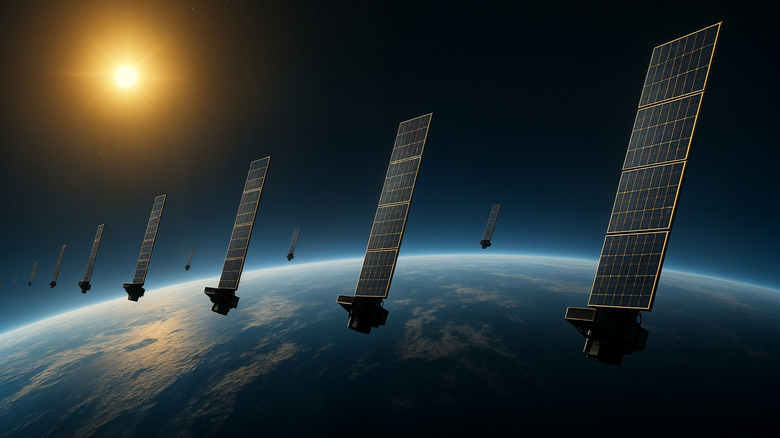
There are over 1,800 satellites that are no longer functioning, and hundreds of those have deorbited or fallen back to Earth. Starlink satellites actually have a five-year lifespan, and after their fuel runs out, they experience what's called orbital decay, which means they stop orbiting and return — they de-orbit. SpaceX safely sets them on a controlled collision course before they can no longer be controlled, avoiding random crashes, creating a danger — engineers aim for large open areas of water for that.
It also means that Starlink satellites are coming down quite often; some estimates claim as many as one or two satellites are plummeting back to Earth's atmosphere per day. SpaceX isn't the only company launching or planning to launch as many satellites either. Amazon Leo (previously Kuiper), OneWeb, and Lightspeed, along with the planned Qianfan and GuoWang Chinese telecom constellations, all have satellites either going into orbit or are already there.
So the sky is going to get very crowded, and as the expiration date of more satellites comes to pass, Starlink's variety included, we'll see more and more falling back to Earth. That could create all sorts of problems up there in low Earth orbit, like the potential for anthropogenic meteor showers and lots of pollution. Starlink satellites are largely designed to avoid other space debris, though. Between 2025 and 2026, many Starlink satellites carried out 40 avoidance maneuvers per year to weave around objects and other craft.