

YouTube Is Tackling A Big Problem With Music Transparency

Artificial intelligence is rapidly flooding streaming platforms, making it harder for listeners to know when content is AI-generated and not created entirely by a human. The problem is that it seems like the programs that write and perform tracks are becoming more sophisticated than the systems for detecting them, and it's blurring the line between art and the synthetic. Finally, though, YouTube stated that it is adding labels so you can see if a song was created by AI.
To combat the rise of synthetic music, the streaming giant announced it'll now start putting an "AI" badge on the Now Playing screen. This badge will be just below the song name for any track created mostly with generative AI, making it easy to spot. Tapping on the badge opens a small pop-up that gives you more context; this explains how this track was made with AI, either being partially altered by it or fully generated by it.
This transparency rollout is hitting the dedicated YouTube Music app soon, and is also coming to YouTube. To enforce these new transparency labels, Google says it will be using its own detection tools and, it says, teaming up with music partners to identify AI-made music. The new label is easily among some of the best YouTube Music features to know about.
How these labels will reshape the streaming landscape
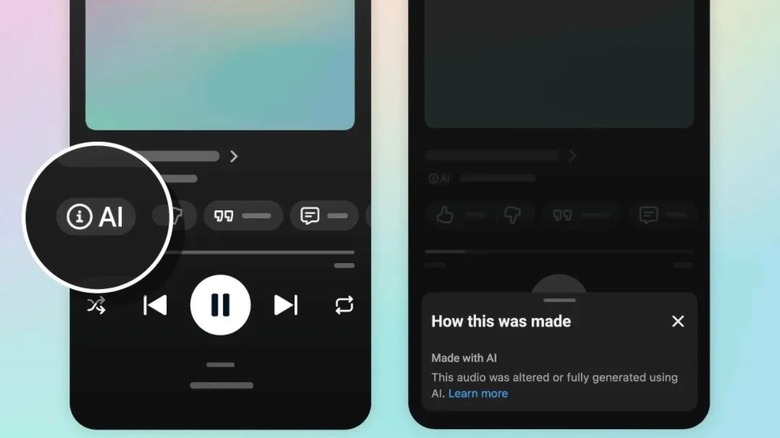
Although this update means you can stop guessing whether new artists are actually AI, it still notably lacks any actionable efforts. Unlike Deezer, which is testing a filter that'll let you completely remove fully AI-generated tracks from search results, YouTube's new badge is informational only. So if you don't want AI-generated songs messing with your algorithm, you have to do the heavy lifting yourself by manually skipping that song or giving a thumbs down to any AI tunes.
Unsurprisingly, the recording industry has been lobbying for things like these AI badges, as they're a way to fight against audio slop. Organizations like the Recording Industry Association of America have pushed hard for clear boundaries between fully synthetic tracks and AI-assisted human music. These transparency labels are a big step forward, but questions remain about enforcement and even industry payouts. Rival platform Tidal recently turned up the heat by saying it will both tag AI music and stop paying out royalties on it. YouTube adding an informative label is good, but really, it should match Tidal's approach to AI, as listeners should have the right to know about and control what's playing through their headphones.