

Starlink Vs. 5G Home Internet: The Cheaper One Might Actually Be Faster

Starlink is one of the fastest growing internet services on the market. Instead of relying on legacy technologies such as fiber-optic cables, Starlink runs off satellite communication, which gives it several advantages over regular home internet. According to the official Starlink website, the service provides comparatively faster internet speeds, but real-world testing disagrees with these claims.
Some people have put Starlink and 5G home internet through the ringer, and learned that despite costing anywhere between $30 and $130, Starlink has trouble competing with 5G services that cost $35 to $60 (less depending on your bundle). One person who performed such a test, tech YouTuber Nater Tater, used nothing more than the Speedtest and LibreQoS sites to prove this hypothesis. Specifically, he compared Starlink's Standard 4 kit, which is designed for home setup, to T-Mobile's 5G standalone and non-standalone networks (SA and NSA, respectively). And T-Mobile beat Starlink by a wide margin.
According to Nater Tater's findings, even though Starlink promises 400 Mbps download speeds, his setup barely managed 206 Mbps, with upload speeds at a comparatively glacial 18.4 Mbps. Meanwhile, T-Mobile blazed past Starlink with 368 Mbps download speeds for the NSA network and 406 Mbps for the SA. However, while T-Mobile's 5G NSA network managed a respectable 41 Mbps upload speed, the SA came in last place with barely 10 Mbps. However, Nater Tater promised that T-Mobile 5G SA's numbers were a glitch and a sign that he needs to call tech support. Still, the difference in numbers paints a pretty obvious picture: T-Mobile 5G is faster than Starlink and thus a better deal.
Your mileage (and geography) may vary
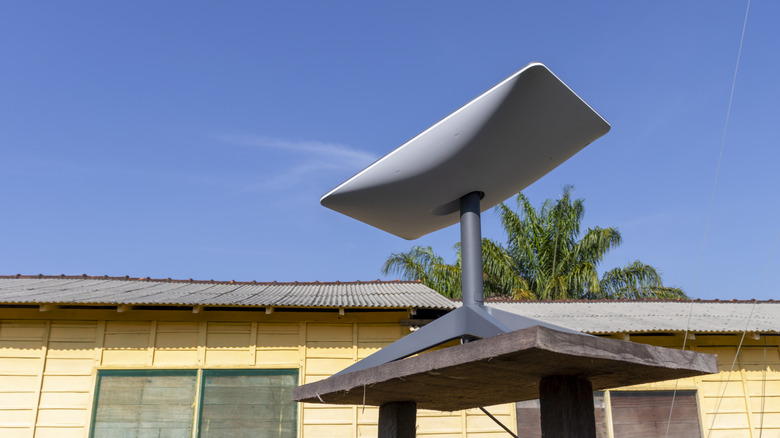
We honestly can't say we're too surprised T-Mobile 5G internet speeds eclipse Starlink's speeds. After all, T-Mobile is one of the best major internet providers available. However, speed isn't always everything in the world of internet communication. Assuming otherwise is a common mistake many people make when setting up wi-fi networks.
While T-Mobile won in the download and upload departments, Nater Tater discovered that Starlink provided superior ping (the time it takes for data to reach and return from a remote server). According to his data, Starlink's ping sat at 46 ms during idle periods and surprisingly decreased to 43 and 31 ms while downloading and uploading under heavy loads, respectively. Meanwhile, Nater Tater's T-Mobile 5G NSA ping was 39 ms while idle but jumped to 458 ms during heavy downloads and 317 ms during heavy uploads. The SA network's idle ping, meanwhile, was the fastest at 21 ms, and while its heavy download ping only increased to 226 ms, the heavy upload ping bloated to a whopping 1,469 ms. That's borderline unusable.
Given Starlink's more consistent ping numbers, the service is better suited for tasks such as online gaming and video calls. However, Starlink has one more advantage: reliability. T-Mobile is one of the few internet providers that's on par if not superior to Starlink, so if you use services like Cox or Frontier, your 5G connection probably won't outpace Starlink, especially if you pay for a cheaper package. Moreover, many people claim that Starlink stays connected even during adverse weather conditions that would knock out other internet services. Depending on where you live, Starlink is the best option to stay connected, even/especially when it isn't the cheapest.