

Which Anker Power Accessory Is Best For Camping Without An Outlet?
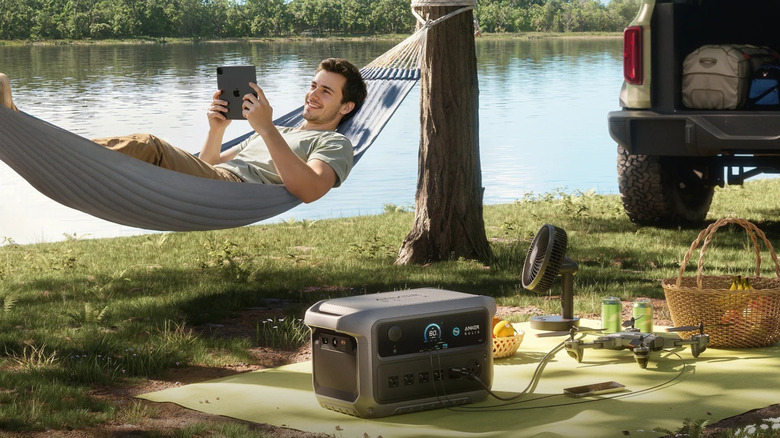
While camping is a great way to temporarily disconnect from the hustle and bustle of daily life, that doesn't necessarily mean you want to go completely unplugged. Indeed, modern camping trips often incorporate technology into the experience. There are the essential camping gadgets like lights, radios, GPS devices, and satellite communicators. You might also want to bring your phone to take pictures, a Bluetooth speaker to set mood music, or a handheld vacuum to keep your space clean.
With all these electronics on hand, having a portable power source at your campsite is a must, especially if you'll be away for a while. Fortunately, Anker has a range of options for different camping needs. For short trips, you can go with Anker's high-capacity power banks. They're light and can easily fit in your backpack but are still capable of keeping your devices charged for about a day or two. If you're planning longer adventures, you'll need Anker power stations instead. They're significantly beefier than power banks but great for powering even your AC devices. We've rounded up three options in each category that are worth considering the next time you head to the great outdoors.
For overnight or weekend camping trips
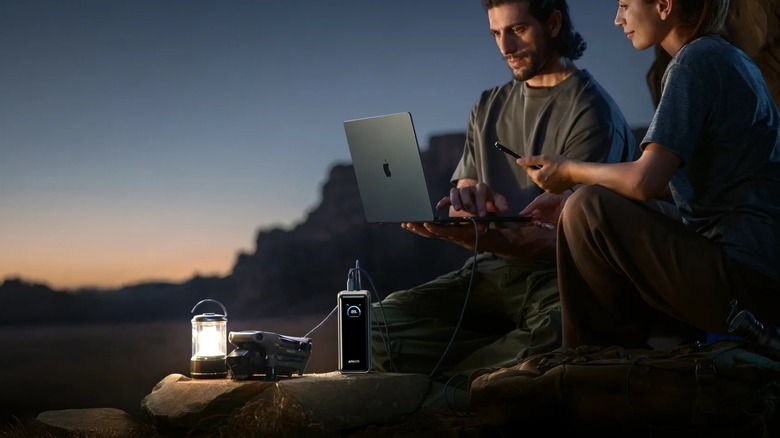
If you're only going for a short one-to-three-day camping trip, Anker recommends carrying a power bank with a minimum capacity of 20,000 milliampere-hours (mAh). One handy option is the $180 Prime Power Bank. This soda-can-sized Anker accessory is pretty compact at only 1.73 by 1.99 by 5.79 inches and 18 ounces, ideal for when you want to pack light. More than the size, this power bank is also relatively long-lasting. Following Anker's guidance for calculating a power bank's capacity for the number of charges, the Prime can charge a Samsung Galaxy S26 Ultra with a 5,000 mAh battery about 2.6 times and an iPhone 18 Pro Max with a 5,567 mAh battery 2.3 times.
If you want to be on the safe side, you can always go with a higher capacity power bank like the $120 Laptop Power Bank or the $230 Prime Power Bank (26,250 mAh model). Both come in handy when you have more devices to charge or just want power to spare. Thanks to its capacity, the Laptop Power Bank is large enough for roughly 3.25 full charges on a Galaxy S26 Ultra and 2.9 full charges on an iPhone 18 Pro Max. Meanwhile, the Prime 26,250 mAh delivers 3.4 charges to the Samsung flagship and three charges for the Apple flagship.
These two power banks include some convenient features for camping, too. For example, the Laptop Power Bank is one of the Anker power banks with built-in cables. This means you won't have to bring separate charging wires that would only clutter your bag. Meanwhile, the Prime 26,250 mAh comes with two 140-watt USB-C ports, which translates to faster charging and having your devices ready with less lag time.
For week-long camping excursions
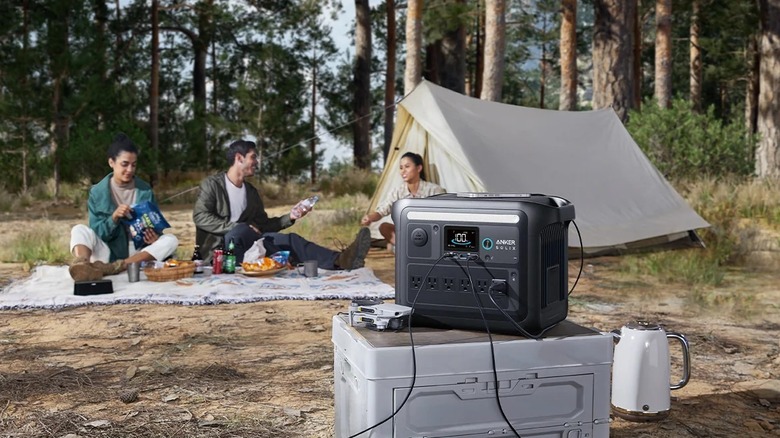
For long camping trips, you need a power accessory bulkier than a simple power bank. The good news is, Anker also offers several portable power stations. We have narrowed those down to three options here, all of which can be recharged with solar panels and aren't too heavy to bring to a campsite.
For starters, there's the SOLIX C1000X, available for $600. It has 11 ports and a capacity of 1,056 watt-hours (Wh), which should be enough to last you about two days while using two phones, a camp light, a 12-volt camping fridge, and a drone with a camera. When you need to top off the power station, you can connect a 600-watt solar panel to it and wait for it to fully charge, which should take about two hours. Size-wise, the SOLIX C1000X measures 14.8 by 8.07 by 10.5 inches and weighs 28.44 pounds.
A slightly bigger alternative is the SOLIX F1500. At $1,200, this 13-port power station is an Anker accessory designed for the outdoors. It includes a built-in light bar and drop-proof and anti-UV unibody enclosure. It also features a 1,536 Wh capacity and solar input support of up to 600 watts, which can recharge the power station in 2.5 hours. As for portability, the SOLIX F1500 comes in at 18.2 by 11.3 by 9.3 inches and 43.7 pounds. If you prefer a power station that you don't need to charge as often, you might consider the $1,200 SOLIX C2000 Gen 2. It's a 2,048 Wh power station that you can recharge in three hours with an 800-watt solar panel. It weighs in at 41.7 pounds and measures 18.1 by 9.8 by 10.1 inches. Its large capacity means it should last longer per charge than the other two options.