

How Many Tesla Superchargers Are There In The US (And Who Can Use Them)?
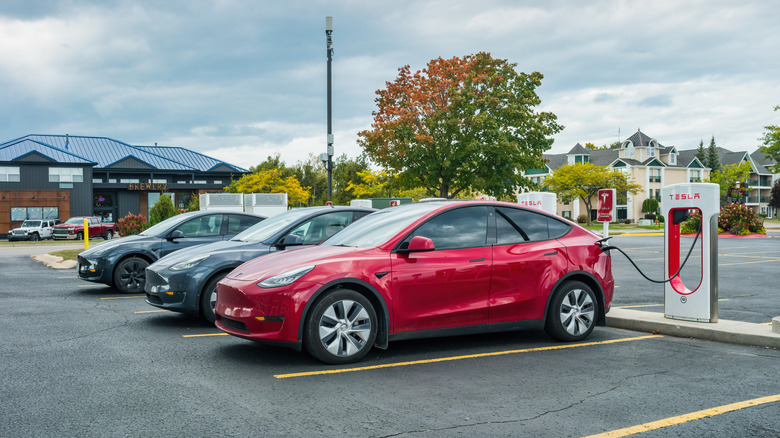
The idea of owning and operating a Tesla vehicle as an everyday driver is far more grounded in reality today than it was when the electric-vehicle (EV) manufacturer introduced its O.G. Roadster in 2008. Driving a Tesla means never needing to refuel at a traditional gas station; it also means little to no traditional maintenance and freedom from emissions. But now, one of the biggest pros of Tesla ownership is access to the company's extensive network of Superchargers. Located in all 50 U.S. states, at the time of writing, there are 3,135 Supercharger stations throughout the nation, equipped with 38,558 charging ports.
Tesla's Supercharger ecosystem is open to all Tesla drivers, but the network was once fully privatized. It was only as recent as 2023 that the company introduced the Magic Dock adapter at Supercharger depots, making it possible to top off non-Tesla EVs. But now that Supercharger stop-offs aren't private anymore (since 2023), most EVs that are compliant with Tesla's North American Charging Standard (NACS) can be serviced at a Supercharger station.
This is particularly good news for the greater world of EV ownership, as Tesla plans to expand its Supercharger network even more. The company has plans to put up additional stations in a number of U.S. metropolitan areas and also intends to build more private stations to support its expanding fleet of Robotaxi vehicles.
Competitive EV brands wanted in on the action too
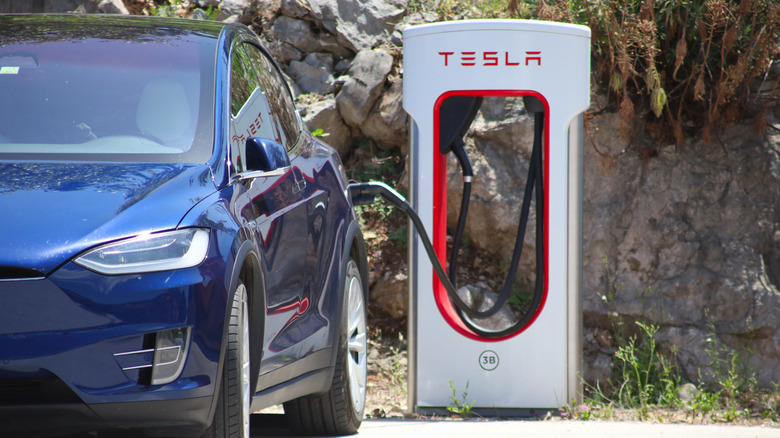
For those unaware, the NACS was exclusively developed by Tesla, and it allows for both AC and DC charging with the same plug type. Up until the 2023 privatization shift, only Tesla vehicles were equipped to handle the charging interface. But once Ford made headlines as the first automaker to incorporate the NACS technology, other EV manufacturers followed suit. This led to the NACS being classified as an official charging standard (labeled as SAE J3400); as long as your EV has the NACS interface, you can recharge it at a Supercharger station.
It's nice to see a major vehicle brand opening up to its competition, at least as far as recharging is concerned. This is a transitory era, and many folks who have long owned internal-combustion-engine cars, trucks, and SUVs are switching over to EV driving. The fact that you won't need to search for a non-Tesla charging station makes cruising the country way easier. It also prevents you from needing to purchase extra tech to get one brand working with another.
Do keep in mind that when it comes to overall compatibility, Tesla still has the final say. Just because a non-Tesla EV is outfitted with an NACS interface doesn't guarantee it'll work at a Supercharger depot. Other compatibility factors include your vehicle manufacturer, the specific station you're visiting, and whether or not Tesla has added your vehicle to its massive list of approved non-Tesla EVs.