

Are Hardware Security Keys For Your Laptop Actually Worth It?
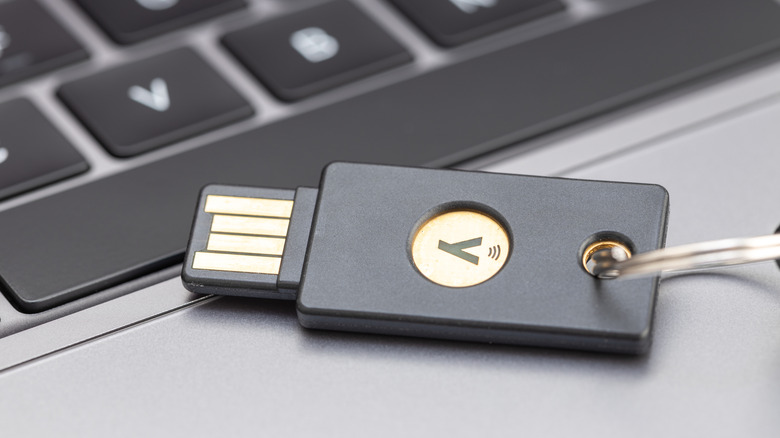
Multi-factor authentication is a standard security feature many of us use in daily life, whether we're at the office or just trying to spend rewards points on a muffin at the bakery. Many services have recently ditched accepting passwords that are easy to remember or even easier to forget, switching to multi-factor approaches. Digital passkeys are fast becoming a new standard across the web, but if you're looking for something even more concrete, physical real-world security keys you can hold in your hand reign supreme.
A hardware security key is a flash drive-esque device that establishes an authentication relationship with a host like your laptop or phone, providing a private answer to a public cryptographic hash, effectively acting as a digital key to your proverbial lock. Subsequent logins rely on the key connecting to the device — typical through USB, NFC, or Bluetooth — to re-generate the response for authentication. Hardware security keys are sometimes paired with additional tests such as a PIN code or even a fingerprint reading to ensure that the person connecting really is who they say they are. To that end, security keys have security measures that prevent them from being hacked into or cloned. Some keys are actually designed to be left in a USB port all the time, including one of the most popular on the market: Yubico's $68 Yubikey Nano.
That said, you'll need to think about what threats you might face when considering whether a hardware security key suits your needs. A basic key starts at around $30 while those with fingerprint scanners can go all the way up to $100. It's not much to pay when protecting corporate or national security, though it means jumping through more hoops to access information.
Anyone can use a security key — even you
Many people who deal with privileged digital information such as intelligence agents, whistleblowers, and journalists often use security keys to access hardware, software, and online services. App developers might use them to verify that the code they've published comes straight from the source. For professionals, these keys are just one measure in a sophisticated toolkit against interference when they're handling sensitive data or ensuring the integrity of their work and communications.
But as we've said, security keys are affordable enough for nearly anyone who wants a little extra peace of mind. While you, the average reader, might not feel particularly threatened by incredibly capable adversarial organizations, many crimes and a lot of civil litigation happen between parties that know each other such as business associates, neighbors, roommates, friends, and relatives. If you aren't in a position to trust someone you know and live in close proximity to them, you might be interested in a security key.
Just as it is with professionals, security keys are not the end-all, be-all of your personal digital safety—in fact, we've got some suggestions on a few other privacy gadgets you might want to pick up, including a USB data blocker for holiday travel. You should keep in mind that these measures may not protect from other threat vectors like the con artists behind those online tech support scams or hackers who install ransomware on your computer. Your best defense against a scary world is to stay informed and develop your intuition around privacy and security. But if you've got documents and programs you need to firewall from prying eyes, a security key can help.