

Battery-Free Sound Tags Might Actually Replace Your Smart Home Sensors
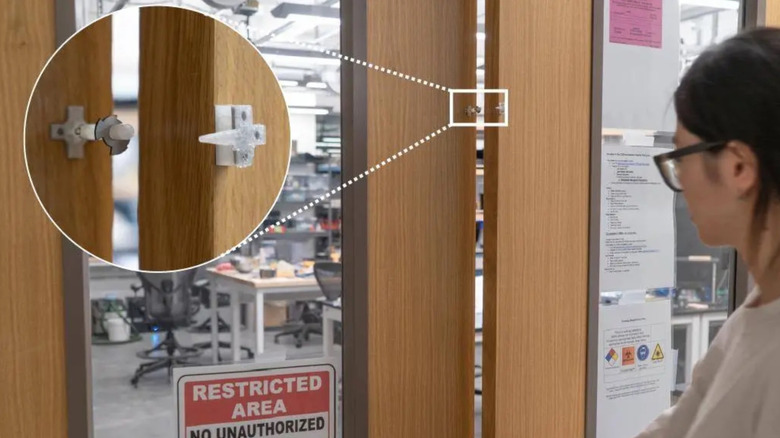
Smart home sensors allow you to monitor everything from leaking water and broken windows to temperature fluctuations and motion. Most sensors are DIY-friendly; you can set them up relatively quickly, and you probably won't need anything besides your smartphone for the onboarding. Unfortunately, a majority of these sensors are battery-powered, leaving you responsible for a recharge or replacement when the cells start depleting. But if the ingenuity of a Georgia Tech engineering team led by Yibo Fu is officially put into production, the future of sensor power could look very different.
Fu's team came up with a simple way of localizing home automations via ultrasonic frequencies, and they're calling this experimental platform SoundOff. Instead of using batteries, Wi-Fi receivers, and other complicated tech, Fu and his colleagues created a penny-sized metal disc with specialized notches that mounts on a 3D-printed base. The disk and base were installed near a tiny plastic tab that connected to a door, drawer, or other open-close mechanism. When you "activate" the item to which the notched disc sensor is attached, the tab strikes the metal, causing it to emit a hyper-specific, ultrasonic sound.
Ultrasonic (frequencies above 20 kilohertz) also means that human ears won't have to deal with a hodgepodge of audible tones ringing throughout a home or business. The frequency is then picked up by a microphone-equipped device, which interfaces with custom software to carry out a particular automation. No advanced AI or other robust tools required.
SoundOff offers a glimpse into a smart home future that doesn't require Bluetooth or Wi-Fi
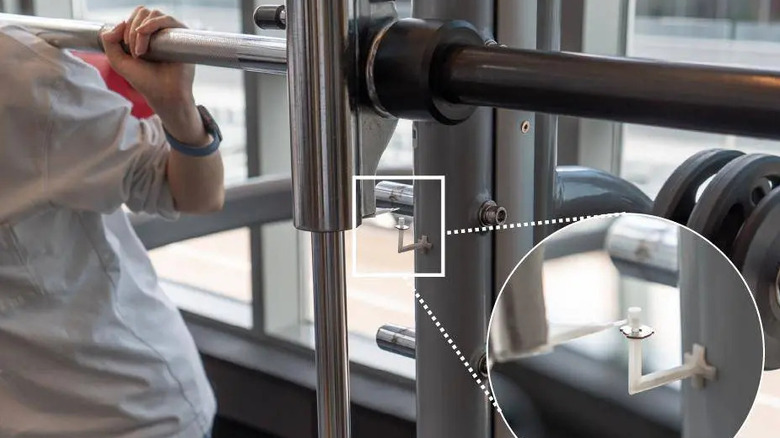
According to Fu's team, SoundOff could literally cost just a few cents to manufacture. The engineers also went on to detail specific use cases for the technology, demonstrating how its disc-dinging tech could be beneficial for fields like geriatric care, personal fitness, and inventory systems. Fu's crew has already come up with about 1,300 unique notch sizes and placements, and each design produces a one-of-a-kind acoustic signature. Furthermore, these unique frequencies offer maybe one of the best forms of privacy known to man: decaying sound waves.
At right around the three-foot mark, ultrasonic tones rapidly disintegrate; that also means the frequencies are essentially impossible for a hacker to pick up on unless they're literally inside your home or business. Throughout their experiments, Fu and his team used a wrist-strapped Ultramic384K BLE mic connected to a Raspberry Pi Zero to detect ultrasonic frequencies. The team also says in their research paper that lower-cost microphones could potentially be used with a smartwatch; but considering the limited ultrasonic range, additional hardware development is likely required.
Should the SoundOff platform actually be picked up for full-scale production, perhaps the developers can come up with a way to utilize the mics on everyday devices like phones and smartwatches to execute automations, instead of a prototype, in-house solution that may never see the light of day beyond a laboratory. One thing's for sure: we need more resource-lite systems like SoundOff to carry out smart home automations, even if the mic device were to end up being a battery-powered add-on.