

Asus Vs. Acer Laptops: Which Brand Should You Buy?

In the battle of cost-effective performance and cutting-edge innovation, two names consistently pop up in the laptop landscape: Asus and Acer. Whether you're a college student looking at a budget-friendly laptop for daily assignments or a software engineer who needs to run heavyweight applications, choosing either of these companies will get you a reliable product. Both Taiwanese tech giants have built a reputation for delivering high-quality laptops across various price ranges, but they differ in key ways.
While both brands are well-recognized, they cater to different demographics, and this difference shows across their ranges. Acer is the budget-friendly pick with its Aspire series. It tries to keep its pricing at the lower end of the scale, with a slight compromise on performance and display. Acer aims to provide laptops suitable for everyday use, slowly transitioning into more focused and high-end machines in its Nitro and Swift ranges.
On the flip side, Asus targets a higher-spending clientele with its premium sleek design and emphasis on display graphics. These aren't your run-of-the-mill machines; Asus prides itself on offering top-tier features with an elegant look, albeit at a higher cost. Its range starts with the Vivobook for daily tasks and family use, and goes up to the ZenBook and ROG series for hardcore gamers — or anyone who might simply prefer premium displays.
Comparing specs, design, and longevity
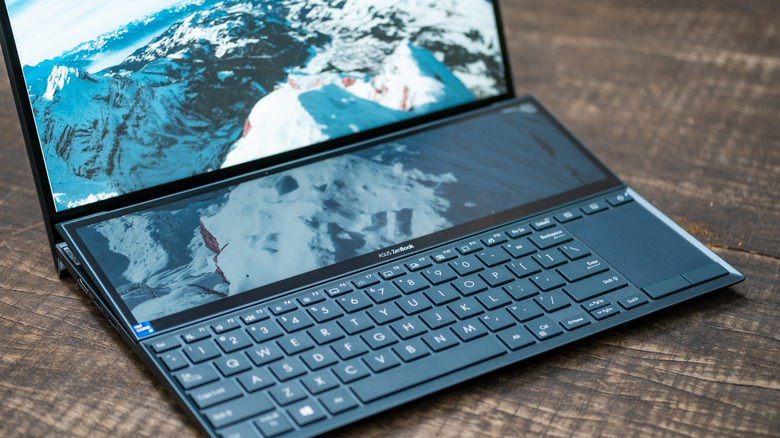
For affordable laptops, Acer's budget-friendly series is called Aspire, while Asus offers the Vivobook. To keep things fair, we'll compare laptops with near-identical prices — the $749.99 Acer Aspire 5 Spin 14 and the $699.99 Asus Vivobook 15. The Vivobook 15 boasts an Intel Core 7 150U processor, whereas the Aspire 5 Spin 14 uses an Intel Core i5-1335U. The Core 7 is comparatively stronger for multitasking and everyday use, giving Asus the win in performance. The biggest difference between the two, however, is the Aspire's flexibility. Unlike Asus' traditional clamshell design, the Acer Aspire's screen can fold into a tablet. It also includes an active stylus, helping to justify the higher price.
For premium ultrabooks, the $1,800 Acer Swift 16 AI features an Intel Core Ultra X9 388H and Arc B390 processor, delivering up to 50 NPU TOPS. This gives it a massive AI hardware advantage over the $1,800 Asus Zenbook 14, which caps at 13 NPU TOPS. However, the Zenbook 14 counters with 32 GB of RAM (double Acer's 16 GB) and is significantly lighter at 2.65 pounds versus Acer's 3.42 pounds.
If you're going for a flagship gaming laptop, both the Asus ROG Strix SCAR 16 and Acer Predator Helios 18 AI cost about $4,499.99. The Predator Helios 18 is huge, boasting an 18-inch screen, which is ideal for a gaming setup. But this reduces its portability in comparison to its Asus counterpart, which has a 16-inch screen. Moreover, Acer offers a dual-native display; it can switch between 4K at 120 Hz and FHD at 240 Hz, while Asus is limited to 2.5K at 240 Hz. Lastly, the Strix has 2 TB of storage with an extra SSD slot, while the Predator comes with 1 TB storage and two extra slots.
Choosing the right laptop for your needs
When deciding between tech giants such as Acer and Asus, the more important question is: What do you need the laptop for? Narrowing down your usage and basic requirements is vital to understanding which brand is better for you. In the above comparison, you can see Acer will often give you more value if you prioritize advanced features like flexibility and AI integration. The Acer Swift 16 AI and Aspire 5 Spin 14 also feature touch navigation and come with an active stylus, so if you're a college student, Acer will give you better value for lectures and note-taking.
If more storage and easier portability are features that excite you, Asus becomes the ideal option. The ROG Strix SCAR 16 provides users with double the storage of its Acer counterpart, and the same can be said for the Vivobook 15 for an additional $100. Asus laptops are also relatively lighter, making them easier to carry around. For esports players who require more usable storage, Asus would be the smarter purchase. But if you're a streamer or you frequently edit videos, Acer's 18-inch display would be a better choice.
All in all, both are decently reliable laptop brands and have their strong points; it really comes down to which trade-off you're more comfortable with. If budget is your limiting factor, you're better off looking into Acer since it packs high-level specs into a lower cost. You might lose out on innovative designs and display fidelity, but the trade-off is worth it for daily usage. But if a premium display is a requirement and cost isn't an issue, go directly for Asus. The company strives to constantly integrate modern designs and the latest display features into its laptops across every series.