

Who Makes Tesla Batteries, And Where Are They Produced?
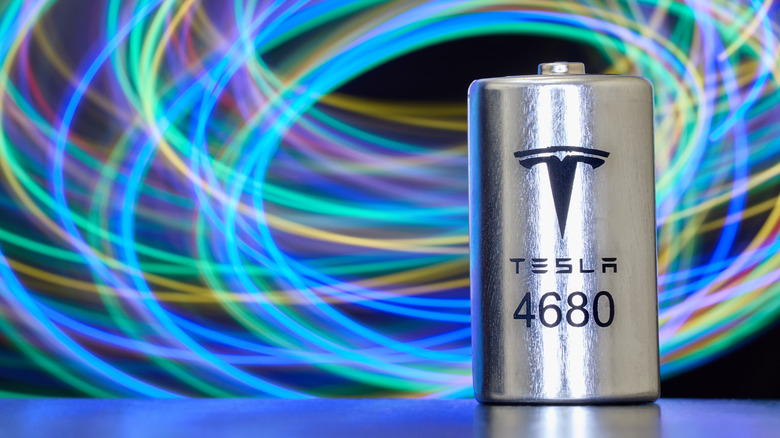
Tesla was founded in 2003, but it wasn't until 2008 that it launched its first vehicle, the all-electric Roadster sports car, powered by a battery pack containing commercially available lithium-ion cells. Fourteen years later, the automaker started delivering vehicles with its own 4680 cylindrical battery cells – named after its 46mm diameter and 80mm height — and while this marked an important step toward reducing its reliance on external suppliers, Tesla continues to use battery packs produced by a range of companies in various countries.
Tesla manufactures its 4680 battery cell at its Gigafactory Texas in Austin, using it in a number of Tesla vehicles that includes the Model Y SUV and its ambitious but struggling Cybertruck pickup. In September 2024, Tesla announced it had produced its 100 millionth 4680 cell across all of its factories. The automaker is also expanding production of its own lithium iron phosphate (LFP) cells at its Gigafactory Nevada, though these are used mainly for energy storage products. Its Kato Factory in Fremont, California, meanwhile, supports battery development and early-stage cell manufacturing.
Tesla's external suppliers include long-standing partner Panasonic, which produces 2170 cells in the U.S. and 18650 cells in Japan for Model S and Model X vehicles. China's CATL (Contemporary Amperex Technology Co. Limited) is another major supplier, especially of LFP cells for certain Model 3 and Model Y cars. South Korea's LG Energy Solution, meanwhile, supplies 2170 cells, manufactured at its facility in Nanjing, China, for certain Model 3 and Model Y versions, and also has an agreement with Tesla to manufacture LFP cells in Michigan for its Megapack energy storage systems from 2027. Even China's BYD, Tesla's biggest rival in the global electric-vehicle (EV) market, has supplied LFP battery cells for Model Y production at Tesla's German factory, although its current supply arrangements with Tesla are unclear.
Tesla's 4680 battery plan
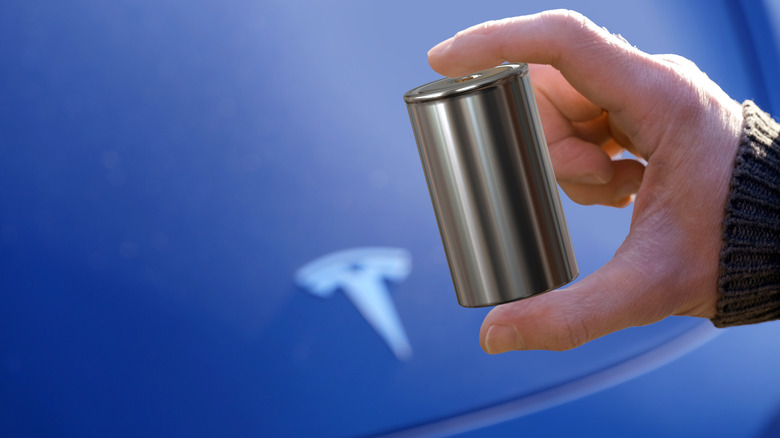
Tesla is best known for its EVs, including the Model 3, Model Y and discontinued Model S and Model X, as well as its outspoken CEO, Elon Musk. You might be less familiar, however, with the 4680 battery cell, which, as we've learned, the automaker developed and manufactures itself. Indeed, this relatively little-known part of the business could play a major role in shaping Tesla's future, helping it to reduce production costs and giving the company more control over its battery supply.
Tesla's 4680 battery cell was developed to improve battery performance while also making vehicle assembly more efficient. The cell is much larger in size compared to Tesla's older 2170 cell, meaning that fewer individual cells are needed to make a battery pack, thereby simplifying pack assembly and reducing the number of required components. Another innovation linked to Tesla's 4680 cells is the structural battery pack, which incorporates the battery into the vehicle's structure rather than having it as a standalone component. The idea is that doing it this way reduces the number of parts and contributes to the vehicle's overall rigidity.
Tesla has also developed a dry-electrode manufacturing process for its 4680 cells, which could make battery production cheaper and less energy-intensive by removing a drying stage that's common in battery production. However, scaling up 4680 cell production has proved challenging, especially when trying to achieve consistent quality while keeping manufacturing costs competitive. Despite the difficulties, designing its batteries in-house should help Tesla lower production costs and give it greater control over its battery supply, as well as allowing it to better tailor battery packs to upcoming vehicle designs. As for buyers, further battery development by the automaker will hopefully lead to more affordable EVs.