

Does The Size Of Solar Panels Affect Their Output?
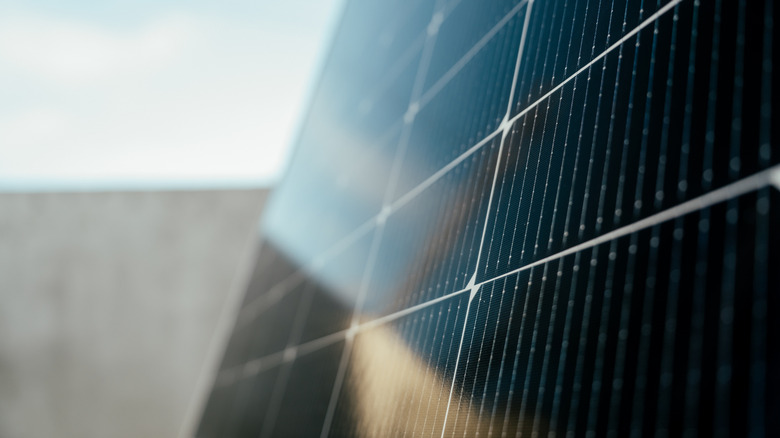
Common sense dictates that a bigger solar panel captures more sunlight and generates more electricity, right? That's almost how it works, but not exactly. The thing that actually determines a panel's output is the number, size, and efficiency of its solar cells. That being said, rooftop solar panels typically adhere to standardized sizing based on their wattage. This helps homeowners adhere to the 33% rule for solar panels when planning their rooftop array.
Here's how it usually breaks down: 60-cell solar panels are very common for homes and typically have compact dimensions of 5.4 feet by 3.25 feet with a 325 W capacity. 72-cell solar panels are also used for residential roofs and measure 6.4 feet by 3.25 feet on average with a 400 W capacity. 96-cell solar panels are standard for many commercial uses, and they usually measure 6.4 feet by 4.3 feet with a 450 W capacity or higher.
So, solar panels generally do follow a "bigger is better" mentality in practice. But keep in mind that it's still possible to see two differently sized panels that have the same solar cell count, cell size, and cell efficiency, and thus the same output. This is something that's more common with portable options that don't always follow any particular sizing standards, especially because there are so many different devices you can power with portable solar panels.
Determining the size of your solar panel array
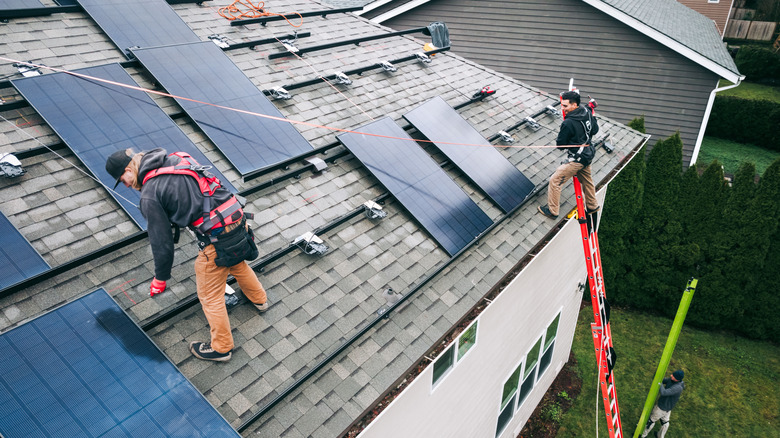
In addition to the things you need to know before installing solar panels for your home, you also should consider your main use cases for setting up a solar system. Is it for offsetting your overall energy consumption? Storing electricity in battery storage for emergency backup power? Or is it just to power a small outdoor security system or charge your electric vehicle? These scenarios have very different demands, so they will determine the size and wattage of your overall solar panel array.
For example, the 400 W solar panels that you typically see on residential roofs actually produce about 1.6 to 2.4 kilowatt-hours (kWh) of electricity per day under optimal conditions. That translates to a maximum of 876 kWh per year per panel. By comparison, the average annual energy consumption for a U.S. household was 10,791 kWh in 2022, according to the U.S. Energy Information Administration.
What this ultimately means is that each 400 W panel can offset up to 8% of your annual electric bill. Of course, there are utility-based factors under the hood that can affect each panel's efficiency. An oversized solar array can have diminishing returns. But the main takeaway is that bigger panels aren't necessarily the answer — it's about the total number of solar cells on your roof, their size and efficiency, as well as your electric system's ability to process the incoming energy.