

Astronomers Used Software To Find A Hidden Planet In Old Images
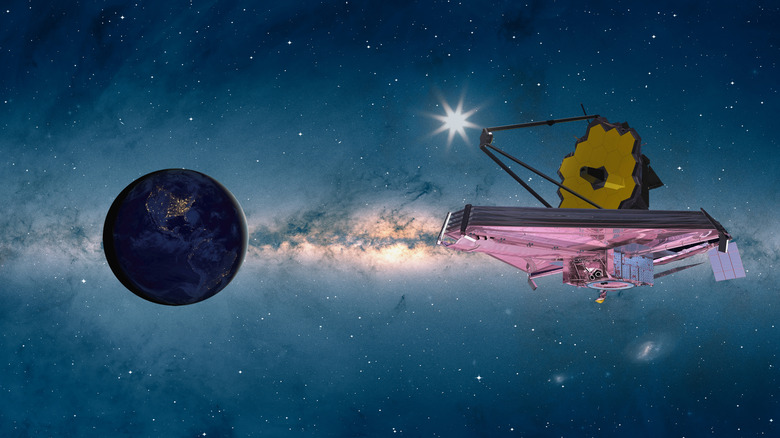
The James Webb Space Telescope (JWST) launched in December 2021, and it soon began taking stellar photos of deep space using powerful infrared technology. It's helping us make astonishing discoveries about our own universe. For example, the James Webb Space Telescope discovered a little red dot that turned out to be an ancient black hole. The JWST isn't perfect, though. When taking photos of superbright stars, the glare prevents astronomers from seeing everything that the JWST is attempting to capture. But a new software innovation might fix that.
A team of astrophysicists at Northwestern University in Illinois has developed a computational technique that erases glare from the JWST's observations and improves its ability to detect faint objects. The study was led by Northwestern's Rodrigo Ferrer-Chavez, who explained that "planets are a million times fainter than their stars," so increasing the telescope's sensitivity was paramount. As a result, the team actually revealed a giant previously hidden exoplanet in an existing JWST image.
This software acts as a "digital twin" to the real JWST. It works by creating a virtual replica of the telescope that uses Physics-based Learning for Imaging Planets (FLIP), which simulates how starlight actually travels through the telescope's mirrors and reaches its detectors. And it's not the first time astronomers have used digital solutions to augment the JWST; the James Webb Space Telescope is actively being improved with AI.
Digital twins are crucial for scientific discovery

NASA describes digital twins as "real-time virtual replicas of physical objects, systems, and processes." It's very different from the digital twins that Meta AI wants to use to take over your accounts when you die. In scientific fields, digital twins are in-software models that allow experts to replicate, simulate, and augment processes so that they can maximize the capabilities of physical hardware.
The glare-removal technology being developed at Northwestern University is far from the first instance of a digital twin being used in astronomy. NASA was using digital twins as far back as the Apollo 13 mission in 1970. Back then, the ground team used simulators and vehicle modeling to resolve a catastrophic oxygen tank explosion that may have otherwise brought the mission to a tragic end.
As of November 2026, astronomers have confirmed the existence of 6,473 exoplanets. However, NASA believes that billions of exoplanets exist out there in the cosmos, and the development of a digital twin that can peer through starlight might help us discover many more of them.