

This New Tesla Supercharger Station Can 'Talk' To The Power Grid
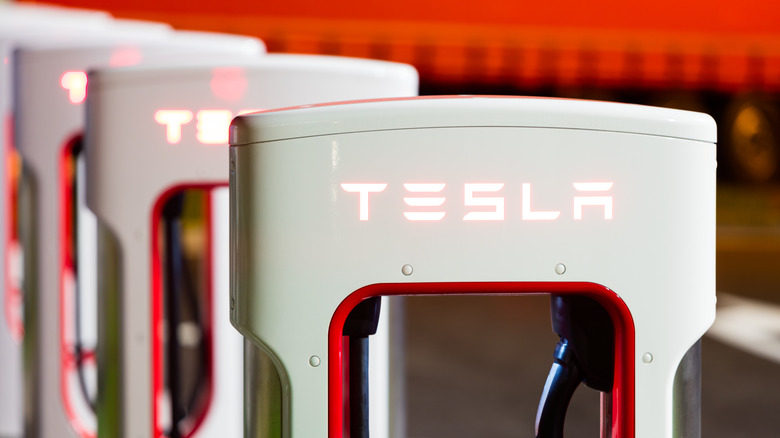
Tesla owners near Cloverdale, California, can now try out a Supercharger that promises to play nicely with local electrical grids. In the past, if a grid wasn't capable of supporting a new charging site, options were typically limited to waiting for upgrades that can support the site or opening the site with reduced power limits. However, thanks to the Flex Connect program from Pacific Gas and Electric (PG&E), Tesla can now utilize direct-to-grid communications to deliver power to drivers without overloading power grids.
The new eight-stall Supercharger site taking advantage of Flex Connect is located at Penny Faire Plaza in Cloverdale, and the V4 stalls deliver 500 kW of power while also being open at all hours. Waiting drivers will also have access to food and restrooms, and non-Tesla EVs with NACS adaptors can take advantage of the chargers as well, just like the other Superchargers scattered throughout the United States. With the site taking advantage of the IEEE 2030.5 communication standard, drivers may be impacted by slower charging speeds, but alternatives included waiting for the site to fully support Supercharging.
The company has yet to mention if drivers will know if a Supercharger is operating with reduced loads, but the new tech may help smaller communities lacking the usual infrastructure to support chargers. Charging sites must also hit certain requirements laid out by PG&E to utilize Flex Connect. Of course, those unenthused by slower charging speeds may want to remember the cost of charging a Tesla at home.
Who pays for the electricity at a Tesla charging station?
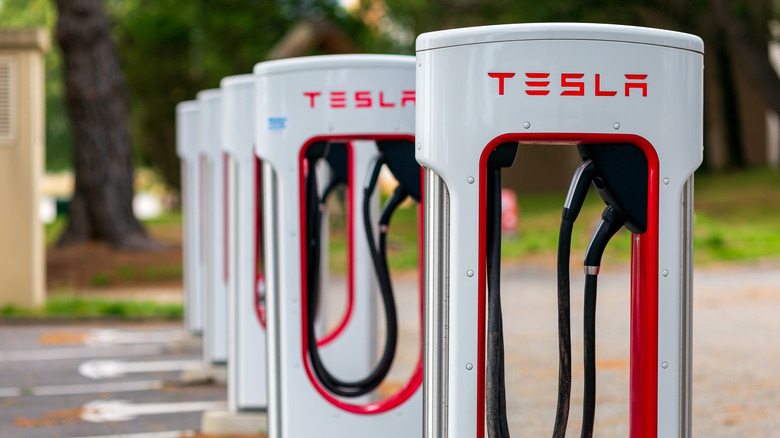
The new Flex Connect-supported Supercharging stations will still require users to pay for their own electricity, which can vary based on a number of factors, including the age and size of a battery, where it's charged, and other vehicle conditions and factors (and congestion fees can be a hidden cost of owning a Tesla). What makes Flex Connect important for drivers is that regions with power grids typically incapable of supporting the tech will now be able to handle them better.
Essentially, how the new system works is that the PG&E grid management system communicates with a charging site's energy management system, sending information over the internet about power limit forecasts up to a day early. As noted by Not a Tesla App, PG&E uses a charging site requiring 2 MW of power for DC fast-charging as an example. When using Flex Connect, such a site can provide the full 2 MW of power most of the time, only lowering its capacity to 0.5 MW to give the grid time to breathe when it can't supply the juice. Without Flex Connect, the site would likely be limited to year-round charging of just 0.5 MW.
Supercharging sites must hit certain requirements to be accepted, including being able to adjust power accordingly while facing local grid upgrades that may take 12 months or longer. In other Supercharger news, Tesla also recently celebrated hitting 85,000 Supercharger stalls at over 9,000 sites across the globe. Flex Connect will likely help push these numbers higher. Users may have more charging options in the future, but you may want to make sure you're not accidentally being held back by the grid.