

12 Of The Least Reliable EVs For 2026 According To Consumer Reports
Electric vehicles have become a viable alternative to fuel-powered cars, which are becoming less and less sustainable. In contrast to petrol and diesel cars, EVs are cleaner, run more quietly, and are cheaper to run, given the affordability of electric charging over refueling. Although gas-powered vehicles have dominated the automotive industry since its inception, EVs may soon carve out a substantial chunk of the market for themselves. However, not all EVs are created equal.
As with any vehicle, EVs should be reliable for both routine use and long trips. The last thing you'd want to deal with is an EV whose battery has turned off for no apparent reason in the middle of nowhere. This problem, along with many others, impacts even the best EVs. While most manufacturers have taken major steps to rectify known issues with both EV software and hardware, some EV models still fail to live up to customer expectations.
As part of its overall scores for the vehicles it reviews, Consumer Reports includes metrics for predicted reliability, which are based on survey responses from Consumer Reports members. Unless there's enough data for a given 2026 vehicle model, the "Predicted Reliability" rating is based on the same model from years prior. Notably, EVs with poor reliability track records were often associated with lower overall scores.
Lucid Air
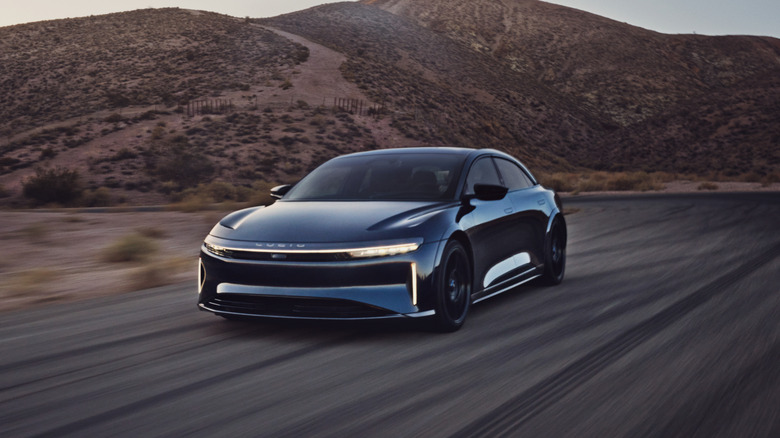
The Lucid Air is a sleek car that looks and feels like a luxury electric sedan. Its range of up to 431 miles is impressive, and with the Sapphire model's 0-to-60 mph time sitting at just 2.1 seconds, the vehicle boasts top-of-the-line acceleration. However, for all its design flair, the Lucid Air is a disappointing purchase if you want a reliable car that doesn't require regular trips to a service center. Hardware faults and software issues are mainstays of the Lucid Air, and while the company has responded positively to critiques, the reliability of its 2026 models remains to be seen. As a new automaker, Lucid may deserve some leniency regarding quality issues. But that doesn't mean you should break the bank for an EV that will cause you constant headaches — after all, the 2026 Air's MSRP ranges between $72,400 and $250,500.
Coolant leaks have been a major problem with the Lucid Air all the way up to its 2025 model. Thankfully, the vehicle diagnostic system reports such issues to the manufacturer to preemptively resolve problems. Software defects, including the infamous key fob problem in the Lucid Gravity, are also prominent across many Lucid models. The Lucid Air is no exception. From doors failing to unlock to the car's media controls becoming unresponsive, the Lucid Air has its share of software issues. The Air's poor reliability is a major pain point reflected in Consumer Reports' extremely low predicted reliability score for the vehicle.
Rivian R1S
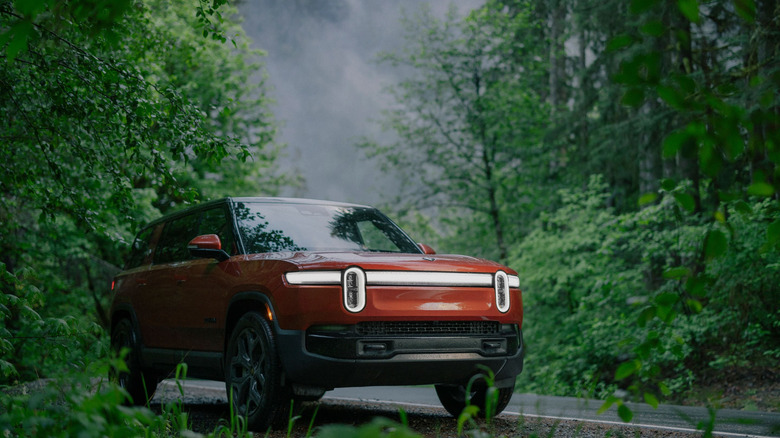
Rivian is another new EV manufacturer that has faced several growing pains. The company has developed its fair share of promising, quality vehicles, and both the R1T and R1S look good on paper. Unfortunately, though, a wealth of technical issues and hardware faults have caused the R1S to become one of the least reliable vehicles on the market. If you're set on purchasing this electric SUV, make sure you know what you're signing up for — numerous issues have been identified in the 2025 model, and there's no indication they'll be solved in the 2026 Rivian R1S. Consumer Reports gave it an extremely low predicted reliability score, which compounds with J.D. Power's quality and reliability score of 69 out of 100.
For starters, the vehicle's climate system problems are not what you'd expect from a premium EV. A user also reported software issues, including the vehicle not registering its owner's presence nearby (and therefore keeping the doors locked) for upwards of 30 seconds. The front electric motor is liable to fail at a moment's notice, and the car's fitment isn't ironclad, meaning there's a chance you could find leaks in your cabin after it rains. Some aren't fans of the car's suspension, either, with drivers reporting a bumpier drive than expected. There are also claims of the dashboard rattling during drives, which doesn't reflect well on the vehicle's build quality. Combined, all these factors make for a car that is too unreliable to justify a starting price point of $78,885.
Audi Q4 e-tron
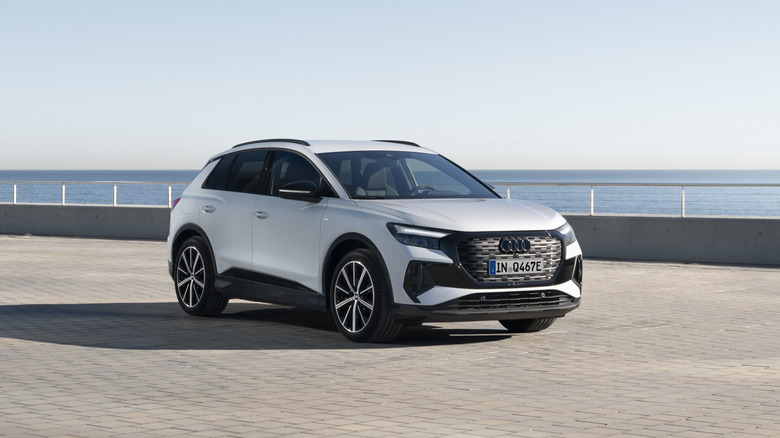
Any EV requires a high range and a smooth drive to stand out in the market. Despite an attractive starting price of $50,600, a beautiful design, and satisfying handling, the Audi Q4 e-tron did see significant reliability issues in its prior models. The vehicle's 2024 and 2025 models were recalled for a battery issue that impeded charging, and this problem often led to a loss of drive power. The Audi Q4 e-tron may look and feel great behind the wheel initially, but this model has faced many problems that have earned it a low predicted reliability score on Consumer Reports.
In the 2023 model, some customers reported the tires wearing down too quickly because they couldn't support the vehicle's weight and high torque. Similarly, the 2025 model was far from a smooth experience for drivers, with Audi's Multi Media Interface (MMI) system exhibiting several issues that had to be rectified with system updates. If you do decide to purchase an Audi Q4 e-tron, expect frequent OTA updates.
Hyundai Ioniq 9
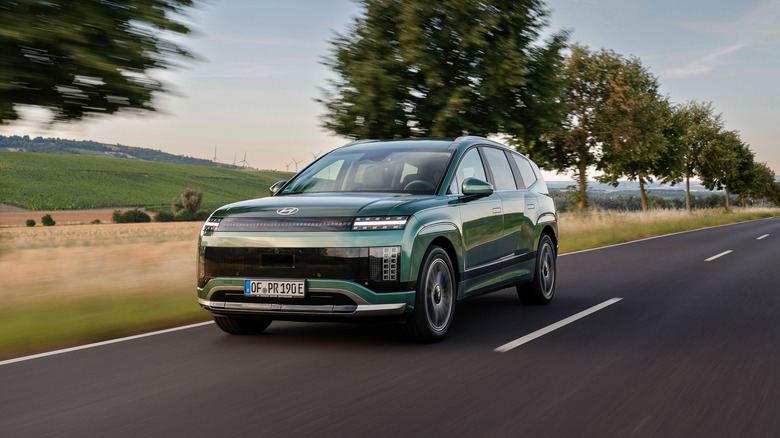
Like many other Hyundai EVs, the Ioniq 5 has faced issues with its Integrated Charging Control Unit (ICCU), which is designed to manage the vehicle's low-voltage charging systems. In the Ioniq 5, ICCU issues can lead to total battery drain, and there's little evidence of this issue being solved in the Ioniq 9. When driving any vehicle, let alone an EV that requires a charging station, random shutdowns are less than welcome. This serious reliability problem is reflected in the car's low predicted reliability score on Consumer Reports.
The Ioniq 9's underwhelming steering and braking modules have been the subject of expert criticism, with the car's drive being significantly impacted by their performance. A driver also reported a glitchy infotainment system with finicky user profiles and an unintuitive, complex user interface. On top of being stress-inducing, these problems could introduce distractions while driving. Despite being an otherwise well-received vehicle (divisive exterior design notwithstanding) with a good overall score from Consumer Reports, the Hyundai Ioniq 9 will be unreliable provided the vehicle line's ICCU problems persist.
Kia EV6
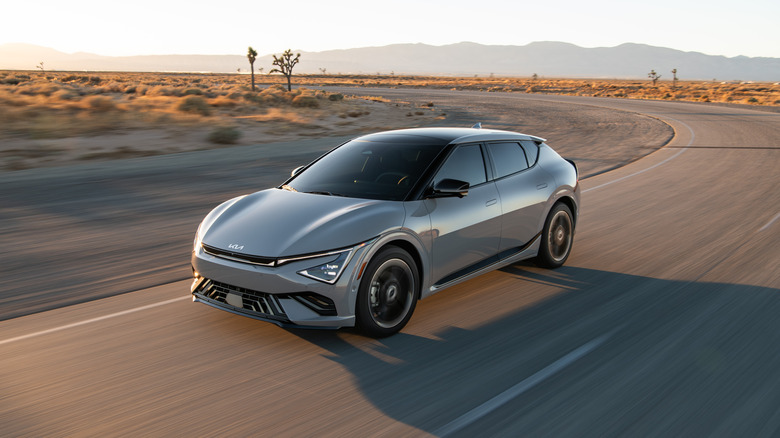
Along with Hyundai, Kia is another manufacturer that's faced ICCU issues. The Kia EV6 goes from 0 to 60 mph in just 4.5 seconds, and it can also charge from 0% to 80% in a mere 20 minutes. Starting at $45,000, it's also relatively affordable. However, these strengths are undermined by a battery fault that can turn this vehicle into an elaborate (but immovable) pile of metal and wires. Along with introducing battery charging issues, ICCU problems affect the car's 12V battery. Getting that part replaced can take a long time. Understandably, this issue seriously impacts the EV6's predicted reliability score on Consumer Reports.
Another issue, trivial it may seem, is that consumers report disliking the combined climate and media controls. When drivers become too occupied with infotainment settings that force their eyes away from the road, it becomes both a safety hazard and a nuisance in the driving experience. The car's subwoofer is also liable to lose power in the 2025 model as a result of a wiring issue. Even though the EV6 is touted by many as one of the most underrated electric vehicles on the market, its reliability issues need to be rectified as soon as possible to earn a larger share of the market.
Honda Prologue
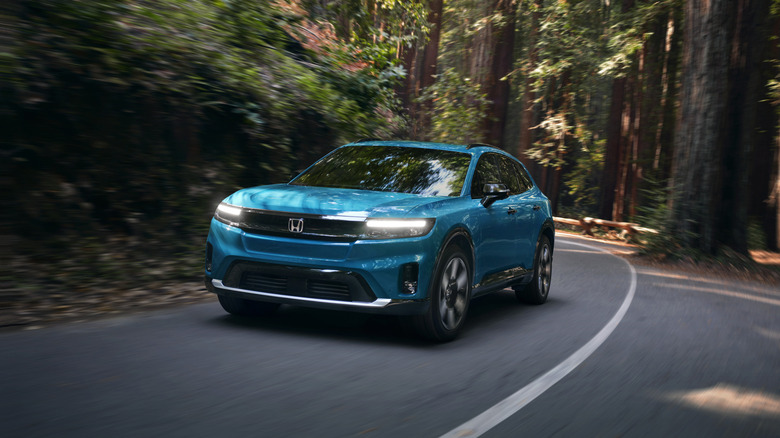
GM cars don't have the greatest track record for reliability, and the Honda Prologue — which was co-developed by GM and Honda — is a prime example. Software glitches are to be expected from first-generation EVs, and the Prologue is no exception. However, issues with Apple CarPlay or the Advanced Driver-Assistance Systems (ADAS), as reported by users, pale in comparison to the Prologue's severe mechanical faults, making it a generally unreliable EV. The axles start clicking after a while, as reported by owners of the 2024 model. The 2025 Honda Prologue is also prone to displaying high-voltage warnings with no clear cause, which is far from ideal — especially during long drives. To make matters worse, these high-voltage warnings can also lead to battery failure.
Customers have also reported issues with the car's braking system triggering randomly. This is a significant safety concern, especially on highways. In other instances, the EV also refuses to charge for no discernible reason. The issues plaguing this car are numerous; if you choose to buy a Honda Prologue despite its poor predicted reliability score on Consumer Reports, expect to visit the service center frequently.
Hyundai Ioniq 5
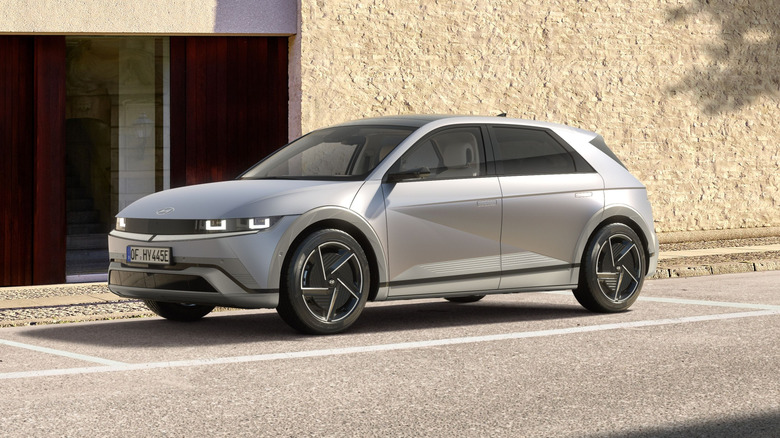
In theory, the Hyundai Ioniq 5 should be one of the best electric SUVs on the market, and it is in the eyes of many. A comfortable cabin and smart interior design are just a few key selling points for the vehicle. However, the vehicle suffers from serious ICCU issues. All the Ioniq 5's features and conveniences are hard to appreciate when it's prone to breaking down.
Battery problems are largely what have tanked the Ioniq 5's predicted reliability score on Consumer Reports. It's a shame, since there are several things to love about this electric SUV. The dual-motor models go from 0 to 62 mph in just 5.3 seconds, and lightning-fast charging speeds yield a charge time of just 18 minutes for the car to go from 10% to 80% battery (provided you use a 350 kW DC charger). If these perks entice you to invest in the 2026 model of the Ioniq 5, remember to do some research on potential ICCU issues. If they aren't rectified, you may end up experiencing battery problems with this vehicle.
Audi Q6 e-tron
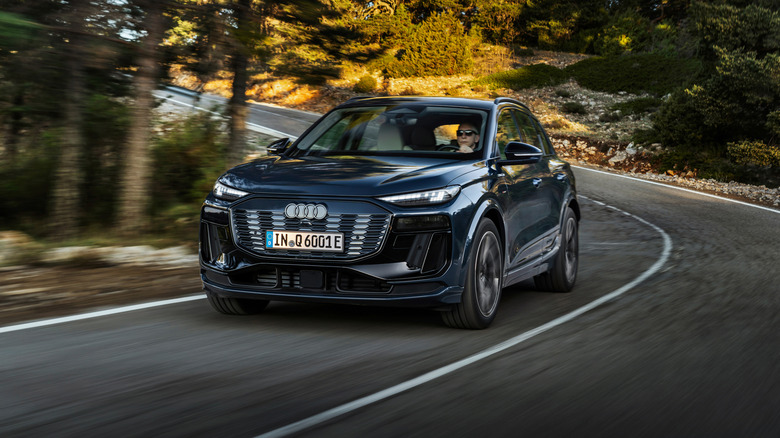
The Audi Q6 e-tron may be well-engineered in many ways, but the appeal of its perks is eclipsed by the vehicle's many reliability issues. This electric SUV does boast an impressive range of 330 miles, with its superb acceleration leading to a 0-to-60 time of just 4.4 seconds. However, its MMI system has annoyed Audi customers, even in the 2025 model.
Basic Apple CarPlay functions failing to work, as well as the Audi app being unresponsive for no apparent reason, are two infotainment issues with the Q6 e-tron. Lane assist and adaptive cruise control are convenient, but a user reported an issue where these features disappeared from their HUD. Another user also reported charging issues on their Q6 e-tron, which is yet another cause for concern. All these problems have led to the vehicle's predicted reliability score suffering greatly on Consumer Reports. The 2025 model didn't fare well with J.D. Power, either, with a disappointing quality and reliability score of 56.
Kia EV9
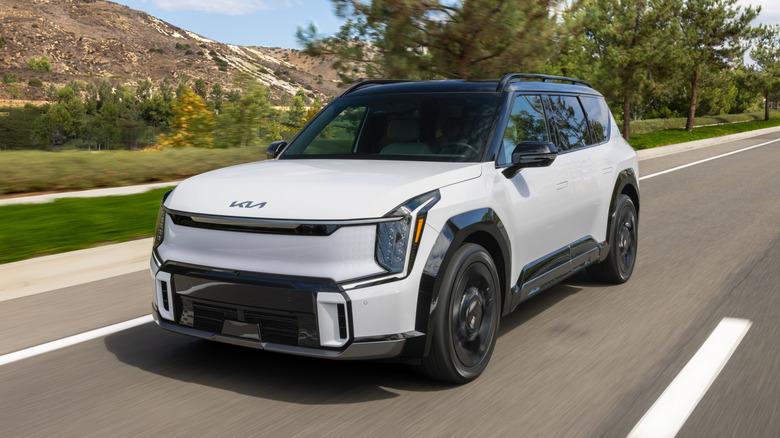
Yet another victim of faulty ICCUs, Kia EVs are generally challenging to recommend. In a perfect world, the car's spacious interior and smooth ride would make it easy to purchase this vehicle. But given its spotty reliability record — as shown by its exceptionally low predicted reliability score on Consumer Reports — it's a gamble to purchase the Kia EV9 if you're seeking a high-quality electric SUV. A quality and reliability score of 67 on J.D. Power doesn't inspire much confidence, either.
One customer commented on how the wait for a new 12V battery can take up to a year. It's also worrying that one user faced lengthy delays in their EV9 being repaired, which was reportedly owing to parts being on order. Moreover, the 2025 model's build quality was also lacking. Some models were even recalled for improperly welded motor shafts that led to loss of drive power. Meanwhile, others had missing seat mounting bolts in the second and third rows, which raised safety concerns. All these issues not only prevent the EV9 from reaching its potential but also worsen Kia's existing struggles to break into the EV market.
Genesis GV60
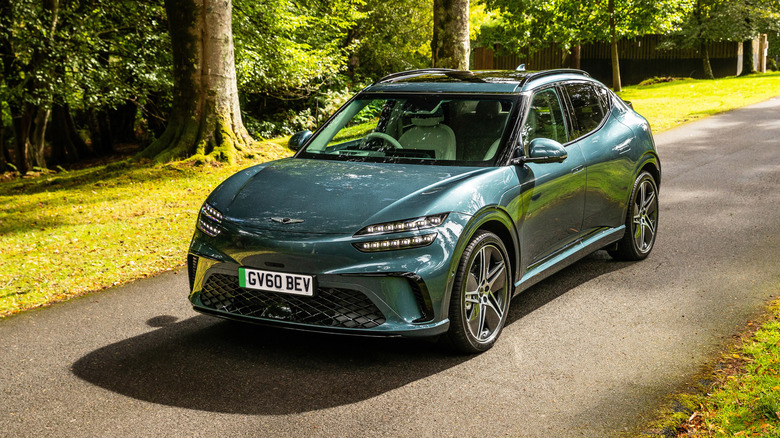
The EV market has seen several new players enter the fray, including Genesis Motor. This South Korean manufacturer aims to unlock a new level of luxury with the GV60, but reliability issues ruin what is otherwise a standout offering. The troubles with the car's infotainment system are widespread, with numerous glitches making it hard to connect phones and operate the touchscreen. The ADAS system has also been problematic for users, with its blind spot and forward collision warnings triggering incorrectly. The latter is especially dangerous; collision warnings can unexpectedly activate the vehicle's brakes, thereby potentially causing an accident.
Just like Hyundai and Kia, Genesis has recurring issues with its ICCUs. 2023 and 2024 GV60s were even part of a recall relating to errors in the vehicles' ICCU software. Despite its comfortable cabin and satisfying acceleration, the vehicle's reliability issues have led it to receive one of the worst predicted reliability scores for 2026 EVs on Consumer Reports.
Chevrolet Blazer EV
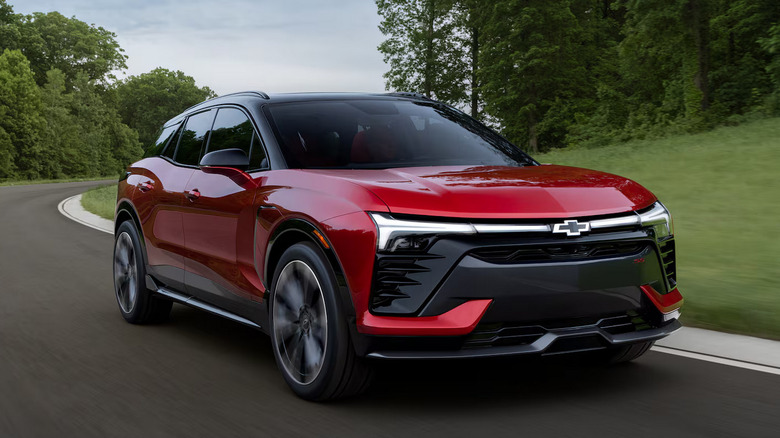
Another GM-made car with hard-to-ignore caveats, the Chevrolet Blazer EV has numerous software problems that make it one of the least reliable EVs on the market. Electronic issues were abundant in earlier models, and many people expect the 2026 Blazer EV's interface to be just as problematic. A user also reported that their 2024 Blazer's battery malfunctioned three separate times following high voltage-related system errors.
Owners of earlier models have stated that the Blazer's climate control systems also leave much to be desired. The vehicle's motorized charging door is a nice touch, but several users have reported that it stopped working for them completely. While most of the car's software hiccups can be rectified courtesy of OTA updates, the Blazer EV's reliability is still up in the air. As a result, it has received the second-worst Consumer Reports predicted reliability rating for 2026 EVs. You're better off avoiding this EV altogether if you don't want to become another disgruntled Chevy customer.
Rivian R1T
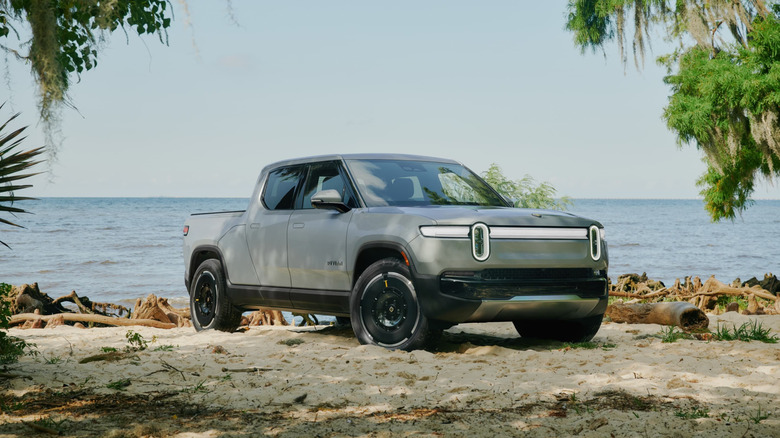
While the Rivian R1S already falls short on the reliability front, the Rivian R1T has faced even more reliability issues. Dubious build quality is a feature of previous models, and the manufacturer even had to recall several R1Ts due to headlight issues and defective turn signals, both of which are major safety hazards. The vehicle's HVAC system is also a point of concern in the 2025 model, with one driver reporting repeat replacements for the same parts following service checks.
However, before you discard the thought of purchasing a Rivian R1T, keep in mind that many users do speak rather highly of Rivian's customer service. Even if you have to make frequent service trips for the Rivian R1T, the vehicle itself is so much fun to drive that you might consider it a worthwhile tradeoff. There's a reason why this electric truck has both the highest "Predicted Owner Satisfaction" rating and the lowest predicted reliability among 2026 EVs per Consumer Reports, making it a fascinating anomaly in the EV space.