

The Easiest Way To Check If Your Car Key Battery Is Weak
We may receive a commission on purchases made from links.
Key fob battery lifecycles can be hit or miss. They typically last between two and five years, but there are many factors that can contribute to them draining or dying faster. Signal interference, constant use like a stuck button, and extreme temperature exposure — especially cold — are all reasons why a battery might die faster. It can also happen just because someone installed a low-quality battery in the device. Regardless, it might leave you unable to unlock or access your vehicle, even though there is at least one way you can start your car with a dead key fob.
Outside of manually testing the key fob by attempting to unlock your car at various intervals, there is a pretty simple and relatively accessible way to check if the battery is weak. You can use a voltmeter, a tool to check electrical strength or voltage between two circuit points. You could also use a multimeter, a similar tool that measures voltage, electrical currents, and resistance, all in one device.
Ultimately, you use the probes the tool comes with to check the voltage output of the battery, and if it's not working, you'll know the battery needs to be replaced. You can find voltmeters and multimeters on Amazon for pretty cheap, ranging from about $10 up to $30 or more. You'll want to make sure to choose one that has smaller external probes, as that makes it easier to interact with cell-size batteries and other smaller power sources.
How to check a key fob battery for weak power
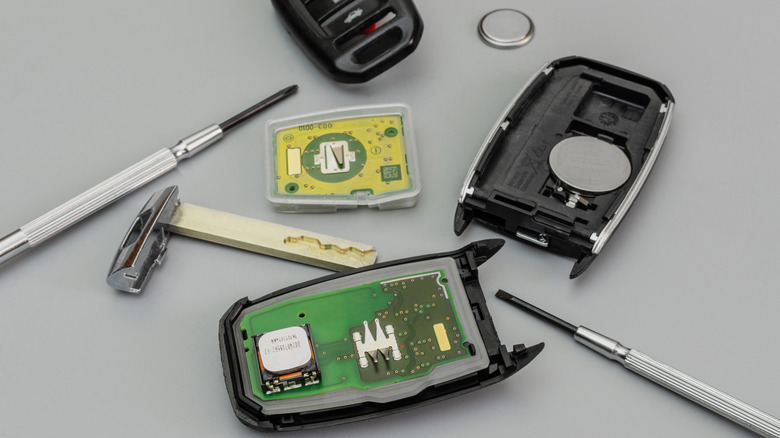
Testing the battery is easy. First, set the meter to DC volts. If yours is not auto-ranging, select the 20-volt range, because a 3-volt coin cell like a CR2032 battery falls within that measurement band. Then, touch the red probe to the positive side of the battery and the black probe to the negative side of the battery simultaneously. Most likely, you'll have to open the key fob and remove the battery beforehand.
The voltmeter display will have a readout. A CR2032 should read around 3.0 volts, and ideally above 2.7 volts. If it's below about 2.7 volts, replace it. If the voltage readings are in the appropriate range yet the key fob still isn't working, the unit may be damaged or faulty. Otherwise, it may be time to replace the key fob. A basic voltage check does not always reflect real-world performance, especially with older cells.
If it does appear to be working, there are ways to extend its wireless range, like using your head as an improvised antenna, which has been demonstrated to work. You might also be able to store a digital version of your keys on your iPhone, on a compatible Android phone, or even a smartwatch. Doing that would nearly eliminate the need to carry a key fob, as you can use the digital key to open the doors, unlock the trunk, and even start the engine.