

What Is The IR Blaster On Smart TVs Actually For?
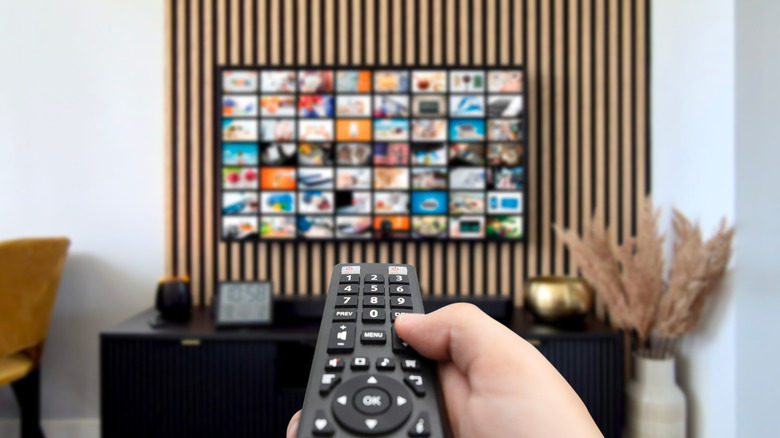
In recent years, IR blasters have become a standard part of smart TV systems, but it's not always clear just what these devices are or do. For starters, the IR in the name stands for infrared, which is a type of harmless radiation invisible to the human eye. Infrared radiation is the universal way for remotes to send signals to home appliances, including air conditioners, fans, and, yes, your TV. With more and more modern TVs now relying on Bluetooth or Wi-Fi to communicate with your remote, though, there doesn't seem to be any reason for smart TVs to use infrared blasters or have infrared sensors inside them.
Yet, not only do almost all modern TVs still use IR sensors alongside Bluetooth and Wi-Fi, but manufacturers like LG have official manuals dictating how to use IR blasters. If you're a casual TV buyer, this might be confusing, but IR blasters provide many benefits, specifically for those using multiple devices connected to their TV. Having an IR blaster — either in a universal remote or as a plug-in option for your TV — is an important part of getting the best home theater system, but there are a number of other, lesser-known uses as well!
They're needed for home theater setups, universal remotes, and more

The term IR blaster can refer to a number of things. First, there are the IR blasters inside universal TV remotes that upgrade any old TV setup by letting them communicate with your TV, your soundbar, and any other part of your home theater system. It can also refer to a feature in some smartphones — such as the OnePlus 15 — that shoots out an infrared beam to interact with IR receivers.
Lastly, an IR blaster can also be an attachable device that comes with your TV or smart box (or can be bought separately). In this case, the IR blaster's job is to take the infrared signal from your remote and blast it to nearby devices, enabling your TV remote to also send commands to your gaming console, electronic blinds, or anything else that supports IR input.
As such, an IR blaster can save you from a lot of frustration. You can use a single remote to control multiple devices, getting rid of the hassle of keeping a dozen remotes and checking if their individual batteries still work. Furthermore, if you've lost your paired TV remote and can't immediately get a new one, an IR blaster can also take the signal from any other remote you have and let you control your TV with it.
Why do smart TVs still have IR sensors?
Wi-Fi and Bluetooth provide more complex communication and aren't as strict with where you have to point on your TV to work, so why do modern TVs still support infrared communication? For one, IR sensors don't cost much to include in TVs, so even removing them wouldn't save too much in the long run.
Additionally, infrared has become a universal medium for signals, which is why most modern TVs still offer it as a method of communication, alongside Bluetooth and Wi-Fi. Infrared radiation also takes very little energy to produce, so having it as an option on certain remotes increases their longevity. Some Wi-Fi-paired remotes also use IR radiation to signal your TV to turn on, conserving the battery it would take to have Bluetooth or Wi-Fi always active on the remote or the TV.
There are a couple of advantages to having a dedicated IR sensor, as well. We've already mentioned IR blasters and how having supported infrared lets you use a universal control for your entire TV setup, but it goes beyond that. When your remote isn't paired with your TV yet, it uses the IR sensor to send signals. This is also what lets you use your phone to control your TV, another feature that wouldn't be as easy without infrared.