

6 VPN Services You Should Try And 5 To Avoid According To Experts
You have your favorite VPN (Virtual Private Network) app installed on your phone, router, or computer, and it's masking your IP address. That sounds great, but it's not everything a good VPN service should offer. The best employ a combination of strict no-log policies, impenetrable encryption, DNS leak protection, and a dependable kill switch that ensures your data doesn't spill if the connection drops.
Conversely, bad VPNs tend to cut corners — they may log every session, skimp on the basics of internet security, or quietly study your browsing habits and sell your data to the highest bidder. The risks are even higher when it comes to free VPN services, as many come riddled with trackers, suspicious permissions, outdated code, and a high risk of data leaks. Such services offer privacy in name only.
Additionally, many of the Best VPN lists you'll find online overhype prominent VPN providers because they offer lucrative affiliate programs. Even though many are safe to use, they're usually recommended only for profit, not for suitability. We combed through tons of expert reviews and news articles of some of the most popular services available in major marketplacesto come up with a list of six VPN providers that you should try out, and five that you should avoid at all costs.
Try: Mullvad VPN offers top-tier privacy that outperforms most of the big names
Mullvad occasionally tops online VPN recommendation lists, but not as frequently as it deserves. This is most likely because the company explicitly refrains from running an affiliate program or paying for reviews. Instead, Mullvad dedicates its resources to privacy and security, while keeping its prices refreshingly sane. You pay a flat monthly rate of €5 (a little under $6)for as long as you like, without the fuss of limited-time offers or renewal tricks.
The standout feature that sets Mullvad VPN apart from the rest is that you don't need an email account to sign up, and you can pay with cash or cryptocurrency. This is a rare layer of privacy in the modern age of subscription services. Other features include a strict no-logs policy, RAM-only servers, and the modern OpenVPN and WireGuard protocols. You'll also get a reliable kill switch and a Lockdown Mode that shuts out all internet traffic unless Mullvad VPN is active.
Supported platforms include Android, iOS, Windows, macOS, Android TV, and Linux, plus certain router models. You can connect up to five devices at once, which should suffice for most people. If you want even more protection, Mullvad offers a free, privacy-focused web browser for Windows, macOS, and Linux. One thing to note is that Mullvad VPN sometimes struggles with streaming services, so if you love a Netflix binge, you may want to explore some of the other options listed below.
Try: Proton VPN is the rare free VPN without strings attached
Proton VPN is one of the easiest free VPNs to recommend since it comes with unlimited data and bandwidth, rather than offering a glorified trial that ends after a few gigabytes of usage. PCMag recommends it over the other free options it has tested due to the generally fair treatment of free users, particularly the uncapped data. The New York Times' Wirecutter also singles out Proton as the standout cost-free choice on the current VPN market.
Under the hood, Proton VPN comes with a strict no-logs policy, strong encryption, and it uses the same high-security infrastructure as Proton Mail. Compared to the paid plans, Proton's free option offers a smaller pool of servers to choose from, and it only works on a single device. You can install it on multiple devices, but it will only maintain one active connection at a time. Even though speeds can dip when traffic is high, many users still find Proton to be more effective than the other free options they've tested.
If you're impressed by the free plan, you can currently upgrade to the VPN Plus package for $9.99 per month, which drops to $2.99 per month with a longer subscription. The paid VPN unlocks more servers with higher speeds, can be installed on up to 10 devices, fully supports streaming, and boasts extras like ad-blocking.
Try: Surfshark is the best budget VPN with premium features
If you need a seamless VPN but want to avoid overspending, Surfshark is one of the best options to consider, as you can grab a two-year plan for as little as $1.99 a month. The company merged with NordVPN in 2022, but still operates independently. It uses AES-256 encryption, WireGuard protocol, split-tunneling, and features a kill switch. You can also use it on as many devices as you want simultaneously, which is quite uncommon in the premium VPN space, as many will cap the maximum number of active devices to between six and 12.
Surfshark typically receives glowing feedback from experts. According to Security.org, Surfshark VPN offers "top-tier encryption and a regularly audited no-logs policy at one of the lowest rates on the market." This makes it a no-brainer if you find yourself priced out of other premium options. Despite the low cost, you still receive top-of-the-line protection and great additional features like Camouflage Mode, which prevents restrictive jurisdictions like Russia and China from knowing that you're using a VPN service.
There are a few caveats to note. Surfshark is based in the Netherlands, which is part of the Nine Eyes intelligence-sharing alliance, so it's possible the company could be legally forced to give up users' data. This VPN will also temporarily log your IP address, which it scrubs within 15 minutes of disconnecting from the service. These issues shouldn't be a big deal if you're a casual user; otherwise, choose Mullvad for greater privacy.
Try: NordVPN is fast and the best for streaming
We mentioned earlier that some VPN services offer lucrative affiliate programs. NordVPN is extremely aggressive in this regard, sometimes offering its affiliates a 100% commission rate. However, this doesn't take away from the fact that Nord is one of the best VPNs you can get right now.
After extensive testing, TheBestVPN confirmed that NordVPN's popularity isn't just a result of strong marketing — if you ignore the hype, it still offers a number of superb features. It also topped the Security.org ranking of the best VPNs. NordVPN provides access to plenty of servers — currently more than 9,000 across 188 regions – and offers features like the speedy NordLynx protocol (built on WireGuard), a kill switch, dark web monitoring, obfuscated servers, and built-in threat protection. The latter ensures that your device blocks trackers, ads, and malware, even when you're disconnected from a VPN server.
If you stream a lot, NordVPN is arguably the best option on this list. In testing, it retained excellent streaming speeds, and it was capable of unblocking platforms like Netflix, BBC iPlayer, Prime Video, and Disney+ in most sampled regions. Plans start at $3.39 per month for a two-year subscription that allows up to 10 simultaneous connections across your devices. While the prices change from time to time, the long-term plans are almost always extremely affordable.
Try: ExpressVPN is fast and the most reliable for travel
ExpressVPN was arguably the most popular VPN service at one point, thanks to its heavy marketing. It's still one of the most trusted and reliable VPNs out there, with dedicated apps supported by all major operating systems and routers.
Many expert reviewers laud ExpressVPN for its great speeds, with testing by Engadget showing just a 2% loss in upload speeds and a 7% drop in download speeds globally. This means that users are guaranteed fast streaming and torrenting. ExpressVPN also uses the Lightway protocol, which ensures fast reconnection after a drop — a critical feature if you often bounce between different networks.
In terms of privacy, ExpressVPN has never been subject to any data-leak scandals. In 2017, Turkish police seized the company's servers but never found any user activity logs, which is a great indicator of the VPN's trustworthiness. It also has low latency and is considered one of the better options if you need to punch through restrictive networks anywhere in the world. The cheapest long-term deal at the time of writing is $2.44 per month if you're happy to lock in for 28 months. Simultaneous connections are capped at 10, which may be a concern if you need protection for a large household of users with multiple devices. If this limit is a deal-breaker, Surfshark is a better option, offering unlimited connections at a slightly lower price.
Try: Windscribe is the most user-friendly with content filtering features
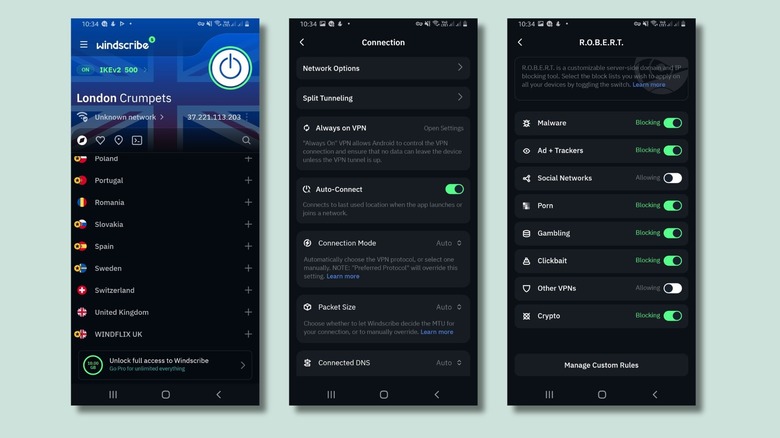
Windscribe is another VPN provider that doesn't get talked about nearly enough. This may be because the company has a similar policy to Mullvad when it comes to avoiding paid marketing efforts. It happens to be one of the most user-friendly VPNs I've come across, especially if you're new to these tools. I'm a parent, and one other thing that sold me on Windscribe is a content-blocking tool called R.O.B.E.R.T. This tool blocks trackers, filters out annoying ads and suspicious domains, and, most importantly for parents, it blocks adult content.
Besides Proton, Windscribe is one of the few good VPN services that offer a free plan, but the catch is, it's capped at 10GB data usage per month. It's also one of three free VPNs recommended by Tom's Guide. But 10GB isn't much unless you use it for basic non-media streaming browsing or audio. Within the app, you can get an additional 5GB by mentioning Windscribe on X. Also, inviting friends will give you an extra 1GB per month per user.
One other thing to note is that the number of available servers won't be as highas on the $5.75 per month (paid annually) plan. The pricing is fair, but Windscribe's server network isn't as extensive as the other VPNs above. However, if you're a light user or a parent who wants built-in content control, Windscribe would definitely be a decent pick.
Avoid: Turbo VPN has millions of downloads with zero reasons to trust it
Turbo VPN kicks off the VPN services you should avoid at all costs. Its main selling point is the fact that it's free, albeit with ads, and it seems to be wildly popular. However, download counts mean nothing, especially if the service is quietly stabbing you in the back. Turbo VPN is registered in Singapore, which is okay at first glance, until you learn that Turbo VPN might send your data to servers in China, which is known to be one of the most surveilled countries on the planet.
The concerns don't just stop there; Turbo VPN's privacy policy admits that it lets advertisers inject and access their own cookies onto your devices in the free plan. In a nutshell, your browsing habits become trackable to third parties. Besides that, many expert reviewers find it hard to recommend Turbo VPN due to many other questionable things, like having very little info on its website and a lack of customer support. ProPrivacy reviewed the service and concluded that Turbo VPN might not be providing any protection at all. Given the absence of clear and verifiable encryption details or customer support, it becomes hard to give this service the benefit of the doubt.
Furthermore, Turbo VPN has no kill switch, and its handling of DNS requests isn't the best. The free version will constantly bombard you with ads whenever you try to navigate the app's interface. Free VPNs are rarely good, and Turbo VPN is the perfect bad example. Try Proton VPN instead.
Avoid: Opera VPN isn't an actual VPN and that's not the only problem
The free version of Opera VPN is more of a proxy built into the Opera browser rather than a full-fledged VPN. This means that the only internet traffic that will receive protection is that which happens inside the browser. Other browsers, apps, and your background data will remain unprotected. Besides leaving you exposed, Opera VPN is also notorious for intrusive logging practices, according to 01net's detailed review. And that's not all you need to worry about. Opera is based in Norway, but a large portion of its shares were bought by a Chinese consortium a while back. As mentioned earlier, China is one of the worst jurisdictions for privacy issues related to VPNs.
Opera Browser will log your IP address, device identity, and your location. It will then use this data for targeted advertising. The VPN section of Opera has been independently audited, but there's no evidence of third-party audits on the browsers' overall privacy practices, and it's not hard to see why. If you're looking for privacy, Opera VPN, especially the browser in general, is the last place you'll find it.
Avoid: HMA VPN is in a bad jurisdiction, and has bad history

To start off, HMA (formerly Hide My Ass) is based in the U.K., which is already a bad VPN jurisdiction. Being part of the Five Eyes surveillance alliance means authorities can demand and share user data with other jurisdictions, and HMA has a history of complying. It happened back in 2011 when the FBI tracked a customer to an HMA IP address, obtained a U.K. court order, and HMA provided the connection logs that led to an arrest and a conviction.
According to CyberInsider, the 2011 case is concrete proof that HMA could share customer data with third parties. Right now, HMA claims to be a fully no-log VPN service, but it took a public privacy scandal to get there, and trust isn't that easy to rebuild in this industry. CyberInsider also flagged an unreliable kill switch that causes potential IP address leaks — a serious flaw for a paid VPN service. Furthermore, overall speeds are average, and streaming performance leaves much to be desired. Additionally, there's no WireGuard support. HMA is not worth the trouble over any of the six recommended VPNs on this list.
Avoid: Hola VPN has one major scary history
Hola VPN is free and popular, but it runs on one of the shadiest business models in the VPN service market. Instead of traffic going through dedicated servers, Hola creates its network out of existing users' connected devices under its free plan. So whenever you connect to Hola, your connection is also being used to route everyone else's traffic. Here's why such a setup is dangerous.
In 2015, Hola was caught up in a major scandal in which it sold users' bandwidth to support a botnet attack. It had monetized its free users' bandwidth via a service known as Luminati by selling access to the peer-to-peer network to paying customers. A hacker then leveraged Luminati to launch an attack on the 8chan community site. The attack left fingerprints tracing it back to Hola's network through users who were unaware that their connections were part of the attack. In a nutshell, imagine someone engaging in illegal or criminal activities through your IP address — there's a risk of you getting in trouble. Avoid Hola VPN at all costs.
Avoid: Psiphon has DNS leaks
TechRadar put Psiphon VPN through some tests and saw several major red flags. They include a lack of a kill switch on all platforms, DNS leaks exposing actual IP address, and a logging policy collecting connection time, bandwidth consumption, your device info, and, in some cases, the websites visited. DNS leaks are unacceptable for any serious VPN offering, and they are very present when using Psiphon VPN. Furthermore, Psiphon infrastructure is based in Canada, another Five Eyes country. Law enforcement can always compel it to hand over your data. Psiphon VPN can bypass censorship in some cases, but it's not privacy-first and should never be relied on for that purpose.
Besides the privacy concerns, Psiphon speeds aren't one of the best, even on the paid plan, maxing out at just 35.9 Mbps in TechRadar's test. Such speeds and a limited number of servers also make it harder to recommend for streaming video content. Even if you ignore the privacy concerns, there's nothing else that Psiphon has to offer, making it another VPN to avoid.
Methodology
We sifted through some of the most popular VPNs with at least one million downloads and four or five-star ratings on at least one major app store,such as the Play Store or App Store. Once we had a comprehensive list of popular VPN services, we cross-referenced expert reviews for each from expert review sites like Best VPN, Mentor, TechRadar, and Security.org, among others. The goal was to see which services perform well and are worth signing up for, and which should be avoided.
To qualify a VPN as a good recommendation, it had to have the following qualities: AES-256-bit encryption, a no-logs policy, fast speeds, multi-device support, a kill switch, and DNS leak protection. The bad VPN services are those that showed evidence of logging user activity, leaking user IP addresses, slow speeds, excessive ads, and a history of sharing user data with third parties.