

6 Office Machines That Ruled The '80s
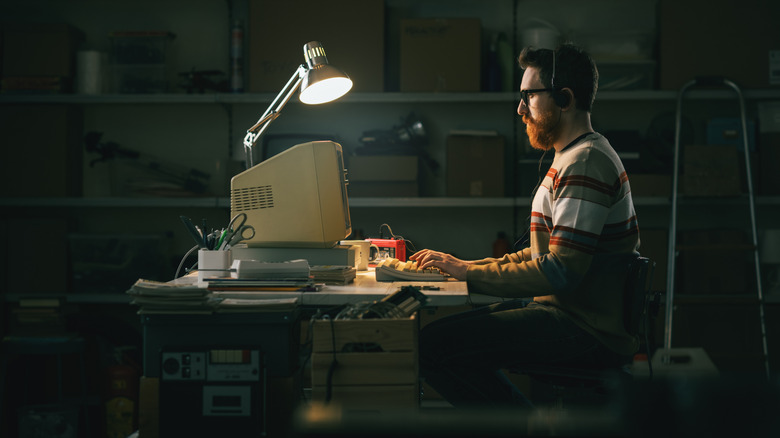
The 1980s are a fascinating period in recent history. It was the decade when regular people really started to experience the high-tech revolution, which, up to that point, had largely been limited to powerful government institutions and big corporations. It's when digital technology began replacing analog tech in our homes, and home computing went from something hobbyists did to something that would clearly become essential to modern life, as the many legendary gadgets that were born in the '90s later proved.
For most people, however, the place where the biggest changes were happening wasn't at home. Sure, maybe you were lucky enough to have a CD player, a Nintendo Entertainment System, or a home computer in the '80s, but these were luxury items. If you worked for a business, technology in your office wasn't a luxury, though. It was about staying competitive!
In the 1980s, an office would have a bold mix of technology from the past that had reached its final form before becoming obsolete, thanks to digital technology, and early and comparatively crude computerized devices. Looking back, it feels like an important transitional time, but for people hitting the daily grind at the time, all that mattered was that these office machines ruled the workplace.
Electronic typewriters were the peak of writing before PCs

One of the earliest typewriters was developed in 1808 by Italian inventor Pellegrino Turri, whose goal was to help a blind acquaintance keep up with written correspondence. From those humble beginnings, these clicky-clacky devices went on to become essential to communication, and business communication in particular.
During the 20th century, the electric typewriter emerged. Powered by an electric motor, it made the life of a professional typist so much easier, but by the '80s, a new breed of electronic typewriter quickly rose to dominance. These machines not only removed the need for muscle power to put ink to paper, but came with electronic memory and smart features that could compensate for all sorts of flaws on the part of the typist.
As you can see in the pages of the IBM Selectric System/2000 brochure, these devices could check your spelling and automatically correct typing errors, and some even had the option of a basic display. A screen allowed typists to check what they had written before committing it to paper. While these models might have been pricey, the time, ink, and paper saved added up quickly. Besides, they weren't as expensive as devices like the Wang Word Processor introduced in the mid-1970s, and nowhere as costly as the IBM PCs that would come later. Ironically enough, you can now buy a cool retro typewriter gadget on Amazon that's the pinnacle of electronic typewriters, which many now use to write without distraction.
Photocopiers stuffed the '80s with tons of paper

Xerox introduced the first photocopier in 1959 with the Xerox 914, and things have never been the same since. By the 1980s, just about every business had at least one copier, and large organizations might have entire copier departments with dedicated staff. While a typewriter or computer printer could spit out one copy easily, if you needed to hand out a memo to a department with 100 people, a copier was the only practical option.
In a time before computer scanners, email attachments, and way before cloud storage, photocopiers were essential for record-keeping. The title to your car, contracts you signed, and anything else of legal significance could be copied and certified so that everyone who needed a record would get one.
Ironically, the ease of copying would create an explosion of paper everywhere, which is probably why the idea of a paperless office became prevalent in the '90s and beyond. It's been a slow process, though, and even in the 2020s, we're not there yet!
Fax machines seemed like they would never leave us

Over the course of the 20th century, the world became more and more connected, with transcontinental phone lines and communication satellites making it possible to talk instantly to someone on the other side of the world. With global communication came global trade and business that was faster and more profitable. However, businesses need documents!
Quotes, contracts, blueprints, and many other crucial pieces of business intelligence need to make it across the world, the country, the state, or just to another branch in town. That's where the fax machine came into the picture, or rather, where the pictures came out of the fax machine. It's hard to overstate how important fax machines were in the 80s. They were such a vital part of everyday life that when the movie "Back to the Future Part II" imagined what the year 2015 would be like, it put tons of fax machines everywhere, right next to flying cars and hoverboards.
The technological principles of the fax machine are similar to dial-up modems and computer scanners. Eventually, computers would have the ability to receive faxes via modem, and faxing would persist long past its golden age in the '80s. Today, fax technology is usually nothing more than a throwaway add-on for a home office gadget you can buy for cheap at Costco. So, if for some reason someone wants to send you a fax, you probably still have a way of receiving it.
IBM PCs changed everything
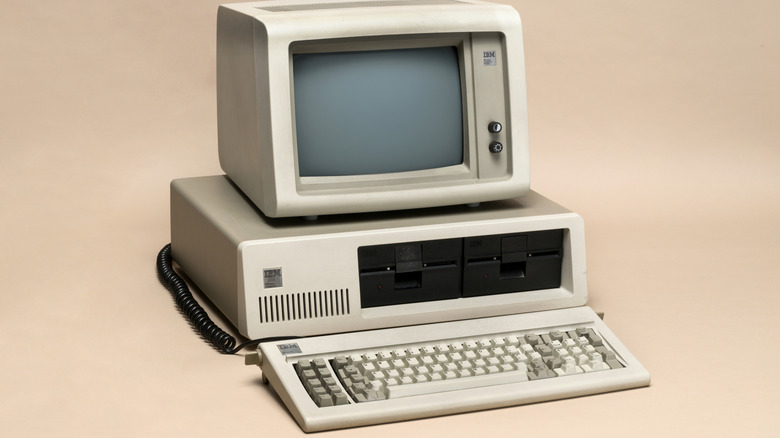
When the first IBM PC was released to the world in 1981, no one (not even IBM) could predict what an earth-shattering machine it would be. Personal computers had been around for a while, of course. Machines from the '70s, like the Apple I and Apple II, as well as the Commodore PET, would be recognizable as personal computers to anyone today. The '80s also saw the rise of microcomputers like the Sinclair ZX80 and Commodore 64, which were affordable and especially popular for home use.
The IBM PC, however, was not a home entertainment toy. After all, the B in IBM stands for Business, and the versatile Intel CPU inside each IBM PC allowed it to do just about anything a programmer could want. Software makers took full advantage of this, and the IBM PC running an early version of MS-DOS received great software support – word processors, accounting applications, spreadsheets, and more. Much to IBM's dismay, other companies (notably Compaq) managed to legally clone the IBM PC's firmware. Suddenly, anyone could make an IBM-compatible computer, and all that software would run on those computers, too.
Businesses ate it up, and by the second half of the '80s, you'd see these early PCs everywhere in company offices. The PC could replace so many specialized machines, while also doing completely new things or speeding up work that used to be manual. You probably work on a direct descendant of that first PC today!
Dot matrix printers turned bytes to ink with a banshee wail
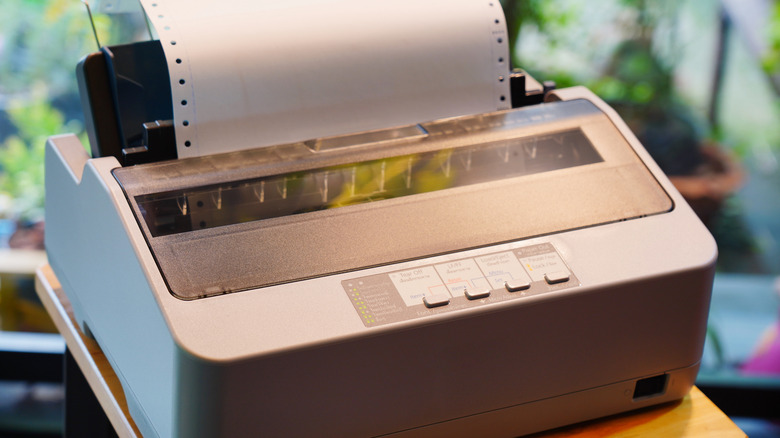
With the rise of the PC, there was a problem. The office of the '80s was still all about paper. Machines like electronic typewriters and fax machines produced paper by default, and photocopiers made it easy to duplicate that paper. On a computer, the information lives on a disk and is viewable on screen. How do you get it on paper?
The answer is, of course, a printer, and dot matrix printers were a popular solution for businesses that needed the contents of a computer turned into a hard copy. It's called a dot matrix printer because the print head consists of a set of small pins that run along a line of text, similar to a typewriter. The pins strike the paper through an ink ribbon, transferring dots of ink to the paper.
This design made these printers cheap and rugged, but it also gave them a distinct shriek like nothing else you'd hear in a noisy '80s office. You'd want to pull your office door shut while printing a report! While only basic graphics could be printed using this design, there were some unique benefits, too. Most of these printers supported being attached to a continuous ream of paper, which made them perfect for printing large documents. Also, since the pins physically struck the paper, this is one of the only printer types that could be used with carbon paper, instantly creating carbon copies of documents.
Laser printers raised the bar of professional print quality
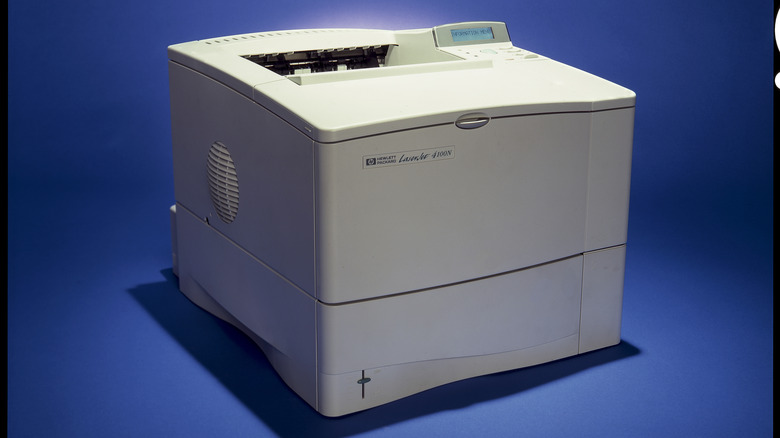
While dot matrix printers were the workhorses of the '80s, the prints they produced were functional, but frankly quite ugly. High-quality printing was expensive, but the rise of laser printers brought professional-quality printing down to the level of office machines. Laser printing technology had been around for a while by then, as Gary Starkweather came up with the concept in 1967. However, it would be decades before these became practical office machines.
Introduced in 1984 at a whopping $3,500 starting price, the HP LaserJet was a pioneering model. Laser printers work with toner powder instead of ink. The paper is electrostatically charged and then exposed to the toner. The powder is attracted to the parts of the paper with the opposite charge, and then heat is used to permanently bond the toner before spitting out the page. The quality is incredible, and once bosses started seeing quarterly reports in glorious laser-printer quality, there was no going back to a dot matrix printout.
Although laser printers may have been relatively expensive, the actual cost per page was low, so once a business had invested in a laser printer, it could pay for itself in the long run. Not only that, but these printers were fast. Even early models could knock out eight pages per minute, regardless of graphics or text density.
The best '80s office machines are still with us
The '80s might now be rapidly receding in the rearview mirror, but the modern workplace isn't all that different. Laser printers and photocopiers are still common, though the need to print hard copies of documents isn't nearly as high as it once was. These days, you may only print something as a last resort, given we're all conscious of our carbon footprint now, right? Well, maybe things aren't so different. It's just that instead of chopping down trees to print reports, we're burning through huge amounts of energy to run prompts on chatbots like Google Gemini.
PCs are still everywhere, and that Windows computer you use to read articles like this one instead of finishing that big report for your boss is still, at its core, just like that first IBM PC from 1981. Even Costco still relies on IBM computers from the '80s. Some types of businesses, like airlines, are still using dot matrix printers because they need an impact printer, or because it's still the most affordable and reliable way to print reams of documents like boarding passes.
It makes you wonder what office gadget of today will still be around 40 years from now. Who are we kidding, though? All our jobs could be replaced by AI by then. But even if that happens, our robot overlords might still need a dot matrix printer for something.