

AMOLED Vs PMOLED Displays: The Main Differences
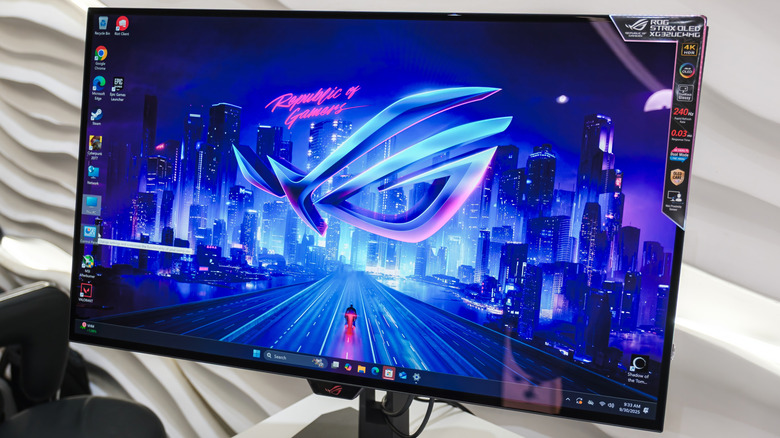
OLED displays are known to be the most premium option available to anyone wanting the best visual experience. While they may not be the most reliable TVs around in terms of how long they last, their high contrast and vast color gamut still puts them leagues above any alternative.
The OLED in OLED TVs stands for organic light-emitting diodes, which is to say they use individual carbon-based pixels instead of a joint backlight. This means that each pixel can be turned on and off without affecting any other on the screen. The relatively simple acronym OLED isn't the only variant, however; there are terms like AMOLED and PMOLED that pop up often, usually when referring to smartphones or smaller digital devices.
AMOLED stands for Active-Matrix OLED, whereas PMOLED stands for Passive-Matrix OLED. So, what's the difference between AMOLED and PMOLED, and why do manufacturers use AMOLED more often? As the name suggests, the technology used in AMOLED actively controls the pixels through dedicated switches present in each pixel, whereas PMOLED displays light up pixels by pulsing them rapidly before turning them off. A PMOLED screen doesn't have switches in each pixel, so rows of pixels are controlled at once, instead of each one separately. This means that AMOLEDs provide better visuals and a much faster refresh rate, while PMOLEDs are cheaper to manufacture and more suited to smaller devices.
What type of OLED is used in TVs?
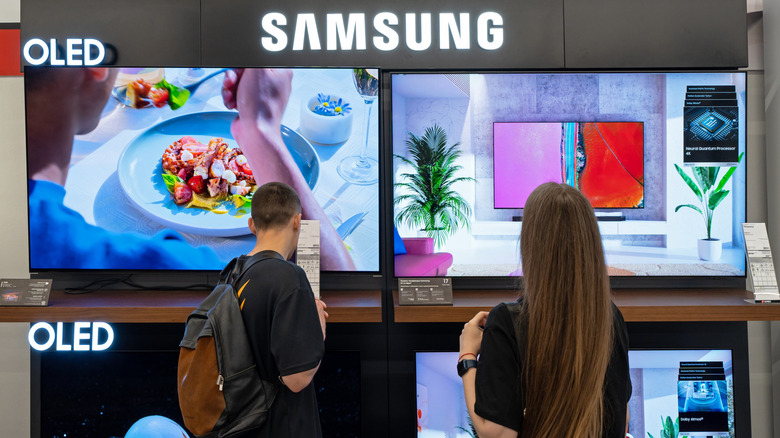
When the word OLED is put next to a TV, it always refers to an AMOLED display. A PMOLED display physically cannot work on a TV, as it only functions on devices a few inches in length. We've already talked about how PMOLED screens have a slower refresh rate, but since PMOLED technology sends signals in lines and columns, the actual difference depends on how many pixels exist in each line. This makes for a marginal difference in small units, but if you were to put a PMOLED screen on a TV or a monitor for gaming that has a 4K resolution, the pixels simply wouldn't refresh fast enough for a decent experience.
PMOLED is a simpler technology that's more suited to cheaper devices with small displays. These include the displays on some smartwatches and on other smaller accessories like power banks. Most higher-end gadgets still use other displays, though, such as the Apple Watch making use of AMOLED. While phones are smaller, they're still a bit too big for PMOLEDs, which is why smartphone screens also opt for AMOLED technology.
Apart from worse visual quality, PMOLED displays also aren't as efficient, as they need significantly more energy to be as bright as an OLED. This means that PMOLEDs don't last long if they're made to output bright visuals. This is already a disadvantage of OLED displays, and it's worse in PMOLEDs.