

What's The Difference Between 120Hz And 144Hz TVs?
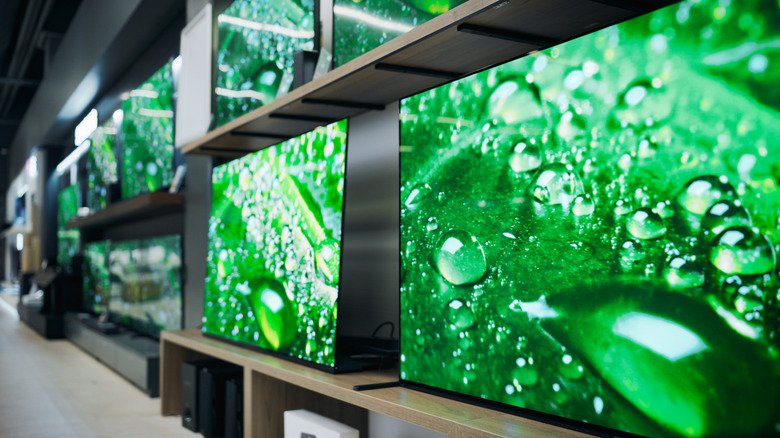
The TV technology is always evolving. We have had CRT TVs and Plasma TVs, and then those made way for LCD TVs, which were further upgraded to Mini-LED TVs and QLED TVs. Let's not forget the OLED TVs, QD-OLED TVs, and the newer "Micro RGB TVs" that are being touted as the future. But it's not just the panel technology that's getting a fresh coat of paint every few years. There have also been 120Hz TVs and 144Hz TVs, the latter of which has particularly gained traction over the last couple of years.
All major smart TV brands, from LG and Samsung to Hisense and TCL, currently have at least one 144Hz television in their portfolio. That said, the slightly older 120Hz TVs remain a popular choice among TV buyers. But why are the terms like 120Hz and 144Hz important for a TV, and is there a reasonable difference in TVs marketing them? Let's find out.
What is 60Hz, 120Hz, or 144Hz?
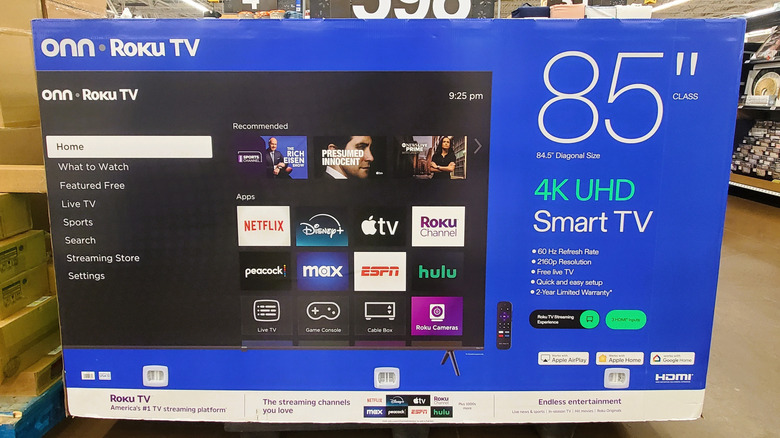
The numbers like 60Hz, 120Hz, and 144Hz in a TV or monitor's specifications refer to the refresh rate of the display panel. It's the number of times a display can change the visuals on the screen in a second. It's not something you see with the naked eye. You can deduce a faster refresh rate over a slower one because faster means more fluid and smoother visuals. This is why the 144Hz refresh rate is typically considered an upgrade over a television with a traditional 60Hz panel or a faster 120Hz screen.
A faster refresh rate is typically helpful in motion clarity when you are watching content on your TV. As a result, when you are looking at a fast-moving object, you'll get a clearer image on a higher refresh rate TV. Moreover, a higher refresh rate can help in removing judder, which is essentially an artifact that appears when the number of frames coming with the visuals doesn't exactly meet the refresh rate of the panel. TVs employ different tactics to minimize judder, and one of the ways is by displaying all frames multiple times to match the refresh rate. For example, each frame in a 24 FPS movie can be displayed five times to match the 120Hz refresh rate of a TV.
Higher refresh rates mostly come into play when you're gaming, and your gaming device — a console or PC — is capable of pushing out a greater number of frames. So, if your TV has a faster refresh rate, it'll be able to make the most of those extra frames. However, whether or not a 144Hz TV is truly a superior choice over a 120Hz TV for someone depends entirely on their needs.
120Hz vs. 144Hz TVs
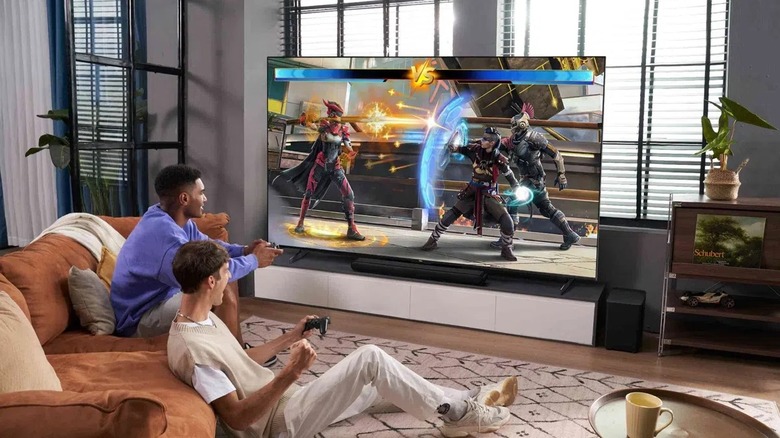
As 144Hz TVs clearly have a faster refresh rate than 120Hz TVs, they are capable of producing more fluid motion and display more frames per second while gaming. However, there is only a small group of buyers that will really benefit from a 144Hz TV – PC gamers with a high-end machine. As both major consoles, the Sony PlayStation 5 and Xbox Series X, are limited to 120fps gaming, it's only the high-end PCs that can really produce 144 fps or higher. So, if you're planning to buy a TV as a display for your gaming PC, you can benefit from a 144Hz panel.
Otherwise, 120Hz TVs are still a great choice for the vast majority of buyers, as most of the content you watch on your TV, whether it's movies (24 FPS) or TV shows (24 FPS, 30 FPS, or 60 FPS), is easily handled by a 120Hz TV. There are no skipped frames or frames that are getting repeated more than others. The same is not so easy with a 144Hz, unless that TV uses variable refresh rate (VRR) to match the refresh rate with the frame rate of each type of content.
So, unless you are looking to get every frame out of your TV while gaming with your PC, you're better off with a 120Hz TV and focusing on other key things when buying a TV, so that you don't make common mistakes that most folks make.