

5 Useful 3D Printer Projects That Can Level Up Your Home

3D printing is often relegated to simply producing plastic shelf-fillers and flexible dragons, but there's far more to melting filament into different shapes. There's a lot to be said about 3D printers being one of the best tools to enter the DIY space and solve domestic design flaws, including smart home applications.
While smart devices are technologically impressive, they're sometimes plagued by clumsy practical designs and trailing power cables that clutter kitchen counters and side tables. Although there are plenty of reasons to include smart speakers and voice assistants in a smart home setup. Instead of spending money on expensive, mass-produced plastic accessories, homeowners and 3D printer users are increasingly contributing to the global maker community to manufacture their own bespoke solutions. This community relies on multiple open-source sharing websites, such as Thingiverse and Makerworld, to upload, share, and download functional 3D models for free or a nominal fee.
By leveraging affordable and advanced 3D printers such as Elegoo Centauri Carbon 2, users can create smart home accessories that seamlessly blend technology (and a bit of fan service) into their home. These projects are a fun and creative outlet for the maker and result in practical objects that make a smart home feel like it's meant for the whole family. This could be a mount that secures a smart home speaker directly to a power outlet, whilst hiding the power cable or a decorative housing based on someone's favorite character to help make a smart home speaker truly theirs.
Amazon Echo Dot 4 Plug Mount
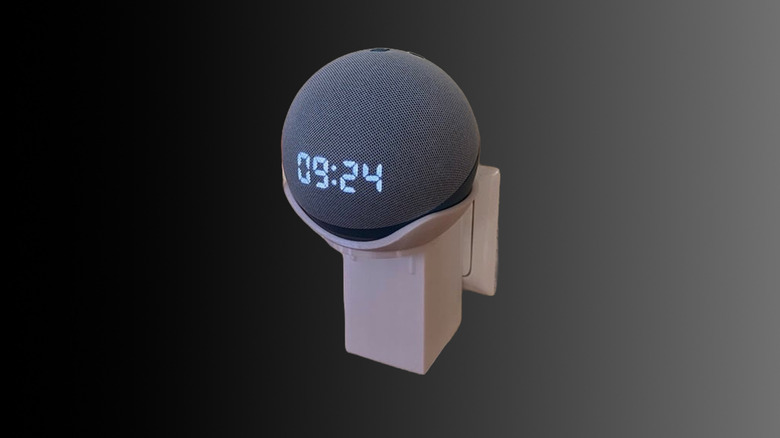
Amazon's move from a flat puck design to a large sphere for its Alexa-powered Echo Dot made it difficult to place on a crowded bedside table or narrow shelf. Designer the_qsr addressed this problem by creating a clean wall mount for the Echo Dot 4th Gen that focuses on cable management and a clean aesthetic. It sits flush against a power outlet socket without a mess of wires hanging down, which comes in handy in hallways or entryways where a trailing cable could be a trip hazard or a big eyesore.
There's also a mount for EU plug sockets by designer Voozac that has the same idea, but the mount is designed around the EU plug form factor. Both mounts consist of two parts that can be combined with a small pin and super glue for maximum stability, although a strong adhesive should work fine. For those concerned about light bleeding through from the Echo Dot, designers recommend using a dark-colored PLA filament or increasing the infill percentage to 10% of higher. This prevents the light from the illuminated base ring from bleeding through the plastic, ensuring that only the "glow" is visible. These professional-looking upgrades only cost a few cents' worth of PLA filament, so it would be rude not to try this design out.
Android Body for Google Home Mini
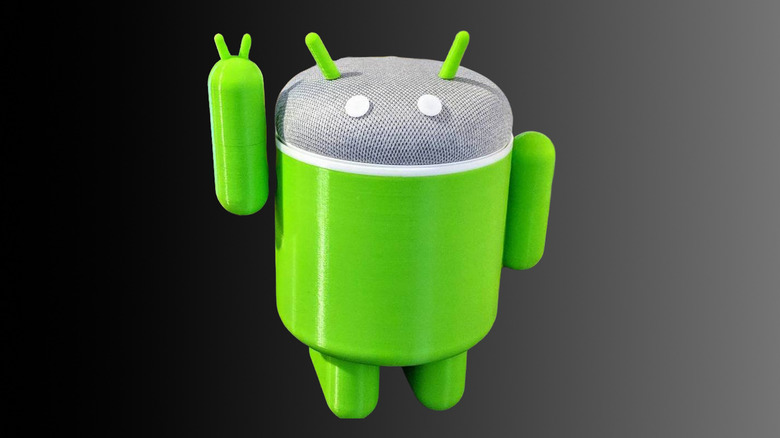
While some want to hide their smart home equipment or make it look eloquent, some 3D printer owners want to get creative and turn their smart home speakers into something fun yet functional. Google Home Mini is a very functional smart speaker, but it's somewhat sterile in appearance to some. RAY_Design created an Android-inspired body that transforms the speaker into a desktop version of the Android mascot. It's a fun project for any room that doesn't sacrifice Google Home Mini's audio quality or microphone sensitivity.
This project is a great example of DIY smart home modification creativity, requiring simple 3D parts and assembly. The main body needs support during the printing process due to its curved geometry, with the designer suggesting using tiny amounts of hot glue for the eyes and antennae. This adhesive is easy to remove from the speaker mesh if users want to change its look later. Google has moved towards the "Nest" branding across its smart speaker range while discontinuing the dedicated brand name as it previously was, so it's nice to see the community giving a nod to Google's roots and supporting housing for older hardware. For those who have an old Google Home Mini speaker in the drawer that's seen better days cosmetically, this is such a great product to breathe new life into old hardware instead of sending it to the landfill.
Outlet Mount for Google Home Mini
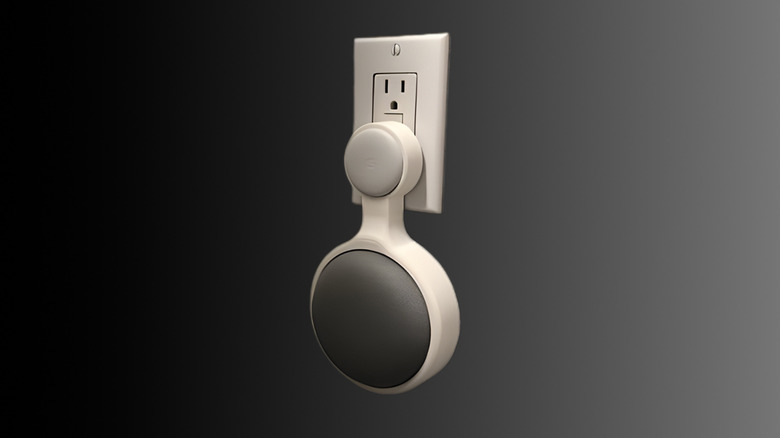
Like the Amazon Echo Dot outlet mount, there's one for Google-powered smart homes, too. The outlet mount for Google Home Mini by Yelt is a simple, functional, and modern design that fits into any home setup. It uses the power adaptor to hold the speaker in place, with the power cord wrapped around the internal holder, resulting in a plug-and-play solution that requires zero additional hardware. This project gets rid of cables, ruining the aesthetics of a user's smart home entirely, while keeping the Google Home Mini away from damp surfaces and kitchen spills.
The design is optimized for PLA+ filament that has a bit more flexibility and durability than standard PLA. It's made with a 0.2mm resolution and a 10% infill, making it a fast and easy print for most entry-level 3D printers. However, most 3D printers ship with a 0.04mm extrusion nozzle, so make sure to double-check this before printing. Although slicing software, such as Elegoo's Make It (based on Cura), should allow for different nozzle sizes, materials, and advanced settings to print the Google Home Mini outlet mount however they want. The settings mentioned above are purely the designer's suggestion; that doesn't mean the print will fail if these settings aren't adhered to, so don't worry.
R2-D2 Google Home Mini or Echo Dot 4/5 Holder
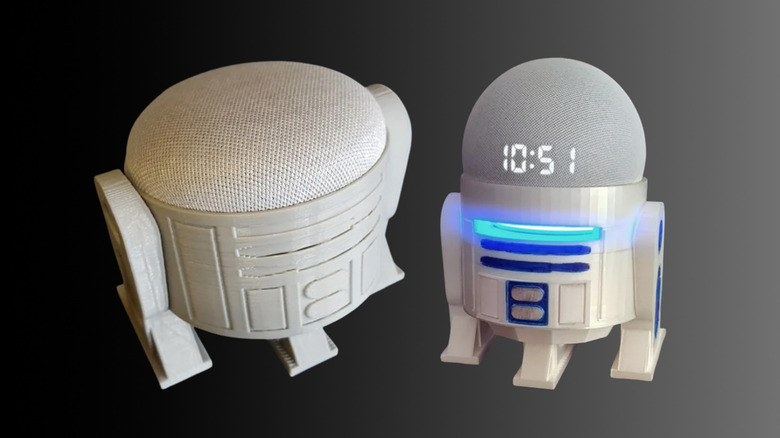
While pretty much any character's face could be fashioned into a smart speaker, there's something about droids turning into smart home assistants that's magical. Designer Simomura used their Fusion 360 skills to create an R2-D2 speaker holder for the Google Home Mini, with the smart speaker's fabric top serving as the droid's domed head. Separately, designer Dinhorj developed a remixed R2-D2 housing for Amazon Echo Dot Gen 4 and 5. This iteration specifically modifies the body to let the glow of the Echo Dot's ring LED at its base shine through R2's utility port. With Alexa+ now rolling out to American users, it might finally be worthy of the best astromech droid from a galaxy far, far away.
Projects are less practical than other accessories here, but they're perfect for that special someone who wants as much Star Wars as possible in their home. Simomura's Google Home Mini design is best printed in four separate components for the best detailed results, while Dinhorj's version utilizes a two-part main body to reduce printing time and support structures. Want to add more detail to this build? Designer Knickohr has designed an R2-D2 with multiple parts, which is an awesome project on its own. It's also worth a mention, as users can scale the parts used for R2-D2's dome head to hot glue them onto the Google Home Mini or Echo Dot Speaker for even more detail.
Cable Corners
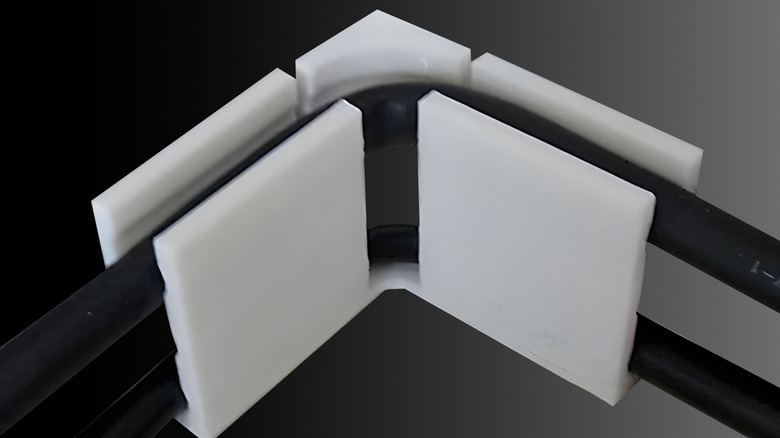
There will be times when visible cables for smart tech can't be avoided, but making them look good helps. Designer muzz64 developed a solution called Cable Corners that keeps power cords tucked tightly against walls and around 90-degree turns without resorting to adhesives, screws, and permanent installations. Conduit is the usual cable management go-to, but it's difficult to bend and stands out like a sore thumb. Cable corners force cords into the position a user wants with uniform spacing to turn a clutter of wires into a professional-looking setup.
The STL files provided are highly versatile to accommodate between one and four standard-sized cables, including network and power cords. It's a modular design that can be scaled up in slicer software depending on what kind of cables need managing, including thick power extension cables to thin power adaptor cables for smart home speakers. To ensure Cable Corners are strong enough, the designer recommends using a 35% infill and three outer shells. It also goes without saying to use a high-quality filament from a well-known brand, going for at least PLA+ for the extra strength and flexibility. It's a very simple design that can be used throughout a user's smart home to have cable management that matches the pedigree of their smart home, where needed.