

Amazon Wants The FCC To Deny SpaceX's Orbital Data Center Proposal - Here's Why
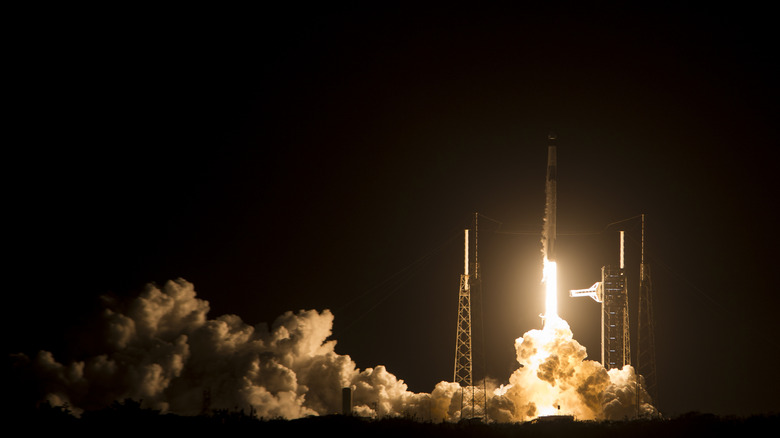
In a headline-grabbing move, Amazon has thrown itself into the fight over SpaceX's controversial plan to launch a million data centers into Earth's orbit. In early March 2025, Amazon lodged a complaint against the plan, urging the Federal Communications Commission to deny SpaceX's application because SpaceX had not presented any solid details about how it would achieve its plan. Amazon argues that SpaceX's plan would take centuries and force every agency that uses low Earth orbit to schedule around a plan that may never even come to fruition.
Moreover, Amazon cites the FCC's own rules (Section 25.112) that make it clear (via Scribd) the Commission must dismiss all "applicants that, among other things, fail to provide complete information or full answers to the questions asked by the Commission's Part 25 licensing rules." That was met harshly by FCC Chairman Brendan Carr, an ally of SpaceX owner Elon Musk, as he publicly scolded Jeff Bezos' conglomerate in an X post.
Amazon Leo's complaint goes on to point out that others are opposed to the development, noting that the pollution of such systems could nullify the environmental gains won by shifting data center infrastructure northward. Furthermore, some worry that such constellations could potentially destroy the field of astronomy. Whether SpaceX gets its orbital data center business off the ground may have a major impact on its status as the most valuable company in the world.
A lofty proposal
SpaceX's data center plan is "the first step towards becoming a Kardeshev II-level civilization," fully harnessing the Sun to propel "humanity's multi-planetary future." According to the company's FCC proposal (via Scribd), the system's one million satellites will operate in "narrow orbital shells" spanning up to 50 kilometers wide. To fully harness the Sun's rays, the satellites must operate outside the Earth's shadow, necessitating a much higher altitude than current LEO constellations, estimated to be between 500 and 2,000 km. Data transfers will rely "nearly exclusively on high-bandwidth optical links," to transfer data to both Starlink satellites and earthbound customers.
Amazon's criticism isn't without merit. SpaceX's ambitions would require it to launch roughly 63 times more satellites than are currently in low Earth orbit. Google's executive Travis Beals of Google confirmed it will take roughly 10,000 satellites to match the capacity of one gigawatt data campus (via WSJ). Many were already skeptical of Starlink's 40,000 satellite initiative. SpaceX's FCC proposal does little to explain how it will meet this currently unattainable launch capacity, requiring the company to dramatically escalate its launch rates from once every few days to every few hours.
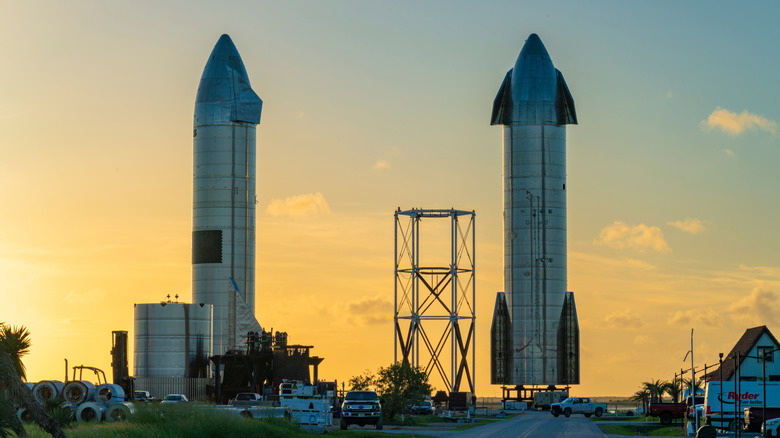
Further complicating the issue is the likely size of SpaceX's LEO data centers. Experts believe that low-Earth orbit data centers' added hardware will make them much larger than any previous SpaceX satellite (via Sky & Telescope). This will require SpaceX to rely on its troubled Starship rocket, whose viral explosions have delayed NASA's Artemis lunar mission by two years and counting. To date, the partnership is aiming for a 2028 launch date that many experts are treating with heavy skepticism.
Grand ambitions

Low Earth orbit could solve many of the issues facing data centers today. For one, the use of solar power could make them more sustainable than their fossil fuel-dependent counterparts. Furthermore, the atmosphere's -250 degree temperatures could serve as a natural coolant, mitigating the need for massive water reserves. Meanwhile, orbit-bound centers could circumvent the expensive, regulation-riddled process of building, maintaining, and operating terrestrial data centers. As Musk stated in a SpaceX press release, orbital data centers could lower costs "within 2 to 3 years."
Meanwhile, some in the scientific community are sounding the alarm. Many worry that SpaceX's constellation will exacerbate environmental issues by causing significant air pollution and space debris. Others have labeled the initiative as an existential threat to astronomy, noting that the massive data centers could virtually destroy dark skies. The FCC heighted environmental apprehensions when it fast-tracked SpaceX's application, allowing the company to forgo several barriers to launch, including key environmental impact assessments.
Despite concerns, industry giants and startups alike will look to transform the great frontier into a data hub. Google, for instance, hopes to leverage its partnership with rocket operator Planet to launch at least two processing units by 2027. Blue Origin, Bezos' alternative to SpaceX, is currently developing its own orbital data center technology. OpenAI, for its part, has investigated purchasing a rocket operator (via WSJ). Startups like Starcloud, Axiom Space, and Aetherflux have also made progress towards the feat. Reportedly, many of these projects will be serviced by Nvidia's recently-announced space chip (via CNBC). China, meanwhile, recently made the technology a key tenet of its five-year plan, further escalating tensions within the space race.