

The 5 Best Multi-Color 3D Printers You Can Buy In 2026
Fused Deposition Modeling (FDM) 3D printers have evolved from a time sink gimmick to sophisticated additive manufacturing equipment that sits on a user's desk. There's no longer a need for multiple printers running to make parts of different colors, and this also goes for subtractive manufacturing with lasers and CNC machining. From high-speed, multi-color plastic modeling to intricate metal carving, today's best 3D printers prioritize versatility and ease of use, switching materials and colors with a single click. It's becoming essential for 3D printers to, at the very least, handle multiple spools of filament and multitask to save desk space and reduce time limitations. Want to make a custom water block for that CPU heatsink with a cool design on it? With these multi-color and multifunction 3D printers, that's now possible from the comfort of home with some amazing sites for free 3D printing projects and open source models.
Investing in a high-quality multi-color 3D printer solves workspace clutter. Instead of buying a standalone laser cutter or a small CNC mill, users can opt for a modular system that handles multi-color 3D printing and has this technology baked into the same footprint. These machines offer incredible value by cutting down on waste and consolidating a project's workflow while reducing the learning curve associated with multiple software and hardware platforms. Even if it's just a 3D printer that can use multiple filaments at once using swappable nozzles and automated filament management, users end up spending less time troubleshooting and more time making.
Elegoo Centauri Carbon 2
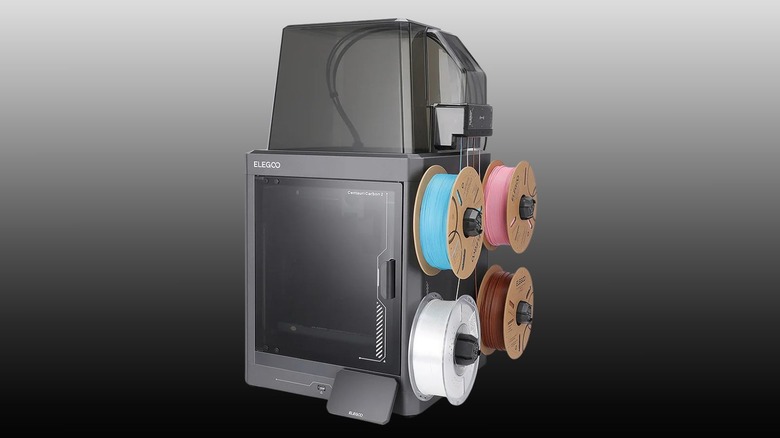
The Elegoo Centauri Carbon 2 Combo is an affordable yet easy entry point into multi-color 3D printing for $419. It features the Canvas 4-color printing system, which manages instant color switching and smart filament detection to keep prints running smoothly. This combination of system features is a lifesaver for long print runs, as it can automatically refill filament or alert users to filament spool tangles before they ruin a project. The printer itself uses a high-speed CoreXY motion system that can hit up to 20,000 millimeters per second squared, which is an extremely fast way of printing off projects.
Pure speed aside (and remembering higher quality 3D print projects are only achievable at slower speeds), the Centauri Carbon 2 is designed to be a set-and-forget 3D printer for the desktop. It includes 31 smart sensors that monitor everything from clog detection to fan self-checks. Users can leave the printer running in the same room without distraction since it operates at noise levels under 45 decibels. Its 350-degree-Celsius nozzle and enclosed chamber allow it to handle tougher engineering materials like carbon-fiber reinforced filaments as easily as standard PLA. The recommended slicer to use for Centauri Carbon 2 is Elegoo's modified Cura build, simply named Elegoo Slicer. You can use the Elegoo Matrix app from a smart device to monitor prints in real-time or start a new project. Struggling to find a new project? Elegoo also has the Nexprint model-sharing platform built into their slicer to get going straight away.
Snapmaker Artisan
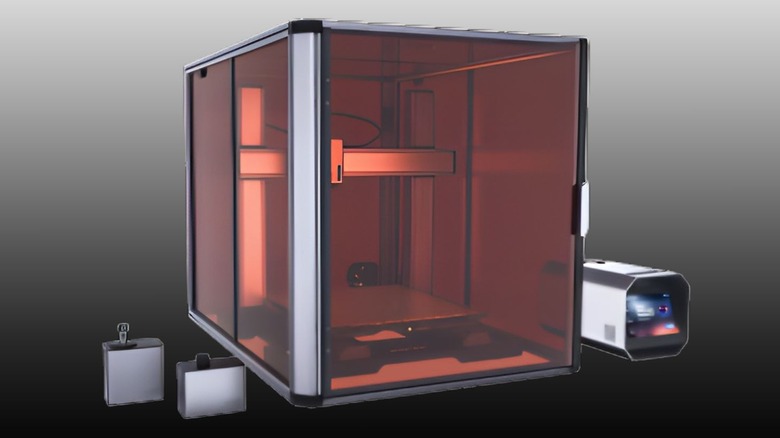
For those looking for a 3D printer that handles subtractive as well as additive desktop manufacturing, the Snapmaker Artisan 3-in-1 3D Printer is a solid fabrication solution that starts at $2,299. Designed for professional prototyping and an all-in-one crafts solution, it offers a large cubic work area that is 400 millimeters on each side and can accommodate all kinds of ambitious projects (though maybe not these giant 3D-printed objects). It uses a dual-extrusion 3D printing head that supports quick-swap hot ends, making it easy to switch between different nozzle sizes or materials, including water-soluble PVA. Rather than just focusing on multi-color prints, which are possible, this is a great solution for using a support filament like PVA that simply washes away in water.
The Artisan features swappable modules, so you can just slide out the dual printhead and replace it with a 40W blue laser module or a 200W CNC module in under a minute. The laser is powerful enough to cut through basswood plywood up to 15 millimeters thick in a single pass, while the CNC module can carve tough materials like beech and aluminum. These are all industrial-grade linear modules with steel guide rails to maintain precision during the heavy-duty tasks they're made for. Operator protection hasn't been overlooked either, thanks to the Laser Class 1 safety enclosure and a built-in emergency stop button on the control unit, which has a 7-inch touchscreen to manage all of Artisan's features.
Original Prusa XL
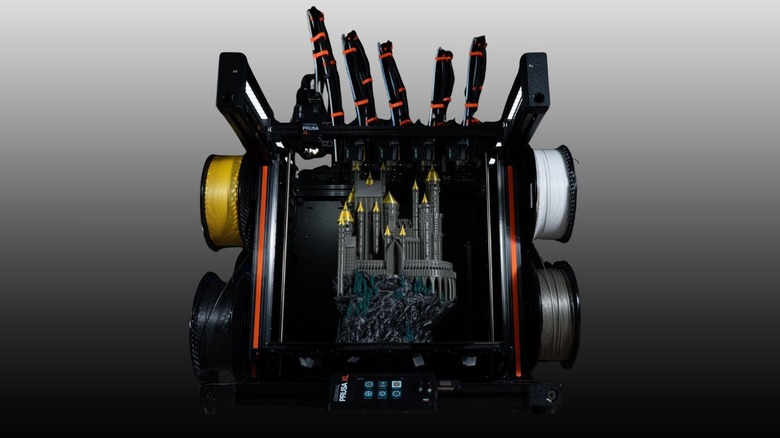
If cutting down on waste in your multi-color 3D printing is important to you, the Original Prusa XL is a large-format 3D printer at $2,299 that supports multiple toolheads and is engineered for material efficiency. Its tool changer can support up to five independent tool heads, each with its own nozzle. This design eliminates the need to purge printer filament during color changes, resulting in zero-waste printing and fast toolhead swapping. The printer also helps you save money on filaments by using cheaper PLA for support structures while reserving expensive engineering materials for the main object. This makes the Original Prusa XL not just one of the best multi-color 3D printers on the market, but also great at using multiple types of filament in one print run and perfect for carrying out useful 3D printer projects to level up your smart home.
The Original Prusa XL also features a segmented heatbed with 16 individually controlled tiles to help prevent warping and reduce energy consumption. Its Loadcell sensor ensures a quality first layer by automatically calibrating the nozzle offset. Because Prusa Research operates in the EU and follows an open-source philosophy, they release full specs and even schematics for their products, allowing users to upgrade easily as new parts become available. Prusa also vows 100% privacy, with their printers designed to be operated offline without any restrictions.
Creality K1 Max AI
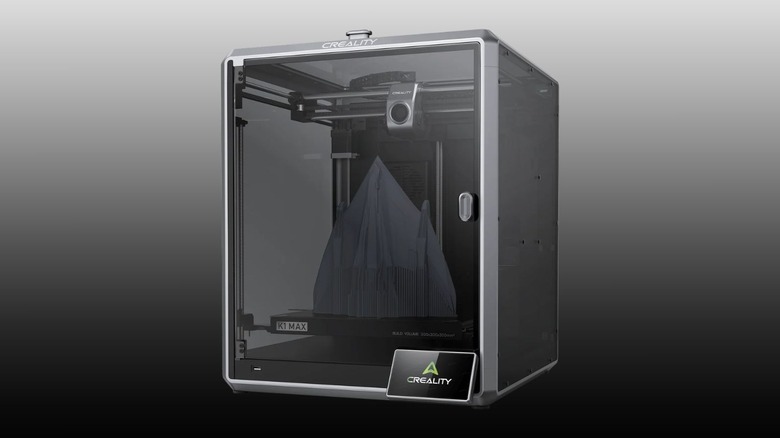
The Creality K1 Max AI is a high-speed flagship 3D Printer that turns into a multi-color system when paired with the Creality SpacePi X4 bundle for $766.19. It's designed with productivity in mind with top print speeds of 600 millimeters per second. An AI LiDAR scanner is used to make sure high speeds don't affect build quality. It also makes sure the first layer is as perfect as possible by preventing any waste material on a failed print as a result. This is a great feature for overnight projects, making sure you wake up to a solid print with alerts should there be issues with the print.
The K1 Max AI features a large cubic build area, 300 millimeters on each side, and a rigid die-cast aluminum frame for stability. The included AI camera covers real-time monitoring and automatic failure detection after the first layer to make sure issues are caught before filament gets wasted, which again is a great feature when leaving K1 Max AI in a workshop or another room. The dual-fan cooling system hardens the model instantly, allowing for complex overhangs without the need for support structures. There's a built-in air purifier to make sure smells and fumes are taken care of before exiting the casing, and its hands-free auto-leveling helps support out-of-the-box 3D printing.
Prusa CORE One+ and MMU3 Upgrade
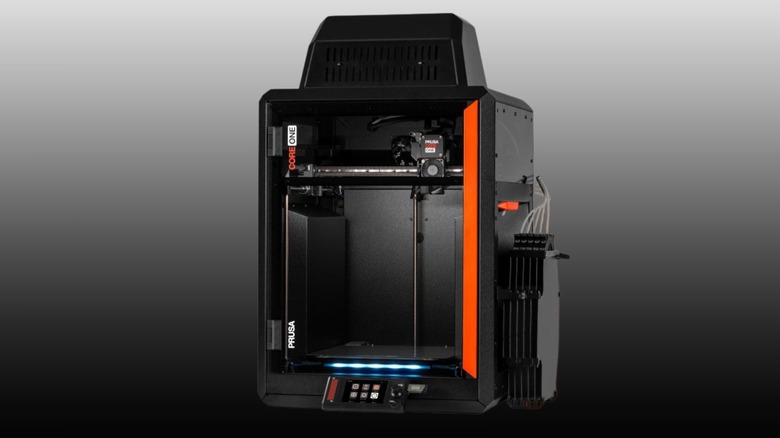
For users looking to get into the multi-color Prusa ecosystem for less, the Prusa CORE One+ is a professional-grade workhorse starting at $999 for the kit or $1,299 fully assembled. This CoreXY 3D printer features an all-steel exoskeleton and a full enclosure that includes an active temperature control reaching up to 55 degrees Celsius. That makes this a great solution for handling advanced materials like ASA, PC, and Nylon. Users can then add an MMU Enclosed upgrade for $399 to enable multi-color printing with support for up to five filaments simultaneously.
This printer is designed for modders and engineered to be a long-lasting workhorse, with no parts glued or welded together, allowing users to repair and customize it with a screwdriver. It includes a Nextruder with 360-degree cooling to ensure overhang quality and dimensional accuracy, and it also supports the use of industrial polymers like PPS-CF and PEKK-CF. As with the Original Prusa XL, the CORE One+ can operate offline for enhanced privacy. For serious 3D printer buffs, this is a reliable investment that saves money in the long run through its modular design and Prusa's strong long-term support that includes regular firmware and hardware updates.