

The 10 Best Budget And Expensive Travel Vlogging Cameras You Can Buy
We may receive a commission on purchases made from links.
With short-form content going mainstream, it seems like everyone's making vlogs these days, especially when they're on the road. And that's for a very good reason, since one viral video can change your life overnight. If you want in, the first step is getting the right gear, and that usually starts with a camera. Truth be told, the best camera for many beginner vloggers is the one they already have in their pocket. In fact, the best phones for photographers these days come with multiple lenses and can shoot 4K video with ease. But phones do have limitations, chief among them being their small sensors, which limit nighttime videography. Plus, they can't be used in extreme conditions, like when riding a bike.
While getting a dedicated camera makes sense for many people, there's no one-size-fits-all travel vlogging camera. People who want to film their lives on the go might need a portable point-and-shoot model, while mirrorless and DSLR setups are better suited for controlled, at-home environments. Still, your budget will play the biggest role, since you can get a decent camera for under $500 or splurge way beyond $1,000. With so many choices, things can get confusing fast. This is why we've compiled a list of the 10 best budget and premium travel vlogging cameras to consider in 2026.
10. Insta360 Go 3s
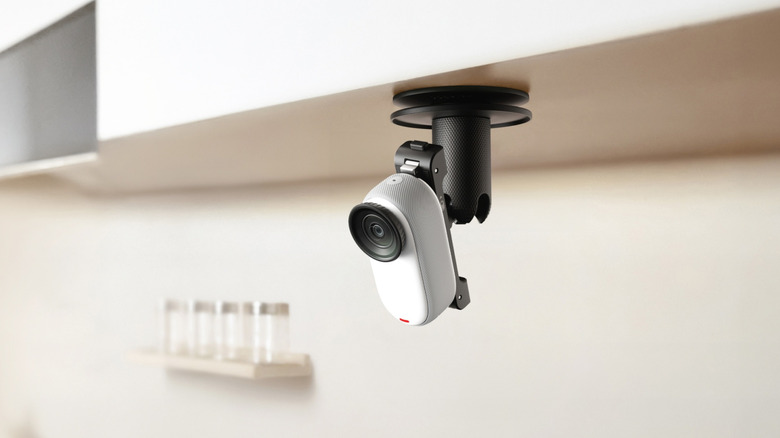
Up until a few years back, small cameras felt more like a gimmick at best. Their lenses were tiny, and they lacked the processing power to make videos look good. Well, Insta360 has flipped that idea on its head, and it's best evidenced by the Go 3s ($269 on Amazon). The whole system comes in two parts: the camera itself, a 1.4-ounce unit capable of capturing full 4K videos, and the Action Pod that holds a flip screen and buttons for easier use.
The Go 3s' bread and butter is its flexibility. You can use the camera on its own by sticking it to your t-shirt with a magnetic mount for POV-style footage or attach it to a cap to record cute videos of your kids or pets running around the house. These are angles you just can't get with a traditional camera. Controls are managed by the Insta360 app or through the interface on the Action Pod.
Still photos are shot at 12 megapixels, which translates to good-looking images with ample sharpness, at least in the daytime. Videos at 4K also carry the same level of detail, along with decent colors. There is support for Dolby Vision HDR, too, and helpful features like FreeFrame allow creators to record videos in multiple aspect ratios simultaneously. As you might have guessed, the small form factor comes with a big handful of shortcomings. For example, the small sensor struggles to capture light when there's little of it available. To keep grain to a minimum, the Go 3s also underexposes footage, resulting in darker videos. The battery life lasts just 40 minutes of 1080p recording, though docking to the Action Pad more than triples that duration.
9. Insta360 X5
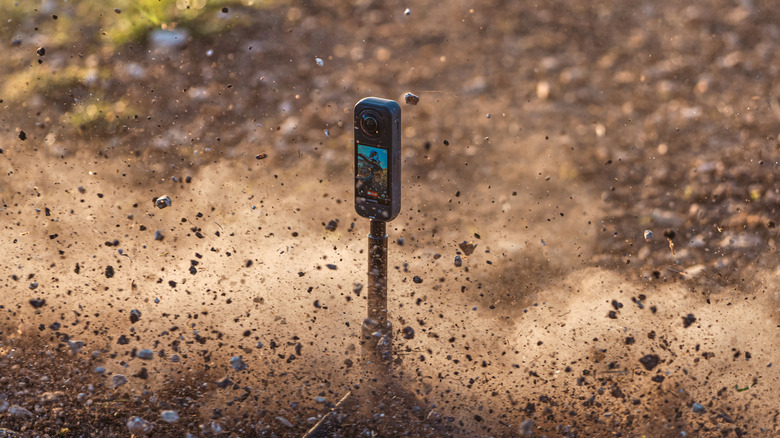
Not everyone wants to shoot 360-degree videos, but the ability to capture everything around you can be incredibly freeing. You simply cannot miss a moment with these cameras, and recently, you might have seen people mounting them on cars to get a third-person POV shot of their drives. If you'd like to record the same, on a budget, the Insta360 X5 ($464 on Amazon) is the camera to get. Our review of the X5 said it's the best 360 camera on the market, and it's easy to see why. The camera is designed like a Snickers bar: Both sides feature the same 1.28-inch f/2.0 sensor, and there is a tiny 2.5-inch touchscreen for adjusting settings.
The X4 was great, but struggled with nighttime shooting, and that's exactly what Insta360 has fixed with the X5. Coupled with the larger sensors that can shoot at 8K video at 30 frames per second (fps) and a new PureVideo mode, the X5 captures detailed videos in artificial lighting, without much noise creeping in or messing up natural colors. For all the high-frame-rate aficionados, there's support for 5.7K/60 fps, while slow-motion videos top out at 4K/120 fps. Modes like InstaFrame also help vloggers shoot both normal and 360-degree video (limited to 1080p) simultaneously. Since the camera is IP68-rated, underwater shooting is possible, too. Edits are handled by the Insta360 app, where you can use AI to make your footage Insta-worthy. Another major upgrade on the X5 is the battery life, which can stretch to more than three hours in Endurance mode.
8. Canon PowerShot V10
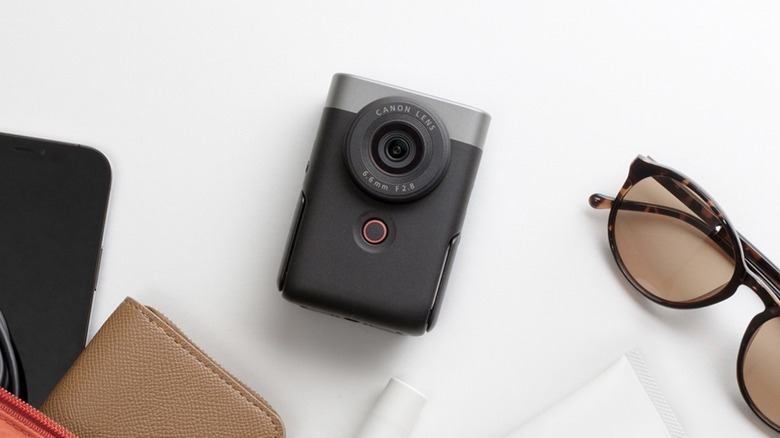
Full-frame cameras can be intimidating, no matter how capable they are. There are places where carrying a big camera can feel intrusive to the locals. That's exactly the problem the Canon PowerShot V10 aims to solve. It's a nifty camera that's about half the size of a smartphone, albeit a bit chunkier, and weighs in at 7.4 ounces. The design is dominated by a 20.1-megapixel, one-inch BSI-CMOS sensor on the back, while the front houses a two-inch touchscreen that can flip 180 degrees for better framing, and there's even a kickstand. Reviews say the controls are easy to learn for just about everyone, and you can connect to social media platforms like YouTube and Facebook directly with the Canon Camera Connect app.
The recording capabilities, though, are where the problems of the form factor become apparent. The V10 can only shoot videos at up to 4K/30 fps, which is limiting even by today's smartphone standards. The battery lasts less than an hour, and some users have reported overheating issues.
What sums up the PowerShot V10 video quality perfectly is that it shoots like a smartphone. And that's not a bad thing, especially at $399 on Amazon. Except for the occasional overexposure, its 4K videos are sharp, where colors look natural, and the digital stabilization works decently in ample lighting. As always, nighttime videos will be noticeably grainier, but they're still usable for social media.
7. Ray-Ban Meta (Gen 2) AI Glasses
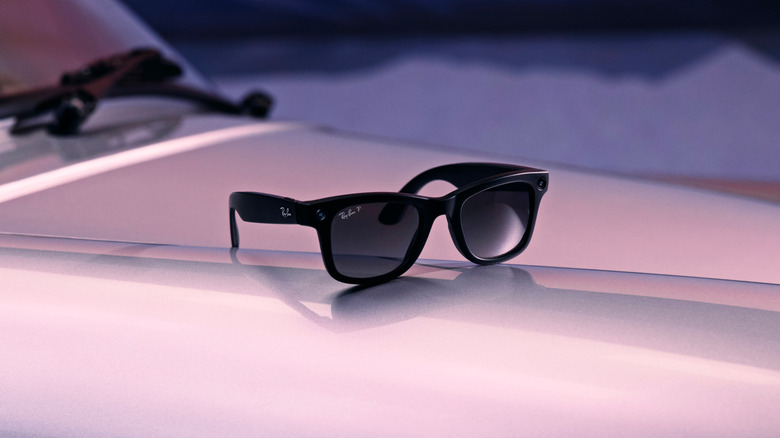
When the OG Ray-Ban Meta glasses arrived a few years back, almost no one expected them to take off. The camera couldn't stand up to the one on your smartphone, and people didn't really trust Meta to capture their private lives. Surprisingly, everyone was proven wrong. Meta's glasses became an overnight success simply because they let people stay focused on what they were doing instead of staring at their screens trying to record it. In September 2025, Meta launched the Gen 2 glasses (available for $459 on Amazon), and they bring meaningful upgrades, such as the ability to record 3K videos at 30 fps and a battery life of 8 hours. Charging is handled by placing the glasses in the included case, which itself charges via USB-C and holds 48 hours of juice.
It's safe to say the Gen 2's camera quality won't rival that of smartphones like the iPhone 17 Pro. There's a limit to the size of sensor Meta can incorporate, and that's clear in nighttime recording, where the details are generally lacking. However, both daytime videos and photos are still quite good. The glasses are configured to capture movement, so there's no shutter delay, and the results are sharp where you'd expect them to be. The colors are strong, though they can wash out under bright light, including full sunshine. Reviews say the stabilization is handled pretty well, so you can record your marathon runs without a hitch. One problem, though, could be that you can only record in portrait orientation, since Meta wants you to post them directly on Instagram and Facebook.
6. DJI Pocket 2
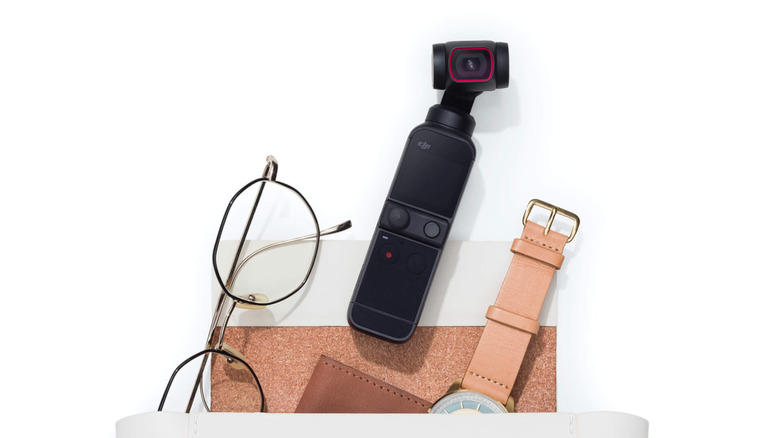
If you're on a budget and can only afford one camera for all your needs, the DJI Pocket 2 should be it — TechRadar ranks it the top pocket camera for videographers. That said, cameraphiles will point out that the updated Pocket 3 is already out. And it's true: the new Pocket 3 brings meaningful improvements across the board, but at almost $200 more than the Pocket 2 ($399 on Amazon), it loses out on value. For the uninitiated, the Pocket 2 is essentially a 1/1.7-inch 64-megapixel camera sensor mounted on a gimbal. The design also includes a stick-like body, where all the processing takes place, and a one-inch display for better framing. It's plenty comfortable to hold, thanks to its light weight (4 ounces).
The 64-megapixel sensor can capture at 4K, 2.7K, or 1080p at up to 60 frames per second in HDR. Give the Pocket 2 enough light, and the videos are relatively sharp and colorful, except for a bit of a struggle with dynamic range with backlit faces. And when the light gets low, noise finds its way through every shot. Still, the biggest reason to consider the Pocket 2 is the gimbal. The videos are insanely stable, without the weird jitter that comes with other cameras its size. There are three shooting modes: Tilt Lock, FPV, and Follow. The latter can be used to track an object, like yourself, through a room when filming a cooking video. Due to its compact size, the battery life is limited to just a couple of hours, even when shooting in 1080p. Plus, some have reported overheating problems while shooting 4K footage, so keep that in mind.
5. Sony ZV-E10 II
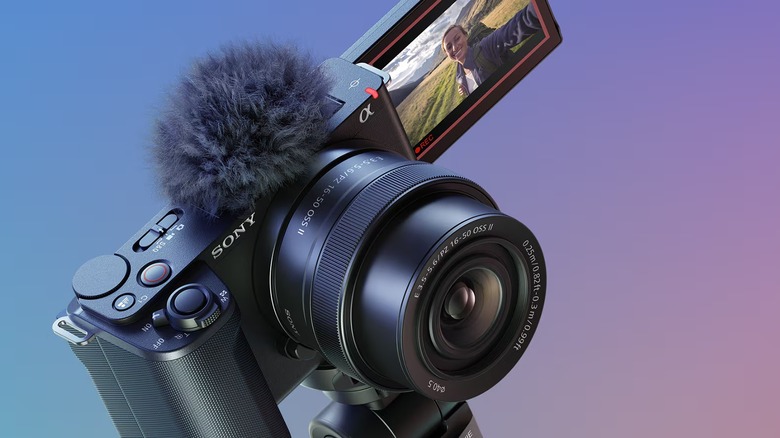
Sony cameras are usually at the top of every vlogger's wish list. Unsurprisingly, most of them are also expensive, often costing thousands of dollars, and that's out of budget for most new creators. The Sony ZV-E10 II acts as a middle ground between budget and expensive cameras. It costs $1,198 on Amazon, and for that, you get RTings' pick for the best entry-level vlogging camera. Much of that praise comes from the 26-megapixel Exmor R sensor, which produces clean 4K/60 fps 10-bit videos in S-Cinetone that don't skimp on sharpness, while maintaining pleasing colors and excellent HDR performance in daylight. Sony's autofocus system remains the best in the business, and the inclusion of an articulating touchscreen is great news for vloggers. The LCD's brightness, though, is on the lower side.
The ZV-E10 II further differentiates itself from budget offerings by allowing creators to load up to 16 LUTs (Lookup Tables) and change the color profile on the go, using the Creators app. Beyond that, there are features specifically designed for content creators, such as Product Focus. When enabled, the camera shifts focus to an item when it's lifted, as in a review or unboxing video. There's also Background Defocus, to quickly highlight an object by blurring the background. Unfortunately, it's not all sunshine, as the ZV-E10 II lacks built-in stabilization. This means your marathon vlogs will come out shaky, or you can rely on digital stabilization, which, according to reviews, does a decent job of reducing jitters but, unsurprisingly, crops into the footage.
4. Sony a6700
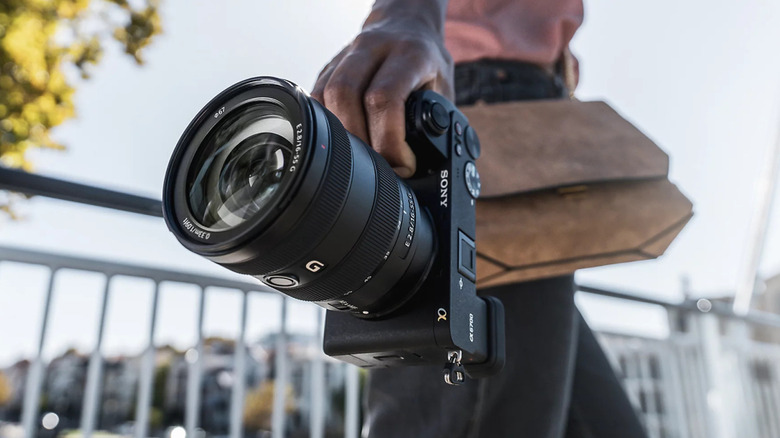
As good as the ZV-E10 II is, the lack of in-sensor stabilization can be a deal-breaker to some. If that's you and you're willing to spend a bit more, $1,599 on Amazon to be specific, then the Sony a6700 makes a lot more sense. The camera uses the flagship BIONZ XR processor, paired with a 26-megapixel BSI APS-C image sensor and five-axis optical image stabilization. It's a proven combination that lets creators shoot in up to 4K/60 fps 10-bit in normal mode, or 4K/120 fps slow-motion footage, albeit with a healthy 1.6x crop.
Expert reviews have been largely positive about the a6700's videos. They are supremely detailed in all conditions, and Sony's color science makes the footage aesthetic without being overly vibrant. The only complaints are that it sometimes underexposes images and overheats when recording 4K footage. You can set the auto power-off temperature to standard or high, but it's still an annoyance nonetheless.
What's not an annoyance, though, is the AI Real Time Recognition autofocus system that can lock on objects, people, or even vehicles without a hitch, even as they move across the frame. Sony has updated the a6700's design to include better grips, and it also features a fully-articulating touchscreen that many vloggers love. While the controls and menus have also been simplified to minimize friction, you will still spend the first few days understanding them. Battery life, on the other hand, is fairly solid at over 100 minutes of 4K/60 fps recording available after a full charge.
3. Fujifilm X-S20
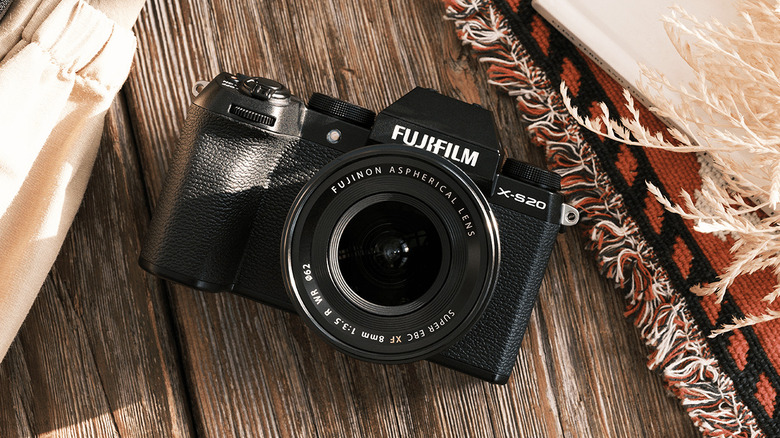
The Fujifilm X-S20 ($1,499 on Amazon) ranks ahead of the a6700, not because of its superior video quality or stabilization. It ranks higher thanks to its ease of use, not just for professionals but for amateur vloggers who are new to working with a dedicated camera. The learning curve is minimal, and the X-S20 has genuinely useful features like a dedicated vlogging mode. With it enabled, you can quickly focus on a product when shooting a review or tap to blur the background. The Auto shooting mode, on the flip side, can detect different scenes and tweak camera settings automatically.
Videos are handled by a 26-megapixel X-Trans BSI CMOS sensor, and they look great. There's very little to complain about in terms of color and dynamic range (more than 13 stops), as the X-S20 performs consistently well across most conditions. Both the highlights and shadows are detailed, and the 5-axis stabilization does a great job of keeping footage steady. You also get access to Film Simulations, which act as built-in color profiles for video and photos. There's also support for flat F-Log or F-Log2 for those who prefer custom LUTs.
What makes the X-S20 even better is its ability to use the sensor's full 3:2 aspect ratio to shoot 6K/30 fps open-gate videos. This is especially useful for multi-platform creators, as they can use the same footage to create 16:9 videos for YouTube and portrait videos for Instagram without sacrificing much of the frame. Sadly, since there's no built-in fan, overheating during long recordings can be a concern. Also, having no weather sealing to protect against the elements is a bummer, but PCMag still rates it one of the top vlogging cameras for 2026.
2. Sony ZV-E1
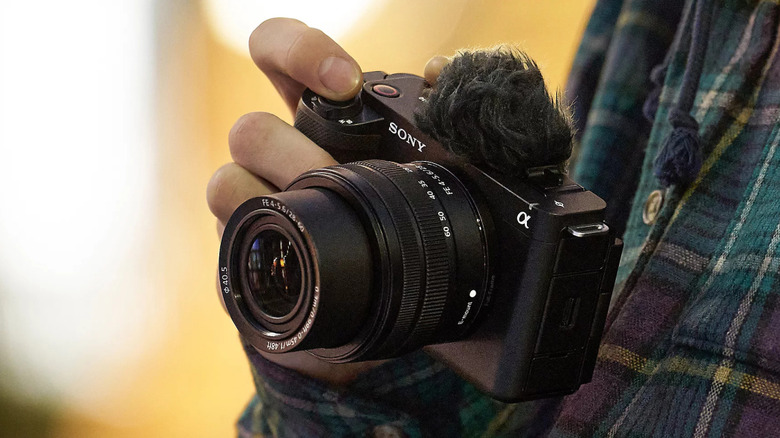
Thanks to their larger sensor area, full-frame cameras offer better nighttime performance, which is great for vloggers to capture the nightlife of a buzzing city. According to RTings, the best full-frame camera for vlogging is the Sony ZV-E1. It features a 12-megapixel BSI CMOS sensor in a form factor that weighs just 17 ounces and is easy to carry around every day. It's one of the smallest full-frame cameras with in-body stabilization.
While the E1 also includes creator-specific features such as Product Showcase and Background Defocus, like the ZV-E10 II, it takes them a step further. The new Auto Framing can automatically crop the frame to keep the subject centered, like Center Stage on iPhones. You can even set it to pan from one person to the other with just a tap. AI also makes its way into autofocus, which helps it identify different objects or lock onto a subject even when they're not facing the camera.
The video capabilities of the 12-megapixel sensor are simply lovely. The E1 doesn't need a particular situation to shoot beautiful 4K/60 fps videos: it can do so in all scenarios. The sharpness is excellent, the dynamic range is spot on, and the S-Cinetone holds up well even at night. There's support for 4K/120 fps slow-motion videos, too, and you can also load custom LUTs. Sadly, there's a catch: The E1 doesn't support any ProRes or raw videos, which, for a $2,798 camera geared towards professional vloggers, is a downside.
1. Panasonic LUMIX GH7
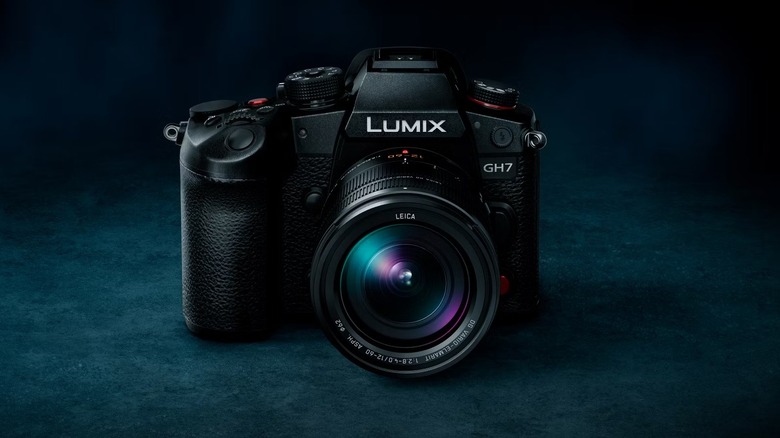
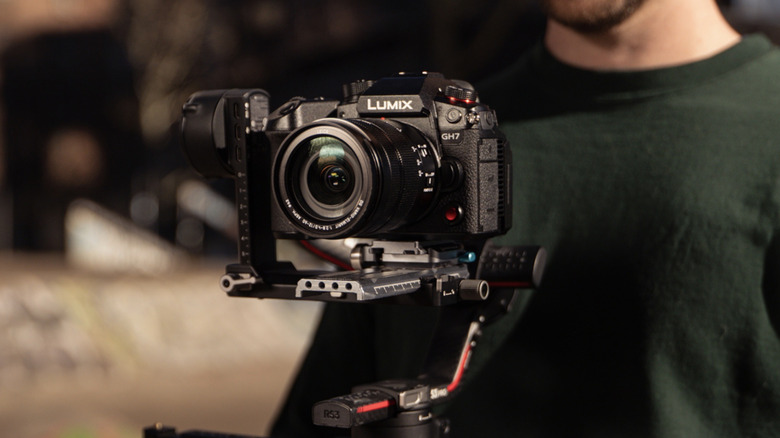
There's no other way to say it, but the Panasonic LUMIX GH7 is the best vlogging camera in 2026 for three main reasons. The first is the price. The GH7 costs $1,621 on Amazon, which we agree isn't cheap, but also undercuts the Sony ZV-E1 by more than a grand. Then there are the formats. The GH7 houses a 25.2-megapixel BSI CMOS MFT sensor that enables recording in up to 5.7K at 60 fps or 30 fps (Apple ProRes RAW). This opens a wide door for color grading and could be useful not just for vloggers, but also for cinematographers. Like the Fujifilm, the GH7 supports open-gate recording, meaning you can take full advantage of the sensor's area for better framing in both landscape and portrait videos.
If all that wasn't enough, the GH7 doesn't suffer from overheating, thanks to its built-in fans, which keep temperatures in check. The only sacrifice is weight, which at 25.4 ounces makes it the heaviest camera on this list. On the flip side, MFT lenses are generally lighter, which theoretically offsets some of that weight.
Autofocus is handled by a new phase-detection hybrid system that can be configured to lock onto humans, cars, or your beloved pets. The GH7's video quality digs out details in both bright and dark environments thanks to the 12 stops (13 stops in V-log mode) of dynamic range. Noise is kept to a minimum in low light, and Panasonic's color science delivers natural, yet pretty tones. Beyond that, you can either select the built-in filters or apply your own LUTs directly using the Lumix Lab app.
Methodology
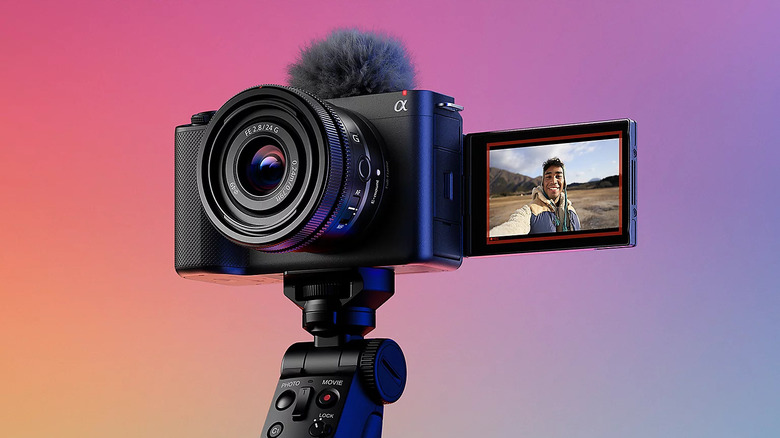
Ranking the best travel vlogging cameras isn't as easy as you might think, simply because everyone has different needs. We first scoured the internet for best-of lists and year-end roundups from reputable outlets like RTings, TechRadar, and PCMag, then cross-referenced them and prioritized cameras that consistently ranked across multiple sources. After that, we dug through their individual reviews.
Budget cameras priced under $500 were mainly judged on video quality, portability, and unique features such as 360-degree video or hands-free recording. For premium cameras above $1,000, on the other hand, we looked beyond video quality, considering professional factors such as video codecs, support for custom LUTs, autofocus capabilities, and ease of use for the average vlogger.