

What's The Difference Between Wi-Fi 6 And Wi-Fi 6E?
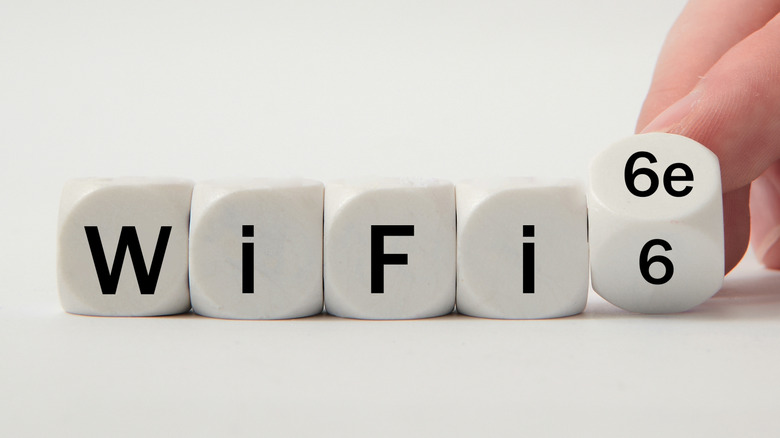
The technology behind Wi-Fi is rapidly evolving. While speeds of 10Mbps might've been impressive once, even gigabit per second speeds are nothing new nowadays. Each new generation of Wi-Fi brings many improvements, and there's no doubt that Wi-Fi 7 is better than Wi-Fi 6. However, where does Wi-Fi 6E come in, and how does it compare to Wi-Fi 6?
Wi-Fi 6E stands for Wi-Fi 6 Extended, in that the main difference between Wi-Fi 6 and Wi-Fi 6E is the addition of a 6GHz band in Wi-Fi 6E. It sits alongside the 2.4GHz and 5GHz bands already available to Wi-Fi 6. This additional band solves a number of common Wi-Fi issues – such as bandwidth congestion and home devices interfering with your connection — but not everyone can benefit from it. 6GHz bands cannot improve your internet beyond the plan that your ISP provides.
If you've got slow internet, there are some things to do before replacing your router. However, if you're using a gigabit-per-second plan but only getting 200-300Mbps download and upload speeds on your devices, Wi-Fi 6E can get you much closer to the speed that your ISP is supposed to give you. To get Wi-Fi 6E to work, you'll need a router that supports it, as a Wi-Fi 6 router won't work. Fortunately, you don't need to get an expensive router, and any hundred-buck router that supports Wi-Fi 6E you find on Amazon would work for the most part. Or you can look at any of the best mesh Wi-Fi routers available.
Wi-Fi 6E solves some of Wi-Fi's biggest problems

An extra Wi-Fi band means that there's more bandwidth to efficiently distribute between devices. Your smartphone or PC that needs faster internet doesn't have to fight your smart home devices for bandwidth, which results in a lot less Wi-Fi congestion. Devices that require faster speeds can connect to the 6GHz band, and those that don't require super-fast internet speeds will work fine with the slower Wi-Fi channels on the 2.4GHz or 5GHz bands.
The 6GHz band is only compatible with newer devices — usually those that require more reliable internet connections. This means that older, legacy devices likely cannot connect to this band, even if they tried to, further ensuring traffic is more spread out across your network. This 6GHz band in Wi-Fi 6E also has more high-bandwidth channels (80MHz and 160MHz) than the 5GHz band in Wi-Fi 6, making it much better for streaming high-quality 4K and 8K video without buffering or hiccups.
Since all Wi-Fi routers in an area can cause congestion (when using the same channels), a slow internet connection might be a result of your neighbors. If they have too many devices connected to the same Wi-Fi channels that you're attempting to use, it could cause interference. The wider channels and device exclusivity of Wi-Fi 6E help here as well, getting you much closer to the speeds of your internet plan by eliminating unneeded devices taking up space in the same channels that you're using.
Do you need Wi-Fi 6E?
Wi-Fi 6E's main advantage over Wi-Fi 6 is the 6GHz band. As such, you should only get Wi-Fi 6E if you're someone who can benefit from this added band. If you don't have a newer device that supports the 6GHz band, Wi-Fi 6E may actually be slower than Wi-Fi 6, since bandwidth is distributed among the bands, and not being able to use an entire band means a significant loss in speed. If, however, you have devices that can connect to a 6GHz band, have a large number of devices that can benefit from wider channel widths, or live with neighbors that clog up the 5GHz bands, getting Wi-Fi 6E will be a worthwhile upgrade.
Additionally, Wi-Fi 6E also has one hidden benefit that not many people know about. If you live near a TV station or an airport, you cannot make full use of your Wi-Fi channel spectrums, as some of them — typically wider, 120MHz channels — are reserved for the stations or radars, making them unusable. The 120MHz channels in Wi-Fi 6E have a different spectrum that isn't shared, which means that TV stations won't be interfering with your high-bandwidth channels, allowing you full use of them. This will lead to a significant improvement in speed and less congestion, even if the potential top speeds don't change.
It's also important to note that 6GHz isn't always better, even if your device supports it. The way Wi-Fi band frequencies work is that a higher frequency leads to better speeds, but it also has a shorter range. If you live in a large home and often use your phone away from the Wi-Fi router, a fast band might not even reach you.