

Firefighters Are Turning To These 'Turtles' To Put Out EV Battery Fires
One of the biggest risks of an electric vehicle is its battery. In order to provide enough power to not need gas, a large lithium-ion battery is placed in the car, typically at its underside. Even the small battery inside your phone can be dangerous if it catches on fire, and with the one powering an EV being exponentially more powerful, an electric car battery fire can be fatal.
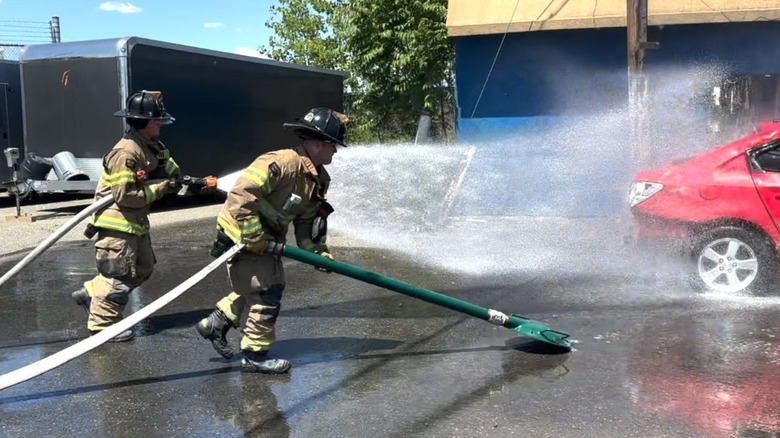
To solve the problem of dealing with thermal runaways in electric cars, a team of firefighters developed the Turtle Fire System. This simple device looks like a turtle shell attached to a long pole, and despite relying on a straightforward mechanism, it solves many issues faced by firefighters dealing with electric car fires in the past. A firefighter can use this pole to put the "turtle" underneath the car and blast its underside with gallons of water, making direct contact with the area of the vehicle where the lithium battery is located.
The companies behind these electric vehicles are doing a lot to ensure the safety of their customers, often spending up to a million dollars on a single crash test dummy alone. This means that, under most circumstances, you're relatively safe in your Hyundai Ioniq 5 or Tesla Model Y. However, on the incredibly rare occasion that an EV fire does occur, the Fire Turtle directly deals with some of the biggest dangers of fires caused by electric vehicle batteries.
What makes electric car fires so dangerous?
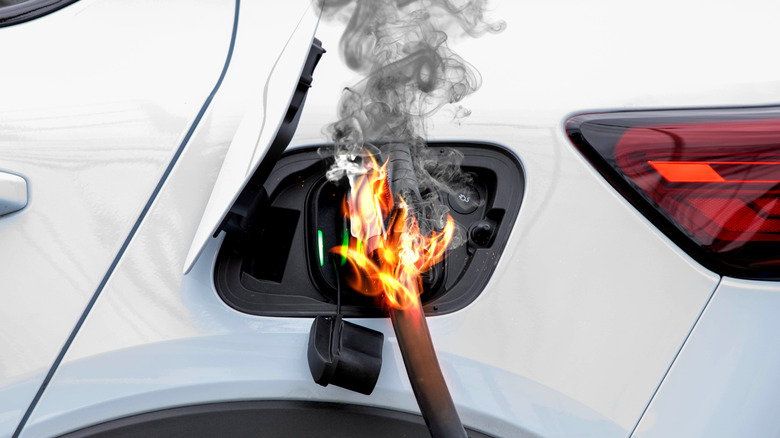
There are many factors that make the fire from an EV battery much more dangerous than a typical car fire. First and foremost, you need copious amounts of water to put out an electric car fire compared to a non-electric one. According to The Independent, Thayer Smith, division chief of the Austin Fire Department, said that an electric car fire — such as a Tesla — can take up to 40,000 gallons of water to put out. For reference, a fire from a car running on gasoline only needs at most a thousand gallons to be extinguished
The water is enough of an issue, but the hard-to-reach placement of the battery makes it even more complicated. The large lithium batteries used in electric vehicles are generally placed on the underside of the car. When these batteries are at the heart of the fire, it's very hard to efficiently shoot water at the source, as you'd normally need to turn the car over to be able to properly extinguish the fire. A burning lithium-ion battery also produces toxic gases and poisonous smoke. This is dangerous for first responders and firefighters that need to deal with the fire, but also for civilians in the area who happen to inhale the air.
There's also the issue of thermal runaway; since a battery is made up of different cells, if a cell heats up too much or short-circuits, it can be very difficult to control. This heat can spread to other cells in the battery, which can quickly result in a fire or even an explosion if not treated properly. Additionally, these cells can reignite at a later time even after the initial fire has been put out, leading to further risks even if you safely treat it once.
How the Fire Turtle deals with EV fires
The Fire Turtle directly addresses some of the biggest problems and risks with EV fires. According to the Turtle Fire Systems website, the turtle can output more than 500 gallons of water per minute at high pressure. The turtle-like shape connected to a pole can also be slid under a car and directly blast water at the battery without forcing firefighters to turn the car over. The long pole means that firefighters don't endanger their lives by going near the fire and the toxic smoke produced, as they can reach the battery from further away.
The Turtle Fire System is already in use by many fire departments in the U.S. today. These include firefighters across Arizona, Minnesota, and Tennessee, with the technology rapidly increasing in use as an alternative to the "let-it-burn" method that is the default for electric car battery fires.