

This 3D-Printed Plane Only Needs A Four-Second Charge To Fly
If you're a fan of bizarre 3D-printing projects, you'll love this story about an electric-powered plane that flies with tissue paper wings. Degreed aerospace engineer Tom Stanton wanted to create a 3D-printed plane that could be hand-cranked for prolonged gliding. He was inspired by traditional wind-up planes that use wound-up rubber bands to spin the propeller. In a similar way, Stanton's plane uses a supercapacitor that he charges with a hand-cranked generator in just four seconds.
While old-school toy planes are typically made of balsa wood, Stanton used 3D-printed plastic so he could get his prototype in the air as soon as possible. The plane's frame was printed directly onto tissue paper to create the wings, and a carbon fiber rod secured the wings to the plane's body. Stanton needed a lightweight supercapacitor to hold an electric charge, so he went with a 2.7-volt capacitor with a 10-farad capacitance, weighing just 3.2 grams. To finish the model, Stanton 3D-printed a plastic bracket for mounting the propeller, supercapacitor, and a micro-brushed motor to the plane.
In practice, the supercapacitor ran out of charge very quickly, but that's okay. Its purpose is to give the motor enough initial juice on launch that the propeller will lift the plane and keep it flying for an extended period based on aerodynamics alone. In its best test, the plane flew for approximately 45 seconds of continuous airtime.
Bringing new ideas to 3D-printed aviation
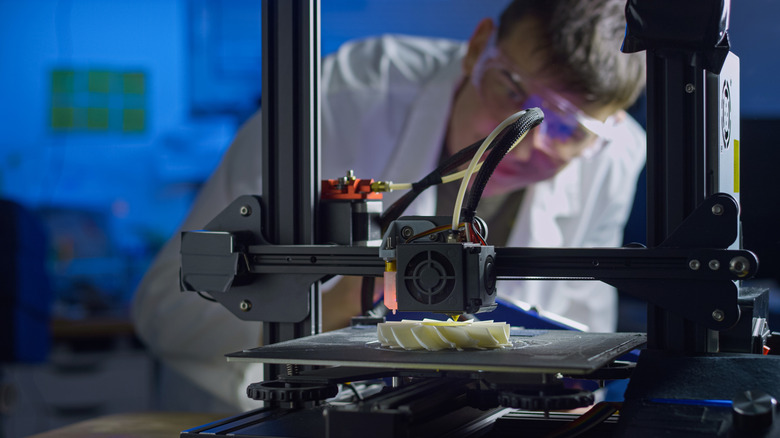
Stanton's model plane experiment gives a new perspective on the question of whether 3D-printed parts are actually reliable. While the plane in question served as a proof of concept with no practical use in itself, there's no denying that some very impressive engineering went into its design. There are already 3D-printed gadgets you can use every day, and with people like Stanton pushing the possibilities further, the sky's the limit when it comes to future applications.
As it stands, there are already giant things being 3D-printed on an industrial scale. Real aerospace manufacturers are producing engine components, airframe structures, and many other parts via additive manufacturing. On the other hand, there are concerns regarding performance and stability in the broader aviation industry. But that's exactly why backyard projects like Stanton's have a real chance of making a positive difference. If you're interested in getting in on the fun, Tom Stanton provided the 3D-printing blueprints for his basic tissue paper glider via his Printables page.