

Star Trek's Original Crew Was Changed By A Sexist Demand From NBC

"Star Trek" fans know that the original series had two pilots: "The Cage" (listed as Season 1 Episode 0) and later, "Where No Man Has Gone Before" (later listed as Season 1 Episode 3). "The Cage" featured a somewhat different cast from those we know and love so well. In this version, Christopher Pike captained the ship and a rather different, more emotional version of Mr. Spock was aboard.
Most importantly, Pike's executive officer, referred to as Number One, was a strong, pants-wearing, weapon-carrying woman played by Majel Barrett, who later in the series became the lovelorn Nurse Chapel. There were many changes made between the first and second pilots, but the most impactful was the replacement of Jeffrey Hunter as Captain Christopher Pike with William Shatner as Captain James T. Kirk. Almost equally important was the elimination of the female executive officer, under the orders of NBC brass, who simply couldn't stomach the idea of a strong, unemotional female leader.
Not your average wagon train to the stars
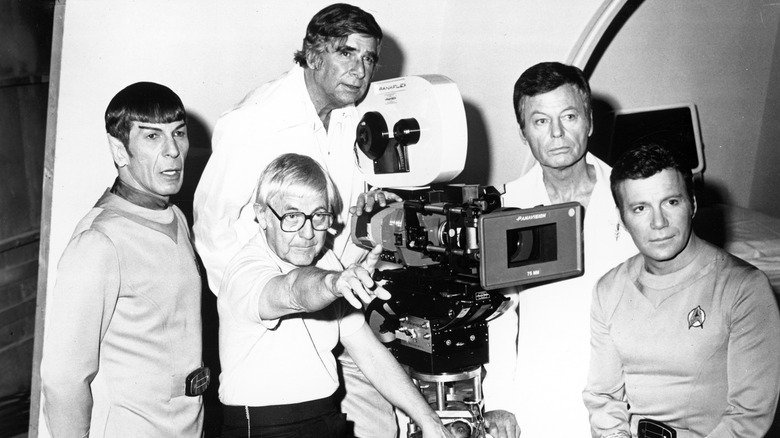
When Gene Roddenberry pitched his concept for "Star Trek," he famously suggested that it would resemble a "wagon train to the stars." That is, it would use the popular tropes of old Western films to engage audiences — but add a science fiction twist. While Westerns like "The Big Valley" occasionally included tough, gun-toting women, they were still a rarity in the 1960s. They were even rarer in typical TV fare, in which women were cast as housewives, secretaries, mother-in-laws, and the like. In fact, just a few years before "Star Trek" launched, Mary Tyler Moore had to argue the case for wearing pants on set.
Roddenberry, however, wanted to push the envelope. He cast his wife, Majel Barrett, in a "man's" role, dressed her modestly in the same uniform as her male crewmates, handed her a phaser, and asked her to unemotionally take charge of the away team as it headed to an unknown planet. Perhaps even more daring, he asked Barrett to actually take a physically challenging role in subduing an admittedly wimpy alien. Some of Roddenberry's more radical ideas survived well into the 2000s, but in 1965, they were simply unacceptable.
Based on its understanding of the American audience, NBC took issue with Number One. According to Majel Barrett in "An Oral History of Star Trek," "NBC felt that my position as Number One would have to be cut because no one would believe that a woman could hold the position of second-in-command."
Sexism and the creation of Spock and Nurse Chapel
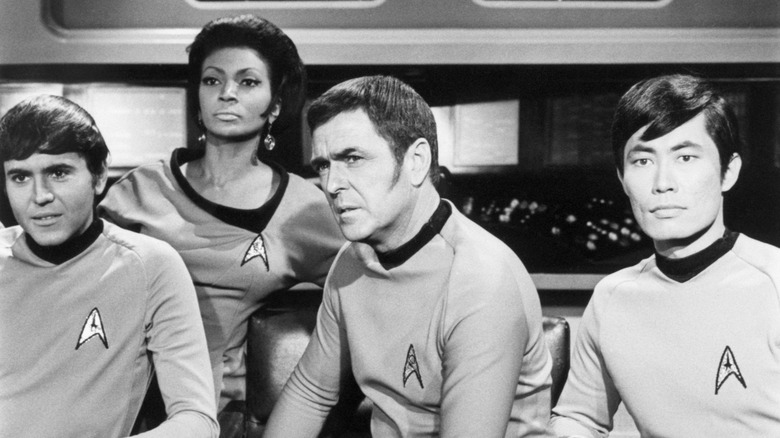
Once the decision was made to jettison the character, Roddenberry was left with a conundrum. He had dumped his strong, emotionless character, but still very much wanted one. His solution: Spock, rather than Number One, became logical, tough, and unemotional. This change led to the now-familiar and much-beloved character of Spock, who constantly battles his emotions and, frequently, loses. Succumbing to the network's expectations, he developed the role of Nurse Chapel.
Nurse Chapel was pretty and blond, subservient to the male chief medical officer of the Enterprise, Dr. Leonard McCoy. She, in direct contrast to Number One, was a kind, empathetic underling whose most significant character trait was a romantic and (apparently) unrequited passion for Mr. Spock. In a final blow to women's place aboard the Enterprise, costumes were radically changed after the second pilot, "Where No Man Has Gone Before."
While even the sexy Yeoman Smith in this episode wore slacks, this wasn't to last. Grace Lee Whitney, who played the desirable Yeoman Rand, recommended to Roddenberry that micro-mini skirts over nearly-invisible shorts, paired with black hose and boots, would increase the show's popularity. These outfits, dubbed "skants," became a permanent staple of the show. In the long run, both Roddenberry and Majel may have gotten the last word. After their deaths, both had the honor of having their ashes shot into space. And, of course, later "Star Trek" iterations featured female captains such as Kate Mulgrew's Captain Janeway in "Star Trek: Voyager."