

Micro RGB Vs. Micro-LED: What's The Difference Between These TV Panels?
We may receive a commission on purchases made from links.
Although the first Micro RGB televisions (also referred to as RGB Mini-LED, True RGB, or RGB LED by some manufacturers) showed up in 2025, 2026 is said to be the year that Micro RGB TVs will finally take over your home's entertainment setup. Several manufacturers, including LG, Samsung, and Sony, showcased Micro RGB TVs at CES 2026, which are set to become available over the year. Notably, these TVs are sometimes mistaken for Micro-LED TVs because of their similar names.
However, despite their similar-sounding names, the Micro RGB and Micro-LED TVs are very different. While the former have quickly appeared on the market from various makers, albeit at high prices, the Micro-LED TVs remain a very niche product. Both TV display technologies are very exciting, and while the Micro RGB TVs are the next step in the evolution of Mini-LED TVs, the Micro-LED TVs are on a completely different level.
How do Micro RGB TV panels work and perform?
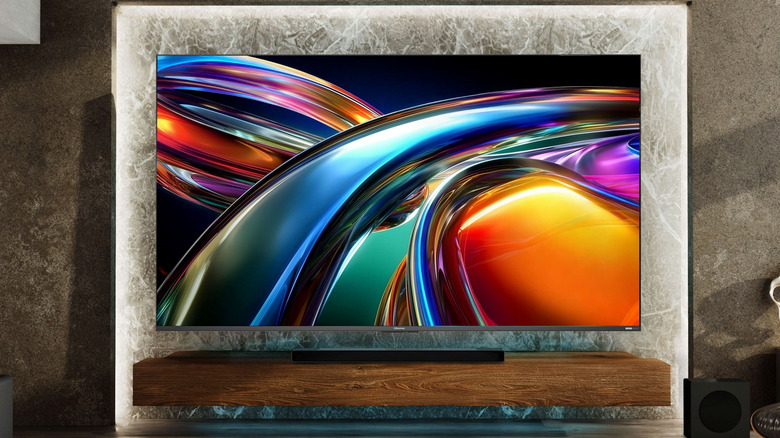
The Micro RGB panels, currently used in select televisions from Hisense, Samsung, and TCL, are, as mentioned, an evolution of Mini-LED technology. Instead of the blue or white LEDs used in conventional Mini-LED TVs, the Micro RGB panels use red, green, and blue LEDs. As a result, they don't need color filters or quantum dots to convert the white or blue light coming from the backlight into RGB colors to make up the visuals you see on the screen. They are simply using the colors coming from the RGB LEDs. This not only produces purer colors (as there is no secondary filtration involved) but also brighter ones, significantly enhancing a Micro RGB TV's color volume, gamut, and HDR performance.
Like regular Mini-LED TVs, the Micro RGB TVs rely on local dimming to improve contrast, as there aren't enough LEDs to deliver pixel-level dimming, something you get in the OLED TVs and actual Micro-LED TVs. This means that the number of dimming zones and the quality of the dimming algorithm can govern the level of contrast. There is also the issue of potential light bleed, when light from lit LEDs bleeds into neighboring pixels that are supposed to be dark.
The expert reviews of the TVs featuring Micro RGB panels have largely been positive, praising color performance and high brightness. However, these TVs are plagued by some of the same issues as the regular Mini-LED TVs, including poor off-axis viewing and some blooming. The good thing is that although the first Micro RGB TVs were really expensive, it hasn't taken long for the prices to come down, with Samsung selling its 55-inch Micro RGB R85H TV for only $1,600. Hopefully, as the Micro RGB technology matures, it will get even better and cheaper.
How do Micro-LED TV panels work and what are their advantages?

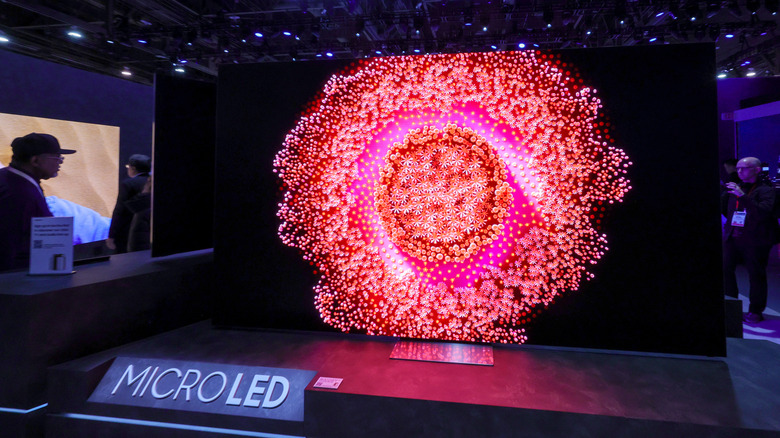
Micro-LED TV panels are significantly different from any other LED technology and are a true competitor to OLED technology. It uses self-emissive RGB LED pixels instead of a limited number of backlight LEDs, like in other LED panels, and has the same number of LED pixels as the display resolution. Because of this, Micro-LED TVs can turn LEDs off on an individual pixel level, giving them a near-infinite contrast ratio, inky blacks, and higher brightness than the current crop of Mini-LED TVs, including Micro RGB TVs.
More importantly, Micro-LED panels use inorganic material in the RGB LEDs, unlike the organic material in OLED panels. Therefore, there is potentially a lower chance of Micro-LED TVs suffering from burn-in and pixel degradation that's associated with OLED displays. The color performance of the Micro-LED panel is expected to be on the same level as the Micro RGB panels or surpass them once the latter matures.
Unfortunately, Micro-LED TVs have remained niche because they're difficult and expensive to make. Manufacturers have struggled to bring LED sizes down to fit popular mainstream TV sizes at 4K resolution, which will be necessary for mainstream adoption. The likes of Awall and Samsung currently offer Micro-LED displays, with Awall's offering mostly being a commercial display solution, and not your typical TV. Samsung offers it as both, with its 114-inch model costing $150,000.